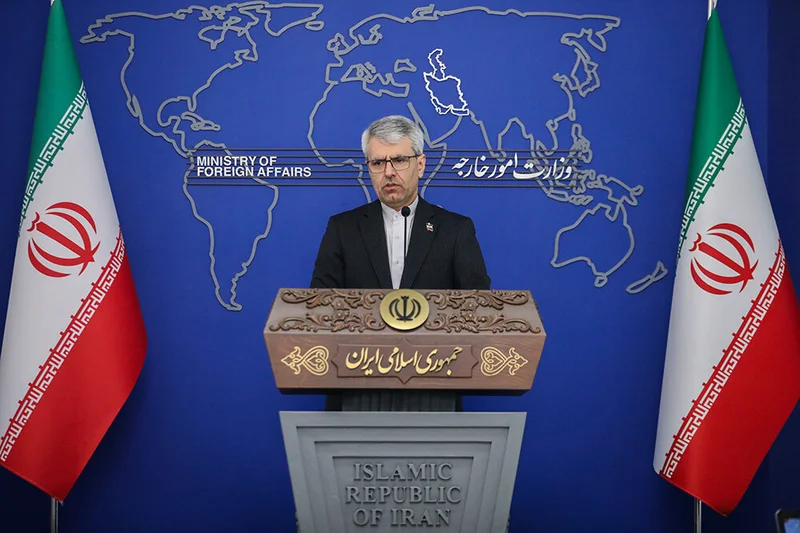
Iran rejects US role in setting war terms
TEHRAN – Iran declared on Monday that it will not allow the United States to dictate the timing of war or peace, reaffirming that all national security decisions will be made solely based on Iran's interests, while also warning Ukraine over its reported attack on an Iranian commercial vessel in the Caspian Sea and emphasizing that ongoing negotiations with Oman on the Strait of Hormuz are purely bilateral and unrelated to Washington.
Speaking at his weekly press conference in Tehran, Foreign Ministry spokesman Esmaeil Baqaei said the United States had failed to achieve its objectives after months of military confrontation with Iran and had become trapped in a conflict of its own making.
"The United States will not determine the time of war and peace for Iran," Baqaei said, stressing that Tehran would continue defending itself "for as long as necessary."
He said Iran's decisions on security and foreign policy are guided exclusively by national interests and are made through established state institutions rather than external pressure.
Baqaei also rejected suggestions that Tehran's approach toward negotiations was influenced by Washington, referring to the US-Israeli military campaign launched against Iran on February 28, which he said ended in failure despite forcing a ceasefire weeks later. Although a Pakistan-mediated memorandum of understanding (MoU) was signed on June 17 to end hostilities and pave the way for further negotiations, Baqaei accused Washington of violating all of its commitments under the agreement.
Ukraine attack "will not go unanswered"
Addressing the reported Ukrainian attack on an Iranian commercial vessel in the Caspian Sea, Baqaei condemned the incident as a dangerous escalation and warned that Iran reserves the right to respond.
He described the attack as "dangerous adventurism" and said it "will not go unanswered," adding that countries supporting Ukraine also bear responsibility for Kiev's actions.
The spokesman accused the Ukrainian leadership of pursuing reckless policies with potentially serious consequences and reiterated Tehran's long-standing position that it has not been a party to the Russia-Ukraine conflict.
Baqaei said Iran's response would be based on international law and its inherent right to self-defense, stressing that responsibility for the consequences of the incident lies with the Ukrainian government and its supporters.
His remarks followed the Foreign Ministry's earlier condemnation of the strike as a violation of Article 2(4) of the United Nations Charter and an act of aggression capable of further escalating regional tensions.
Oman talks focused solely on Strait of Hormuz
Baqaei also dismissed speculation that recent negotiations between Iran and Oman were linked to the United States, saying the discussions have focused exclusively on managing maritime traffic through the Strait of Hormuz.
He confirmed that several rounds of talks were held in Tehran on Friday and Saturday at the deputy foreign minister level, describing the negotiations as constructive and productive.
According to Baqaei, the two neighboring countries are working to establish operational mechanisms that ensure the safe passage of commercial shipping while fully respecting the sovereign rights of both coastal states and safeguarding Iran's national interests.
"The talks are entirely bilateral between Iran and Oman and have nothing to do with the United States," he said.
He added that technical and political consultations remain ongoing despite the conclusion of the latest negotiating round.
Baqaei maintained that the Strait of Hormuz remains closed because of insecurity created by 'US aggression' and said there has been no change in the status of the strategic waterway.
Criticism of regional states and Western allies
Expanding on the Hormuz issue, Baqaei criticized a recent joint statement by the Persian Gulf Cooperation Council and Jordan concerning Iran's retaliatory military actions, describing it as a distortion of reality.
Instead of criticizing Iran, he said, regional governments should condemn the United States for violating the Pakistan-brokered memorandum of understanding and refrain from allowing Washington to exploit their territory for military operations against Iran.
Baqaei expressed concern that some regional countries had aligned themselves with US military actions and urged them to reconsider their positions in the interest of regional stability.
China praised as strategic partner
The spokesman also highlighted growing cooperation between Tehran and Beijing following Foreign Minister Abbas Araghchi's meeting with his Chinese counterpart on the sidelines of the Shanghai Cooperation Organization summit.
He described China as a strategic partner that shares Iran's concerns regarding regional and international peace and security, particularly 'the destabilizing effects of US unilateralism.'
Iran condemns UK decision on IRGC
Separately, Baqaei strongly criticized Britain's decision to designate the Islamic Revolution Guards Corps (IRGC) as a threat to British national security.
He described the move as politically motivated, contrary to international law, and intended to increase pressure on Iran.
The spokesman defended the IRGC's role in safeguarding Iran's national security and combating Daesh (ISIS), arguing that London's designation lacks any legal foundation and warning that Tehran would take appropriate reciprocal measures in response.