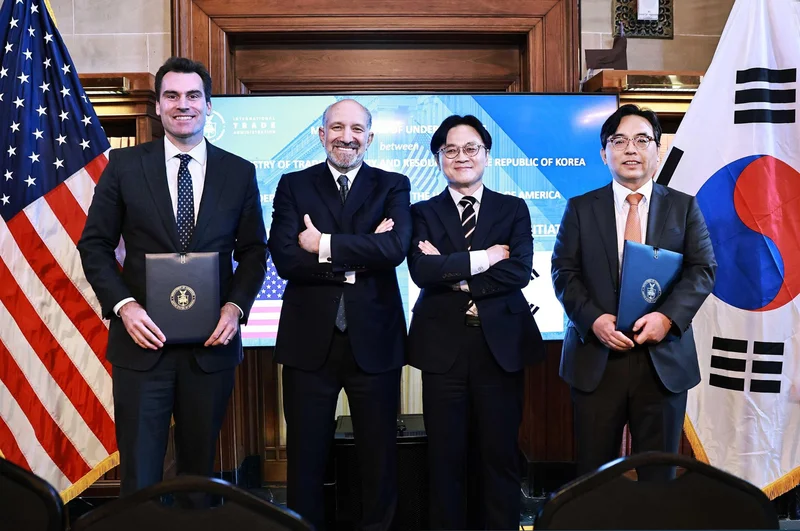
Industry Minister Kim Jung-kwan, third from left, poses with U.S. Commerce Secretary Howard Lutnick, second from left, at the U.S. Department of Commerce in Washington, May 8, after the two governments signed a memorandum of understanding to expand bilateral shipbuilding cooperation. Courtesy of Ministry of Trade, Industry and Resources
Industry Minister Kim Jung-kwan departed for Washington on Wednesday to address pending trade issues with the United States as the Trump administration prepares to introduce a new Section 301 tariff regime for Korea under the U.S. Trade Act.
During the four-day visit, the minister is also expected to flesh out Korea's $350 billion investment commitment to the U.S. agreed under last year's bilateral tariff agreement, while reaffirming the commitment to maritime cooperation under the Make American Shipbuilding Great Again (MASGA) initiative.
Kim will meet U.S. Commerce Secretary Howard Lutnick and Energy Secretary Chris Wright to discuss strategic investment, energy cooperation and other bilateral trade issues. The industry ministry said he will also conduct outreach to members of the U.S. Congress to explain Seoul's trade and investment stance.
The visit comes as Washington prepares to replace a temporary 10 percent global tariff imposed under Section 122, which expires on Friday. New measures under Section 301 target what the U.S. describes as unfair trade practices, including forced labor and industrial overcapacity.
Korea is among the countries facing potential Section 301 duties after being included in U.S. investigations into alleged forced labor and industrial overcapacity. The U.S. Trade Representative (USTR) has already proposed tariffs of up to 12.5 percent on products linked to forced labor and is expected to finalize those measures after completing public consultations.
A container ship floats off the Port of Los Angeles, Calif., Friday. AFP-Yonhap
Seoul has argued that any new Section 301 tariffs should remain within the 15 percent ceiling agreed to under last year's trade deal, in which Korea pledged $350 billion in U.S. investments in exchange for lower tariffs.
"The U.S. Commerce Department and USTR have indicated that any measures would not go beyond a level that maintains a balance of interests between the two countries," Kim told reporters at Incheon International Airport before departing for Washington.
"We plan to further develop the investment projects with the U.S. and agree on implementation timelines."
Attention is now focused on whether Kim's visit will help finalize the first investment project under the agreement. Leading candidates include U.S. natural gas-fired power plants, solar energy projects and liquefied natural gas infrastructure, with his planned meeting with the energy secretary increasing the speculation.
On Thursday, Kim will attend the opening ceremony of the Korea-U.S. shipbuilding partnership center in Washington, established as a follow-up to a bilateral memorandum signed in May to support cooperation between Korean and U.S. shipbuilders.
Industry Minister Kim Jung-kwan speaks to reporters at Incheon International Airport before departing for Washington in Incheon, Wednesday. Yonhap
The center is expected to serve as a hub for cooperation under the MASGA initiative, under which $150 billion of Korea's $350 billion investment commitment has been allocated to shipbuilding projects.
"I think it is meaningful that Korea and the U.S., which have been working together on the MASGA project to rebuild the U.S. shipbuilding industry, now have an official platform," the minister said.
Kim also said he would explain Korea's position regarding U.S. claims that Korean authorities have unfairly treated American e-commerce company Coupang over its massive data breach last year involving more than 33 million users.
"Coupang has its own logic and supporting grounds, but there are areas where the U.S. has misunderstood the issue, so we have been providing explanations consistently," Kim said.
"I believe there is a certain level of mutual understanding with our counterparts. If there are misunderstandings, they should be resolved, and if there are gaps, they should be narrowed. A single issue like this will not shake Korea-U.S. relations."