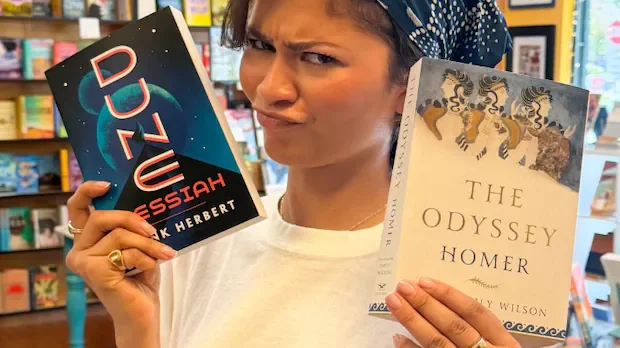
Emily Wilson's translation of The Odyssey helped inspire the film. She just panned it in a new review
'I would be ashamed to have written any part of this script'
British American classicist Emily Wilson's translation of Homer's The Odyssey made waves when it was released in 2017, marking the first time a woman translated the ancient Greek epic to English.
It also served as a inspiration for British director Christopher Nolan. In early publicity for his recently released The Odyssey, Nolan cited Wilson's controversial opening line — "Tell me about a complicated man" — as a reference point for main character Odysseus.
But Wilson's feelings about Nolan's take, which has so far made more than $600 million US since its release just over a week ago, appear more mixed, according to a new essay published online Monday in the London Review of Books (notably titled "An Uncomplicated Man").
"I was humbled to learn that Nolan has read at least the first line of my translation," she wrote. "But I would be ashamed to have written any part of this script."
WATCH | The Odyssey trailer:Nolan film lacks depth, narrative: Wilson
The essay took issue with nearly every aspect of The Odyssey aside from its entertainment value, which is credited to the source material — "impossible to mess up entirely," wrote Wilson, who is also a classical studies professor at the University of Pennsylvania.
But the film's narrative and emotional depth was about the same level as "an elaborate Fourth of July fireworks display," she wrote.
The film doesn't have a through line pulling together the multitude of ideas it presents, she argued, nor does she believe it develops its characters enough to deliver a clear message.
WATCH | Wilson previously spoke with The Sunday Magazine:"Nolan's Odyssey lacks many of the elements that make the poem great," the essay reads. The main couple, Odysseus and Penelope (Matt Damon and Anne Hathaway, respectively), have neither chemistry nor a deep connection, she wrote, while Tom Holland does well playing their son, Telemachus, as a man aged "20 going on 12."
Of the leading performers, meanwhile, Damon's Odysseus is "lummoxy," "neither a master storyteller nor a flirt," while Hathaway's Penelope "looks beautiful and mysterious" but is given little to do but yearn for Odysseus "for reasons unknown."
Chief among her objections was that she didn't feel the film had a clear message. When Odysseus defies the gods, for example, the act is portrayed as noble and brave, but when his second-in-command Eurylochus does the same, it is "stupid and greedy," she wrote.
- An epic stretch — Christopher Nolan tries to conquer The Odyssey
- Does it really matter how you watch The Odyssey? Film-lovers are divided
On a larger scale, the Trojan War, which Odysseus helps start, is portrayed as being horrifying, with innocent civilians subjected to violence and terror. But at the same time, the final scene, where Odysseus massacres Penelope's suitors, is presented as a series of "action-movie sequences in which the reluctant warrior finally gets his hands on his bow and the blood starts flowing."
She also challenged Nolan's decision to film part of the movie in the Moroccan-occupied territory of Western Sahara, which she said "[normalized] the ongoing violence against the indigenous Sahrawi people."
Wokeness allegations
Both Nolan's and Wilson's takes on The Odyssey have received similar criticism from some right-wing users, who charge them with diverting from the source material for political means. Wilson, in particular, has received so much backlash that she has included a separate contact form on her website for "misogynistic trolling."
The war against her translation focused on her "complicated man" opening line. "Complicated" was her interpretation of the ancient Greek word polytropos, an unusual term that has in other versions been translated to "skilled in all ways," or "man of twists and turns."
For her part, Wilson defended the choice on her Substack, saying that other phrases didn't fit her meter- and pacing-related constraints, nor did she feel they were as evocative. But online critics fought back, calling it "vandalism," "condescending" and even an "assault on a foundation of Western culture" with a "clear feminist woke agenda."
The Odyssey the film also garnered its own share of racist and transphobic backlash even before its release, due to its casting of Lupita Nyong'o, who is of Kenyan descent, as Helen of Troy, and Elliot Page, who is trans.
In her review, Wilson didn't take issue with the race-neutral casting itself but said there was "nothing progressive about" it, noting that most of the non-white actors' roles resembled the "Black best friend," referring to the trope of Black characters being reduced to supporting roles for (often) white leads, with no lives of their own.
Even still, she concluded that the film's release was "an event to celebrate," bringing audiences back to theatres and potentially sparking new interest in ancient Greek and the humanities.
She acknowledged that it helped propel sales of her own book and that Nolan was doing his best to "get the general public reading again." Besides, her teenagers had a good time.