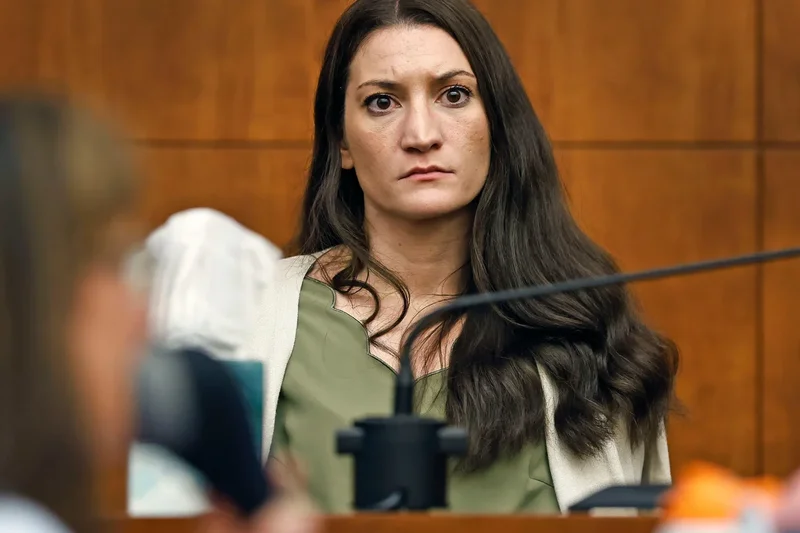
Lindsay Clancy loved her three young children “right up to the time of their death,” her lawyer has told jurors during the first day of the mother’s murder trial.
Clancy, 35, stands accused of strangling her children, aged 5, 3 and eight months, in their Duxbury, Massachusetts, home before attempting to kill herself in January 2023.
In opening statements of the case, Clancy’s lawyer, Kevin Reddington, argued that the mom was suffering from postpartum psychosis, a rare mental illness following childbirth that causes behavior changes such as hallucinations and paranoia.
“These children were loved, nurtured and cared for,” he told jurors Monday. “She loved those children right up to the time of their death.”
Clancy’s now-ex-husband, Patrick Clancy, found their children, 5-year-old Cora, 3-year-old Dawson and 8-month-old Callan, after returning home on January 24, 2023. The dad, who also appeared Monday at Plymouth Superior Court, has since said he forgives his ex-wife.
On the day of the killings, prosecutors said Clancy had sent her husband out to run some errands.
Police were called that evening after someone reported a woman jumping from a window of the home.
When first responders arrived, they first found Clancy, who had survived a suicide attempt after she attacked the children, the court heard. Responders then went down to the basement of the home, where they discovered the three children unconscious with “obvious signs of severe trauma,” according to prosecutors.
Cora and Dawson were rushed to a local hospital, where they were pronounced dead. Callan died several days later.
Clancy appeared in court Monday in a wheelchair as she remains paralyzed from the waist down.
Clancy, a former labor and delivery nurse at Massachusetts General Hospital, pleaded not guilty to three counts each of murder, strangulation and assault and battery with a dangerous weapon. She admits to killing her children, but Reddington argued she is not criminally responsible for their deaths due to her mental state at the time.
Clancy was receiving psychiatric care for about four months before her children’s deaths, the court heard.
She said she heard voices the day of the murders telling her, “This is your last chance. Kill the children so you can kill yourself,” Reddington said.
While postpartum depression affects up to one in seven women who have recently given birth, postpartum psychosis is more severe and less common. It occurs in about one to two per 1,000 women post-delivery.
Assistant District Attorney Shanan Buckingham argued Clancy “acted intentionally, rationally and swiftly” in the killings.
“This was not a woman in the throes of psychosis,” Buckingham said in court Monday. “This is not a public debate about women’s mental health and how the medical system treats women. This case is about this defendant, Lindsay Clancy.”
Patrick Clancy, who will testify for both the prosecution and the defense, was visibly emotional as he took the witness stand Monday. The couple got divorced after the killings, and he has since remarried, according to CBS News Boston.
In December 2022, Clancy started a “big spiral,” Patrick Clancy said, per the local outlet.
"She started to lose a lot of weight, she became really depressed and was having a hard time. She started to say she was suicidal,” he said.
It was also around this time that Patrick Clancy said his wife told him she was having intrusive thoughts about hurting their children. But he testified that Clancy said she did not need to be kept away from them when her husband asked.
“It was very confusing because the next minute she was making them lunch or putting them to bed,” he said. “I never saw Lindsay harm the kids.”
Clancy faces life in prison without parole if convicted of murder. She would be sent to a state mental health facility if found not guilty because of a lack of criminal responsibility.
Clancy’s case is similar to that of Andrea Yates, a Texas woman who drowned her five children in a bathtub in 2001. Her lawyers argued she suffered from postpartum psychosis.
She was initially convicted of murder, but during a 2006 retrial she was found not guilty by reason of insanity and sent to a state mental health facility.
If you are based in the USA, and you or someone you know needs mental health assistance right now, call or text 988, or visit 988lifeline.org to access online chat from the 988 Suicide and Crisis Lifeline. This is a free, confidential crisis hotline that is available to everyone 24 hours a day, seven days a week. In the UK, you can speak to the Samaritans, in confidence, on 116 123 (UK and ROI) or visit the Samaritans website to find details of your nearest branch. If you are in another country, you can go to www.befrienders.org to find a helpline near you