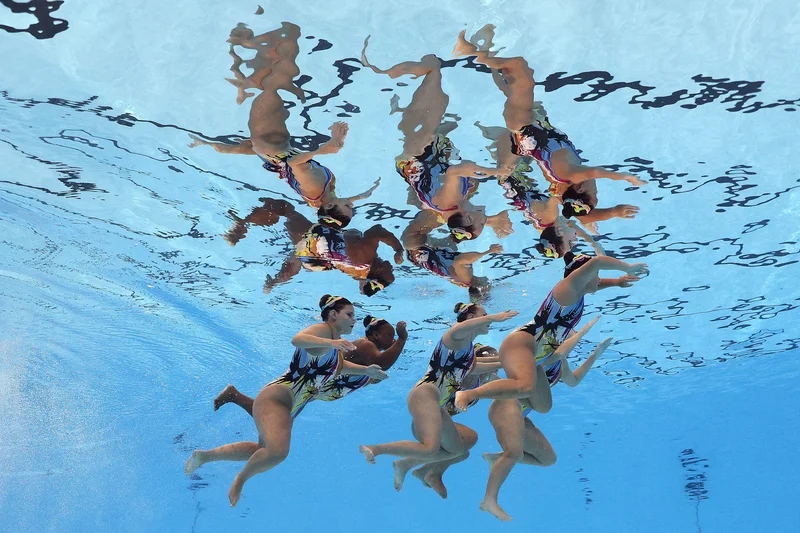
Three South African artistic swimmers selected to compete at the Junior Artistic Swimming Championships in Hungary next month face a bill of R120,000 each to represent their country.
The high price, which increased from an initial R85,980, came after eight of the 11 anticipated athletes declined to participate in the tour, scheduled for 12-16 August. This is according to Swimming South Africa (SSA) operations manager Mafata Modutoane, who responded to Daily Maverick on behalf of the federation.
The withdrawals meant fixed tour costs had to be shared among fewer competitors.
The figure highlights the reality within South African aquatic sport, where athletes are expected to fund a significant portion of their international participation.
It is unclear why the eight athletes declined to participate, but a source within the swimming community told Daily Maverick that costs were a major factor.
Vague âstaff, management costsâ requirement
On top of athletes being asked to pay exorbitant competition costs, they are also required to contribute to staff and management costs.
In a document issued in May, swimmers named in a provisional squad for next monthâs Pan Pacific Championships, running from 12 to 15 August in California, were informed that they would be responsible for âall costs associated with participationâ, including staff costs.
Also included in the list were visa applications, flights and accommodation. Aside from an estimated accommodation cost of about R3,400 per person per night, no other financial estimates were given.
Furthermore, the document does not explain what exactly âstaff costsâ entail.
When asked whether athletes contributing towards staff costs was standard practice, SSA said the âpremise of the question is incorrectâ.
âThe Pan Pacs document relates to a provisional squad and not the selection of a final national team,â said Modutoane.
âThe document was intended to provide greater transparency regarding the potential financial implications associated with voluntary participation and should not be interpreted as representing a change in policy.â
On why athletes were expected to contribute towards staff costs and what those covered specifically, Modutoane said: âThe staffing complement for any tour is determined by the final number of athletes who accept their invitation, together with the technical and welfare requirements of the group.
âAs a result, staff costs cannot be accurately calculated until participation numbers are confirmed. Once these figures are finalised, the associated costs are apportioned accordingly and communicated to participants before any financial commitment is required.â
But when asked in a follow-up question to provide the provisional budget and staffing complement, or an alternative staff cost breakdown from a comparable recent tour, SSA did not reply by the time of publication.
Figures supplied by SSA showed that athlete contributions rose from R7.13-million in 2024 to R9.53-million in 2025 while its total high performance expenditure fell from R19.36-million [an Olympic year] to R15.44-million over the same period.
It appears that the athletesâ contributions as a share of total high-performance expenditure rose from 37% to roughly 62% year on year.
Daily Maverick asked SSA if it agreed with the calculation, and if it did, how it squared its statement that the 2025 reduction should not be interpreted as a shift toward increased athlete funding.
SSAâs 2024/25 annual report shows a single consolidated âAthlete contributionsâ line of R9.53-million under fees received, with no breakdown by discipline or event.
The requests for athlete contributions come against a backdrop of an entrenched reliance on athlete funding not only within SSA, but across South African sporting federations.
High price to represent the country
Last week, a social media post by two-time Olympic hockey player Onthathile Zulu went viral where she expressed how âdishearteningâ it was to see the government spend massive amounts on sports tourism while she has had to âfinancially carryâ her own hockey career.
In order to participate in the upcoming Hockey World Cup and represent her country, Zulu said it cost her almost R70,000 for flights, accommodation, meals, transport, medical treatment and training camps.
The reality is that athletes across numerous sporting federations face a similar plight.
At the Africa Aquatics Junior Swimming Championships in Egypt last year, athletes had to contribute R40,000 each. At the 2025 Junior Swimming Championships in Romania, athletes paid R60,000 each. Now, artistic swimmers must fork out R120,000. These are just a few examples.
Meanwhile, over the past four years, SSAâs high-performance model appears to increasingly rely on athlete contributions.
According to SSAâs annual report, the federation spent R15.44-million on high-performance programmes in 2025. Upon request, SSA provided Daily Maverick with a breakdown of the expenditure over the past four years.
Of that 2025 amount, R5.91-million came from the federation and its funding partners, including the government and private sponsors, while athletes contributed R9.53-million themselves.
The table above demonstrates the contribution athletes have made towards SSAâs high-performance expenditure, according to figures supplied by SSA.
As can be seen, athlete contributions surged by R5.41-million between 2022 and 2025.
âAthlete contributions vary depending on the nature of the event, competition level, transformation objectives, available funding and affordability considerations,â said Modutoane.
âTeams are selected against pre-approved performance criteria, and athlete contributions are determined after considering funding received from the Department of Sport, Arts and Culture, National Lotteries Commission (where available), sponsorships and SSAâs own operational resources.â
According to Modutoane, the high-performance budget encompasses expenditure directly associated with SSAâs high-performance programmes stretched across five aquatic disciplines.
âThis includes international and intercontinental competition tours, athlete preparation, coaching and management support, selected team apparel and other essential operational requirements necessary to support high-performance participation,â he said.
âThe programme covers the participation of hundreds of athletes, coaches, team managers, and technical officials over the course of a financial year.â
Major multi-sport events such as the Olympic Games, Commonwealth Games and African Games are funded through the South African Sports Confederation and Olympic Committee (Sascoc) and therefore do not form part of SSAâs high-performance budget, said Modutoane.
âWithout the financial support provided by SSA and its funding partners, the cost borne by athletes would be substantially higher, potentially limiting South African athletesâ opportunities to compete internationally,â said Modutoane.
Funding model under pressure
Yet, SSA acknowledged that its funding structure had come under strain in recent years.
According to its annual reports, funding comes from various spheres including private sponsors, World Aquatics, the Department of Sport, Arts and Culture and the National Lotteries Commission.
In its email to Daily Maverick, SSA noted that the federation had to absorb additional funding pressures following the âprolonged non-payment of approvedâ National Lotteries Commission grants over the past two years.
SSA last received a grant from the National Lotteries Commission (excluding the Franschhoek High-Performance Centre grant) in 2023, amounting to R18.42-million. This is according to the National Lotteries Commissionâs 2023/24 annual report.
About R4.2-million was deferred to 2025.
Additionally, government support has also decreased.
In the 2024/25 financial year, the federation received R3.1-million from the Department of Sport, Arts and Culture, down from R4.5-million in 2023/24, according to the departmentâs annual reports.
And so the story circles back to sporting federations continuing to grapple with financial constraints while athletes are left to pick up the bill.
The withdrawal of eight artistic swimmers from the Junior Artistic Swimming Championships illustrates the challenge. SSA argued that without federation support, athletes would face even higher costs. Yet its own figures show athletes are contributing an increasingly large share to high-performance.
While the reasons for each athleteâs decision to withdraw remain unclear, the resulting increase in costs for the remaining swimmers on the one hand and being expected to cover staff for the Pan Pacific Championships on the other demonstrates how quickly international representation can become unaffordable. DM