ST Signature Series
Lifelong friendships and memories: How NS shaped this writer’s life and sense of belonging
Alvin Foo
Reporting sick on the first full day of national service was probably the worst start I could have had.
All the farewell parties meant waking up with a throat infection on enlistment day in 1999. So I spent most of my 10 weeks in basic military training (BMT) fighting to get well instead of fighting to excel.
While my NS experience began with pain, the journey I would undertake in the years ahead left me with unique, long-lasting friendships and grounded me with a sense of belonging wherever I go.
These feelings usually come to the fore around Singapore Armed Forces Day in July, when my social media feeds will be filled with friends recounting their army days. Similar sentiments are also felt around Aug 9, when I watch the National Day Parade on TV with my family.
The early days
I was born and bred in Singapore, and was the first in my family to serve NS as my dad was too old to be enlisted, so I did not have the benefit of first-hand advice from home.
Instead, what I received as “legacy” were two big bags of army stuff from dad, who had gone with mum to buy them at the Beach Road army market before my enlistment. I had no idea then what most of the items were, but I knew he cared.
Two things I remember about BMT: There were four women trainees in my platoon, and we were the last BMT batch in Nee Soon camp who helped move everything to Pulau Tekong, including the weights in the gym.
Starting out ill meant an uphill struggle to qualify for Officer Cadet School or the School of Infantry Specialists. Instead, I was posted to be a reconnaissance trooper with an armour brigade, where I would spend my NS and reservist days.
Though disappointed to have missed out on a commander role, it was there that I found friends who have stayed with me through life’s seasons – birthdays, weddings, funerals, newborns, career changes, or just the random catch-up.
Friendships through adversity
Scientific research shows that men bond best through shared challenges. And I found this to be true in NS. Through the stress of navigating a jungle overseas, dealing with difficult people or tasks, and coping with tough physical challenges, I made buddies for life.
It has been more than 25 years since we completed our full-time service, yet not a day passes without an exchange in our WhatsApp chat group on random topics such as Lionel Messi’s latest exploits at the recent World Cup, Manchester United’s transfer news, the best dentists in Johor Bahru, or the latest news about others who have also served NS.
These friendships have been a constant presence in my life – whether as a prominent group at my 21st birthday party and my wedding day, or familiar faces at corporate dinners. These are friends I have relied on to lend a non-judgmental listening ear or to laugh with after a hard day’s work.
These strong bonds make returning for every reservist cycle easier. Rather than view them as a disruption, the fortnights away from civilian life allowed me not just to be introduced to the latest army technology and processes, but also to spend time with friends.
Gaining a broader perspective
Training often takes full-time servicemen out of land-scarce Singapore, to countries such as the US, India, Australia and Germany, and this was the highlight of my NS days.
In one location, I witnessed the locals’ deep respect for soldiers. One night, my team of five encountered a severe thunderstorm and had to seek shelter on the porch of a family’s house. To our surprise, the occupants were warm and hospitable, and even made cup noodles for us.
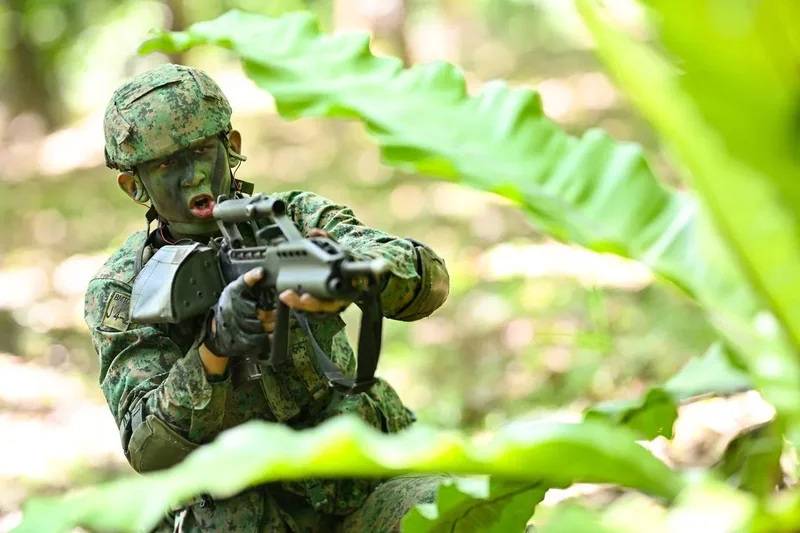
In another, I learnt how residents care for the land and picked up jungle survival skills, such as how to collect river water and use a purification tablet. The training was gruelling and intense, but there were also memorable moments, such as catching a rare glimpse of a Rafflesia flower – the world’s largest – and conquering hills and trails while carrying a load more than half my body weight.
These overseas experiences challenged me to think outside the box and adopt a broader perspective. Later, they would also partially influence my parenting style – to not overprotect my children from the rough and tumble of life, and to teach them the importance of being among nature.
A ‘can-do’ attitude
The physical and mental adversity experienced during NS was also a lesson in resilience and adaptability. At work, when I am asked to do tasks that seem impossible, I recall how I passed the army motorcycle course despite not even knowing how to cycle.
To qualify to take the course, you had to make figures of eight with an old bicycle. I bought a cheap mountain bike, found the nearest gentle slope, and sacrificed precious weekend “book-out” time going up and down the slope until I not only succeeded, but could also do figures of eight.
Influence without authority
Another skill I gained is how to influence without authority – guiding or persuading others to act without having direct power over them. I had no rank to pull, so I had to learn how to influence my peers and commanders by understanding their perspective, finding common ground and building long-term trust.
Through countless chats in the training shed or on long drives on “tonner” trucks, I learnt how to appreciate, communicate and work with people from different family, ethnic and educational backgrounds. It was a skill that would prove especially useful in my future career as a journalist and communications professional.
Bringing skills home
Some lessons from NS even have a place in the home, such as the importance of staying hydrated. Each of my family members now carries a water bottle when going out. Sometimes, I allow the children to eat dessert or treats only after they have finished their water bottle.
Another useful skill is map reading and navigation, especially as my partner loves hiking. These days, it is far easier to use GPS, but there are times when the old-school method still comes into play, such as in places with a poor cellphone signal.
And those motorcycle skills? They came in handy during family vacations at an Indonesian resort, when I ferried the family around on an electric motorbike.
Common speak and a sense of belonging
Canteen break, off-pass, SOP, wayang, ninja van, cookhouse, standby bed, and area cleaning – those who have served NS will know these terms.
These phrases have stuck long after the uniform has come off, filtering into everyday life. For example, I will tell my friends, “Let me apply for an off-pass from my wife so I can join you for football”, which means that I will check with my partner whether we have plans before committing to a game.
Common lingo aside, NS has given me a strong sense of belonging to Singapore. Recollections of camaraderie, common speech and combat-readiness, gathered through 2½ years of full-time service and many reservist cycles, have forged a fond attachment to home. This is especially so as I live overseas, which reminds me more clearly of my national identity.
The shared experience from NS has also enabled me to quickly find common ground when meeting other Singaporeans overseas, such as during my university days in London. I recall one conversation with a Singaporean schoolmate who asked what I had taken with me from my NS experience.
I paused to consider my reply, before answering: “It’s not NS that makes you a man. It’s what you make of NS that makes you a man.”
-
Elevated insights from seasoned perspectives. Crafted by journalists. Powered by Purpose:
-
This article is part of a special collaboration between The Straits Times and Nexus – the lead agency that drives Singapore’s national education and Total Defence efforts – to spotlight national issues.
-
The writer was a journalist at The Straits Times’ business and sports desks, and currently resides in Australia.