Revitalizing Japanese Shipbuilding: Labor Shortages, US Demands Cast Doubt on “Made in Japan” Strategy
Politics EconomyNot long ago, I published a study of the political and administrative processes surrounding Japan’s use of subsidies to rebuild the shipping and shipbuilding industry in the early post–World War II era. For me—and indeed, for anyone familiar with the history of Japanese industrial policy—recent developments in that sector evoke an eerie sense of déjà-vu. That said, facile analogies can be misleading. What is actually going on between the government and the shipbuilding industry? In the following I hope to shed some light on this question, focusing on developments spanning 2025 and the first half of 2026.
How Trump Politicized Shipbuilding
In 2025, the Japanese shipbuilding industry suddenly found itself the subject of intense political controversy.
It all began in March with a speech to Congress in which President Donald Trump made clear his determination to revitalize America’s shipbuilding industry. The following April, he issued an executive order titled Restoring America’s Maritime Dominance. The stated purpose was to revitalize the domestic maritime industries and reduce US dependence on China to bolster economic security and help rebuild America’s industrial base.
At first glance, it might be difficult to see what any of this has to do with Japan. But given the limited production capacity and human resources of America’s shipbuilding industry today, such an undertaking was bound to require the cooperation of an ally, such as Japan or South Korea, that already possessed significant production capacity and controlled a meaningful share of the global market. The Japanese government was keen to cut a deal with Trump to lower his tariffs on Japanese automobiles, and it seized on shipbuilding as a potent bargaining chip.
It did not take long for the Japanese government to announce policy support for the shipbuilding industry. The cabinet’s , released in June, called for measures to revitalize the domestic shipbuilding industry and boost the resilience of Japan’s “maritime cluster,” centered on shipping and shipbuilding. The 2025 Basic Policy dealt with that sector at greater length than previously and included a new reference to Japan-US cooperation, revealing the government’s strategy of using the promise of collaboration to strengthen its hand in bilateral tariff negotiations.
The ruling Liberal Democratic Party responded as well with a set of emergency proposals for the revitalization of Japan’s shipbuilding industry (compiled jointly by the party’s Special Committee on Marine Transportation and Shipbuilding and its Headquarters for the Promotion of Economic Security). The recommendations the LDP submitted to then Prime Minister Ishiba Shigeru—also dated June 2025—called on the government to establish a state-backed fund and draw up a roadmap to bolster policy support for the industry. Moreover, under the heading of “strengthening partnerships with like-minded countries,” it stressed closer cooperation with the United States, offering a number of concrete examples. With the cabinet and the LDP both stressing the need for massive government funding, the shipbuilding industry—having become politically charged in the context of Japan-US cooperation—emerged as the object of intense public scrutiny and controversy.
Critical Industry or Bargaining Chip?
In July 2025, Japan and the United States reached an agreement on tariffs. As part of the deal, Japan committed to investments totaling $550 billion in the US economy, with shipbuilding listed among the target industries. The following October, Japan and the United States signed a memorandum in which the two sides agreed to establish a bilateral working group to deliberate specific cooperative measures pertaining to shipbuilding, including the expansion of production capacity.
In December, the Japanese government released a Shipbuilding Industry Revitalization Roadmap that calls for doubling annual production, from the 2024 level of roughly 9 million gross tonnage to 18 million GT in 2035. In line with the LDP’s emergency recommendations, the roadmap also calls for the creation of a state-backed government fund totaling ¥350 billion over a period of 10 years.
The shipbuilding industry was not about to let the opportunity pass. In October 2025, a group of 17 domestic companies announced a program of capital investment totaling ¥350 billion and called for government support to facilitate additional investment. Clearly, the government and the shipbuilding industry are united in their desire to revitalize the sector. But there are important differences in the way they view that goal and the means of achieving it.
Grappling with Domestic Labor Shortages
The shipbuilding industry, after all, has been pursuing its own strategies for boosting global competitiveness, even while seeking government assistance. In June 2025, Imabari Shipbuilding, Japan’s largest shipbuilder by market share, announced an agreement to acquire majority control over its closest domestic competitor, Japan Marine United (JMU). The following December, Nippon Yūsen, Mitsui O.S.K. Lines, and Kawasaki Kisen, Japan’s three shipping giants, announced their decision to invest in MILES. Jointly established by Mitsubishi Heavy Industries and Imabari Shipbuilding, MILES is a major cross-industry initiative to establish a standard design framework for the development of next-generation ships. Both of these initiatives are aimed at consolidating and integrating the sector into a vast “all-Japan” consortium equipped to compete at the global level.
Of course, the government’s program to revive shipbuilding is also premised on an all-Japan approach. The aforementioned roadmap highlights measures to promote vertical and horizontal integration within the maritime industries. But another key requirement, from an economic-security standpoint is the development of a system in which all “Japanese ships are built in Japan.” Similarly, the LDP’s emergency recommendations stress the need for “Japanese ships to be Japanese built and owned” for security reasons. In short, the government’s concept of an all-Japan shipping system is rooted in the goal of beefing up domestic production capacity, while the industry’s vision is all about cost competitiveness. The two goals are not necessarily compatible.
As a result, there are inconsistencies between the roadmap drawn up by the government and the sector’s own business strategies, and this misalignment does not bode well for implementation. The government’s roadmap proposes consolidating the industry into between one and three “groups” by 2028. But not everyone in the industry is onboard with the idea of a government-driven reorganization.
Challenges of Government-Led Restructuring
There are precedents for using government subsidies as an incentive for industry consolidation, but it is hard to see how Japan’s shipbuilding companies, which have already put a good deal of effort into restructuring, would accept the government’s plan. Presumably aware of potential resistance, the roadmap’s drafters left the details of consolidation vague. With references to a “group footing” and “the possibility of various forms of consolidation and collaboration,” they appear to be allowing room for compromise.
Meanwhile, as the government calls for boosting domestic production, Tsuneishi Shipbuilding, another major industry player, has been pursuing an entirely different expansion strategy, building shipyards overseas, where engineers are more easily secured. Its latest target for expansion is East Timor. History suggests that there are bound to be businesses in the shipping and shipbuilding industry whose corporate philosophy and business strategy diverges from the thinking of politicians and administrators. The case of Sankō Steamship Co. in the 1960s is just one example—hence the aforementioned sense of déjà vu.
For example, in the late 1940s, the Japanese government embarked on an industrial policy to revive the domestic shipping and shipbuilding industries. The scheme was centered on “planned shipbuilding,” under which bureaucrats decided how many vessels would be built, allocated a certain portion of that output to each company, and awarded financial assistance accordingly. This involved reconciling the major shipping companies’ demands for priority allocation with the interests of smaller industry players. Another challenge was ensuring adequate shipyard capacity in the event of business upturns, when Japanese shipbuilders would receive orders from overseas.
In the 1960s, planned shipbuilding was used to advance restructuring of the shipping sector. But some shipping companies, including the aforementioned Sankō Steamship, refused to take part in the government’s restructuring plan, preferring to pursue their own business strategies. Although they supported the objective of revitalizing the sector, their own corporate interests diverged from the government’s intent, and the lack of alignment impacted the implementation of Japan’s industrial policy during this period.
Toward Cross-industry Collaboration
In view of all of this, I would suggest that there are two key points to keep in mind when considering how the current situation is likely to unfold henceforth.
The first point is that shipbuilding capacity hinges on such resources as labor and materials. Chronic labor shortages here in Japan have been a major factor driving Tsuneishi’s strategy of overseas expansion. Shipbuilding also requires steel, and with steel prices rising, collaboration and partnerships with the steel industry will be of the essence. In March 2026, representatives of the domestic shipping, shipbuilding, steel, and marine-equipment industries met for the first in a series of high-level meetings aimed at building a framework for cross-industry cooperation. If economic security considerations continue to grow in importance, the vertical and horizontal integration seen in the all-Japan shipbuilding initiative could well extend beyond shipping and shipbuilding to encompass other related industries.
The other point to keep in mind is that the momentum behind subsidization of the shipbuilding industry will depend in large part on how the Japan-US cooperation progresses. The Japan-US working group on shipbuilding held its initial meeting in the United States in February 2026, but there has been no report of any concrete plans as of this writing. Reconciling international cooperation with the roadmap’s “made in Japan” philosophy will be a tricky balancing act, involving continuous coordination between Japanese shipbuilders and the government in response to demands from the US side—including those from President Trump, who has evinced an intense interest in shipbuilding.
But a closed conversation among a handful of government and industry experts will not suffice to persuade a skeptical public of the need for massive shipbuilding subsidies. If the government is committed to this industrial policy, it must do the work needed to build a national consensus by heightening public awareness and debate of the issues. With interest in shipbuilding on the rise, I am hopeful that this modest analysis will provide additional food for thought on the merits and pitfalls of policy support.
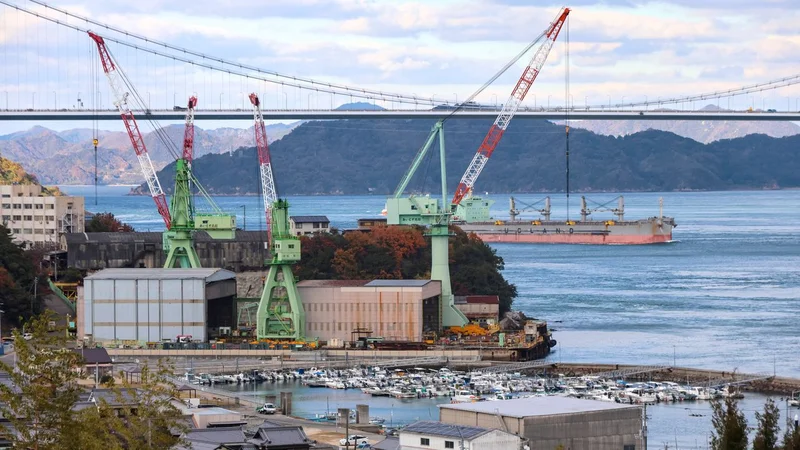
(Originally published in Japanese on July 9, 2026. Banner photo: A Japanese shipyard fronting the Kurushima Strait in the Seto Inland Sea, Imabari, Ehime Prefecture, December 2024. © Jiji.)