Asuka and Fujiwara: Cradles of Japan’s Nationhood Recognized as World Heritage Site
Guideto Japan
Japan in Video History Travel## How Exchange with Continental Culture Reshaped Early Japan
The Asuka period (592–710) marked Japan’s transition from a federation of powerful clans to a centralized state headed by the emperor. The government, based in the Asuka and Fujiwara areas of southern Nara Basin, modeled its legal codes, administrative structures, and taxation systems on those of China. It was also during this time that the characters still used today for the country’s name—read as Nippon or Yamato—were established.
From 630, the Asuka Palace served as Japan’s political and cultural center for over 60 years. Surrounding it were ritual sites where the emperor prayed for peace and a water clock built with technology incorporated from the continent. These remains reveal that ritual and timekeeping were important tools of governance and highlight the advanced stone-working skills of palace engineers.
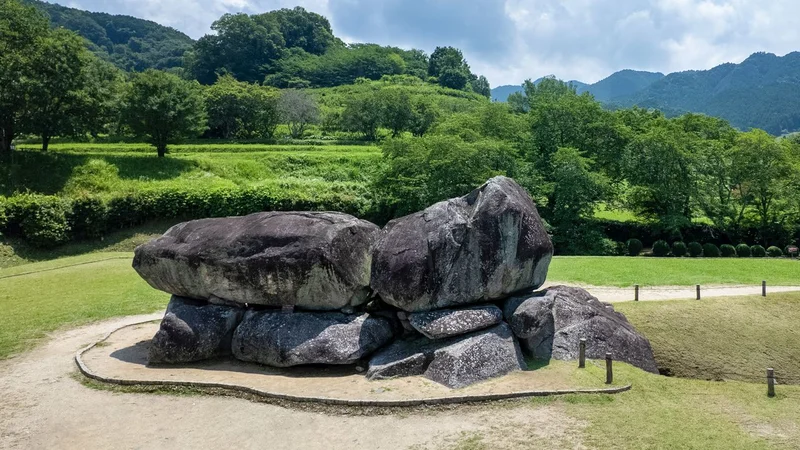
The Ishibutai kofun, or mounded tomb, is another striking stone monument in Asuka. Its exposed chamber, built from 30 massive boulders, weighs an estimated 2,300 tons. It is thought to be the tomb of Soga no Umako, the statesman who championed Buddhism as a state religion. The sheer scale of the stones used for the structure offers a vivid sense of his power and influence.
Early temples such as Asukadera also drew heavily on continental architectural techniques. Buddhism became central to statecraft and shaped Japanese culture, including the use of Chinese characters. The finest evidence of the era’s active international exchange survives in the murals of the Takamatsuzuka and Kitora Mounded Tombs. Their stone chambers are adorned with vivid astronomical charts, human figures, and mythical beasts, and the mounds feature layered earthen construction—indicating the influence of techniques from China and the Korean Peninsula. These two tombs contain the only surviving multicolor murals of their kind in Japan, and both have been designated national treasures.
A Blueprint for Future Capitals
The construction of Fujiwarakyō in 694 marked the completion of a centralized state organized around the emperor and governed according to the ritsuryō legal codes. The palace concentrated political and ritual functions into one core, surrounded by officials’ residential quarters and two state temples. This was Japan’s first fully planned capital—a design that later became the model for Heijōkyō (from 710, in present‑day Nara) and Heiankyō (from 794, in present‑day Kyoto).
After the capital moved north to Heijōkyō in 710, the Asuka-Fujiwara area returned to farmland. As a result, the foundations of palaces, temples, and tombs remained undisturbed underground in remarkably good condition. The unparalleled archaeological record of Japan’s birth as a nation was a key factor in the site’s World Heritage inscription. Revisiting these fields where a nation was born feels like opening a time capsule.
(Originally published in Japanese. Photos and video by Kuroiwa Masakazu and Fujii Kazuyuki of 96Box. Text by Nippon.com. Banner photo: The Ishibutai Mounded Tomb, symbol of Asuka. © 96Box.)