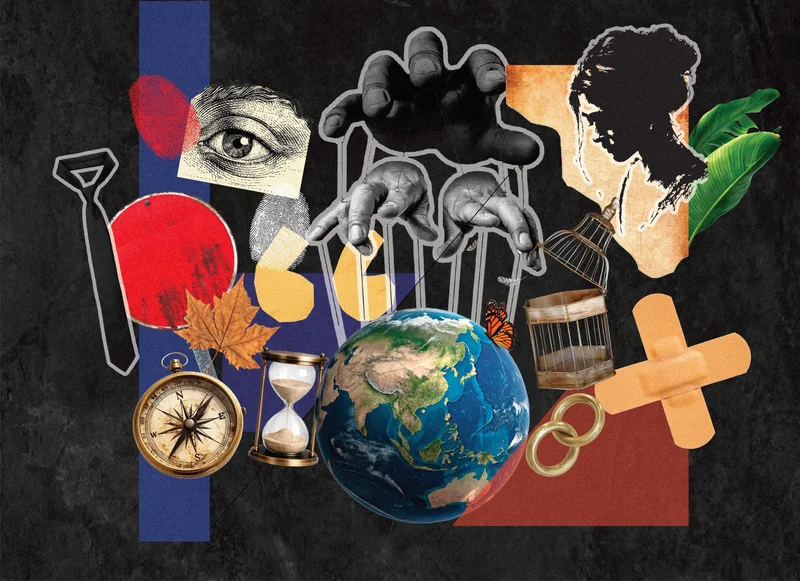
We often think of colonialism as a chapter of history. Yet perhaps its greatest achievement has been persuading us that it belongs only to the past. Colonialism is not simply about territory; it is also a way of organizing human relationships.
Whenever one person's labor is exploited, another person's body is treated as an entitlement, nature is consumed as an inexhaustible resource, knowledge is monopolized, or one life is shaped according to another's interests, the same colonial logic is at work: to possess, to control and, ultimately, to consume.
Perhaps this is why ours has become an age of invisible colonization, one that distances us from our own humanity while drawing us into an unconscious form of globalization.
Today, it is no longer only nations that are occupied. Bodies are occupied too. Not only territories are colonized, but minds as well. Not only natural resources are exhausted, but emotions too.
It is at this point that the work of the French psychosociologist Nicole Roelens opens up a compelling new way of thinking. The result of nearly 30 years of research, her seven-volume Manifeste pour une décolonisation de l'humanité femelle (Manifesto for the Decolonization of Female Humanity) argues that concepts such as male domination or patriarchy no longer adequately explain women's historical experience. According to Roelens, the issue is not simply men's domination over women. Rather, it is a process of bodily, reproductive, intellectual and existential colonization that operates according to the same logic as geopolitical colonialism.
For this reason, she deliberately chooses the word colonization over domination. Domination describes a hierarchy. Colonization describes occupation. It involves the systematic extraction of resources, the production of dependency, and the gradual estrangement of the colonized from their own reality.
At first glance, this may seem like a provocative choice of words. Yet if we recognize the occupation of a people's land as colonialism, why should we reach for a different concept when a body, reproductive capacity, labor or lived experience is systematically controlled, redefined and placed in the service of others? From this perspective, what women have experienced throughout history is not merely inequality or domination. It is a complex and enduring process of colonization.
This is precisely where Roelens departs from conventional critiques of patriarchy. Her aim is not simply to criticize the figure of the "macho man." Her deeper concern is the broader organization of modern society, one that increasingly alienates human beings from their own bodies, from nature and, ultimately, from their own existence. As a result, her analysis extends well beyond masculinity. It encompasses technology, biopolitics, the production of knowledge and identity politics. The forces that regulate women's bodies today cannot be reduced to traditional patriarchy alone. Modernity itself has created new, increasingly sophisticated forms of control.
To explain this, Roelens begins by unpacking the very idea of "woman." In her view, female identity is not a single, unified category but consists of four distinct dimensions that contemporary debates too often collapse into one.
The first is femellité, which she defines as "organic femaleness." It refers to a woman's biological, hormonal and genetic reality, her reproductive capacity, her sexuality and her embodied existence. Roelens introduces this concept deliberately because she seeks to establish a positive biological counterpart to masculinity.
The second dimension is "femininity," the lived experience of womanhood: the way a person experiences and inhabits being a woman.
The third is "gender," encompassing the social roles, expectations and responsibilities historically assigned to women and men.
Finally comes the "performance of gender," through clothing, make-up, aesthetic choices, body language and the identities individuals present to society.
Much of today's public debate, however, blurs the distinctions between these four dimensions. Certain strands of contemporary feminism, in particular, have increasingly reduced the discussion to questions of “gender” and "identity performance." This has placed Roelens at odds not only with conservative circles but also with parts of the leftist academic establishment. Although her books can be found in many university libraries, she argues that her work has largely been ignored within mainstream academic debate and that her ideas have been rendered systematically invisible. In her own view, the reason is straightforward: she challenges both patriarchy and contemporary identity politics at the same time. Her analysis fits comfortably into neither traditional patriarchal discourse nor the prevailing theories of gender and identity of the dominant academic paradigm.
Today, biological reality is becoming increasingly invisible. Paradoxically, the more we speak about women's bodies, the less the body itself seems to occupy the center of the discussion.
When the body is treated as nothing more than a cultural or intellectual construct, a new form of alienation emerges, one that distances human beings from their own biological reality. This process can be understood as a form of biological disembodiment. In other words, it is a gradual movement toward identities that become increasingly detached from the body itself and increasingly shaped by technology, abstraction and artificiality. Taken to its logical conclusion, this trajectory leads toward a form of robotization, in which human beings risk losing not only their biological rootedness but also their embodied experience of the world.
Perhaps this is where cognitive colonization truly begins.
Those who refuse to think through inherited categories and instead attempt to construct a language rooted in their own lived experience are often dismissed before their arguments are even considered. They are labelled "conservative," "old-fashioned," "marginal" or, paradoxically, "too radical." Sometimes they encounter an even more effective form of censorship: silence. Their ideas are neither debated nor refuted. They are simply rendered invisible.
In many ways, this reflects the historical experience of women. The regulation of women's bodies, the control of their reproductive capacity, the invisibilization of their labor and their exclusion from the production of knowledge are not different forms of injustice. They are different manifestations and dimensions of the same colonial logic.
From this perspective, decolonization cannot be reduced to legal or political emancipation. Its deeper challenge is epistemic. It requires women to develop concepts grounded in their own experience, to produce knowledge on their own terms and to recover the ability to name the world in their own language rather than through categories inherited from others.
Genuine decolonization begins precisely with this cognitive liberation.
Yet this vision of decolonization is not directed against men. Its real target is a system that organizes human relationships according to a colonial logic. In this sense, it also reveals how forms of feminism built upon hostility towards men, in other words, forms of feminism shaped by misandry, may end up reproducing the very colonial patterns they seek to resist.
For the colonial order does not oppress women alone. It impoverishes men as well.
At first, this may seem like a surprising claim. Much contemporary debate portrays men primarily as the beneficiaries of the existing order. Yet a system organized around power also produces men who feel compelled to appear perpetually strong, who learn to suppress their emotions, who are taught to undervalue women's labor and who come to understand relationships not as partnerships but as structures of domination.
Painful as it may be to acknowledge, the colonial system infantilizes men. It turns them into what might be described as spoilt 3-year-old children, kicking everything around them whenever they fail to get what they want or realize that the world does not exist simply to satisfy their desires. At the same time, it teaches them to evade responsibility, to disregard “companionship” in human relationships, and to forget what it means to walk through life alongside women rather than above them. This comparison is not intended to demean men. On the contrary, it is a critique of a culture that prevents them from developing the emotional and moral maturity that adulthood requires.
Because true adulthood is not measured by the ability to exercise power, but by the ability to recognize limits, to practice reciprocity, and to live together. If a system raises men to believe they are inherently entitled while raising women to believe they are obliged to serve, it ultimately dehumanizes them both.
The question is no longer one of women struggling against men. It becomes a struggle to free human relationships themselves from the colonial logic that has shaped them for centuries.
Perhaps this is precisely what our age needs most.