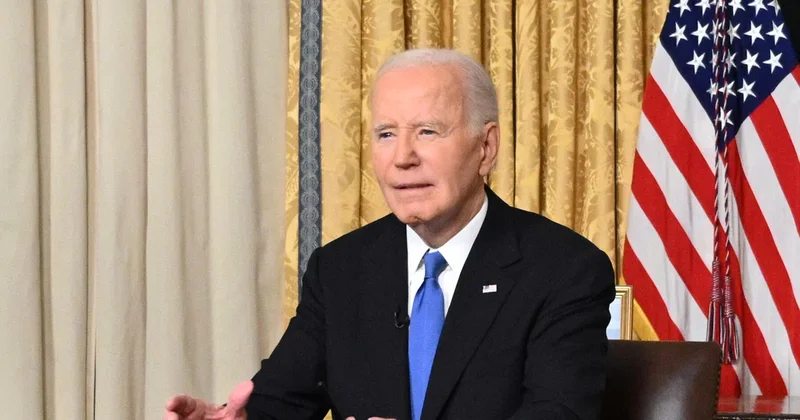
Audio recordings that former President Joe Biden fought for years to keep private have now been released.
The roughly 70 hours of audio recordings, shared with CBS News, were cited in a 2024 special counsel's report, which said Biden kept volumes of notes at his home that included classified information.
Biden, now 83, is at one point in the recordings heard telling his ghostwriter Mark Zwonitzer: "Some of this may be classified … So, be careful. I'm not sure ... It's not marked classified but —"
At another point in the recordings he says again: "The next thing I have here is, um, this is classified …"
The recordings were made while Biden worked with his ghostwriter on his 2017 memoir, "Promise Me, Dad: A Year of Hope, Hardship, and Purpose." No classified material was ever alleged to be in the published book.
The tapes first became the topic of intense scrutiny and controversy when they were referenced by Justice Department special counsel Robert Hur in a on Biden's handling of classified documents. Hur began investigating after , dating back to his time as vice president, were found in his home and private office. He ultimately did not recommend charges.
Hur also characterized Biden as "struggling to remember events," exhibiting "diminished faculties" and having "painfully slow" conversations as early as 2016. On the tapes, Biden speaks haltingly at times. If he is struggling with his memory during that period, the signs of it are subtle.
At one point, Biden seems to lose his way, saying: "Alright — what was I going to ask you? Something else… Uh… um. Oh gosh. I can't think of anything else."
The recordings were released after a two-year court battle by the Oversight Project, a conservative nonprofit that says its goal is to "expose and root out corruption in government."
Biden's legal team had initially sought to enjoin the release, but after a series of adverse rulings, declined to pursue the matter further.
CBS News has reached out to an attorney for Biden on the matter. At the time of the Hur report, Biden told reporters: "I did not share classified information. I did not share it with my ghostwriter." He added that he wasn't aware how boxes containing classified documents ended up in his garage.
Recordings shared with CBS News include Biden describing to Zwonitzer potentially classified meetings, including "a big meeting with the CIA and everyone," "a big meeting down in the Situation Room," and "a long meeting where DOD brief … POTUS".
In an Oct. 10, 2016, recording, he tells Zwonitzer that he has notes that the White House was not aware of.
"I have extensive notes over this period of time… They didn't know I have this," he said.
But Biden appears to be more cautious in some recordings, telling his ghostwriter about the "non-classified part of my discussion with POTUS" on Nov. 3, 2016, while he was still serving as vice president.
Hur investigated whether Biden illegally stored and shared classified information, and highlighted examples in his report, including Biden, then age 75, showing Zwonitzer "classified notes from a National Security Council meeting" of the Obama administration.
But the special counsel concluded the Justice Department would be unlikely to achieve a conviction, in part because the jury would side with Biden, viewing him as "a sympathetic, well-meaning, elderly man with a poor memory."
Justifying his decision not to prosecute, Hur wrote that "Mr. Biden's recorded conversations with Zwonitzer from 2017 are often painfully slow, with Mr. Biden struggling to remember events and straining at times to read and relay his own notebook entries."
"For these jurors, Mr. Biden's apparent lapses and failures in February and April 2017 will likely appear consistent with the diminished faculties and faulty memory he showed in Zwonitzer's interview recordings and in our interview of him," the report said.
Questions about Biden's age and mental acuity dogged him throughout his term, flaring up when moments of slurred speech, apparent vacancy or tripping on stairs were caught on camera. The White House repeatedly sought to downplay those concerns, highlighting Biden's command during key events such as his final State of the Union address.
But Biden's run for a second term ended abruptly after he appeared slow and confused during a disastrous June 2024 debate with then-candidate Donald Trump.
Last year, the Justice Department released audio recordings from Biden's 2023 interview with Hur's team. At times, Biden spoke in a hoarse and halting tone, and he struggled at one point to remember the year when his son Beau died and the year when President Trump was first elected.
The Heritage Foundation, the Oversight Project's sister nonprofit, filed a request under the Freedom of Information Act on Feb. 9, 2024, asking for the "records relied upon by Special Counsel Hur in drafting passages in the Report relating to President Joseph R. Biden's memory and mental faculties."
When the Biden administration's Justice Department failed to turn over the files for a month, the Oversight Project sued in Washington, D.C., federal court to compel the audio's release.
Jeff Clark, the Oversight Project's vice president of litigation, told CBS News that when Mr. Trump took power, the Justice Department agreed to hand over the files.
But Biden's own lawyers joined the legal case and prevented disclosure, until a federal appeals court ruled against Biden on July 20.
In a statement, the Oversight Project called the ruling a "complete and total victory."
Biden received an $8 million advance for the 2017 book, and plans to release a sequel, "Promise Me, America," in November, detailing his presidency, his 2024 reelection run and the decision to step aside.