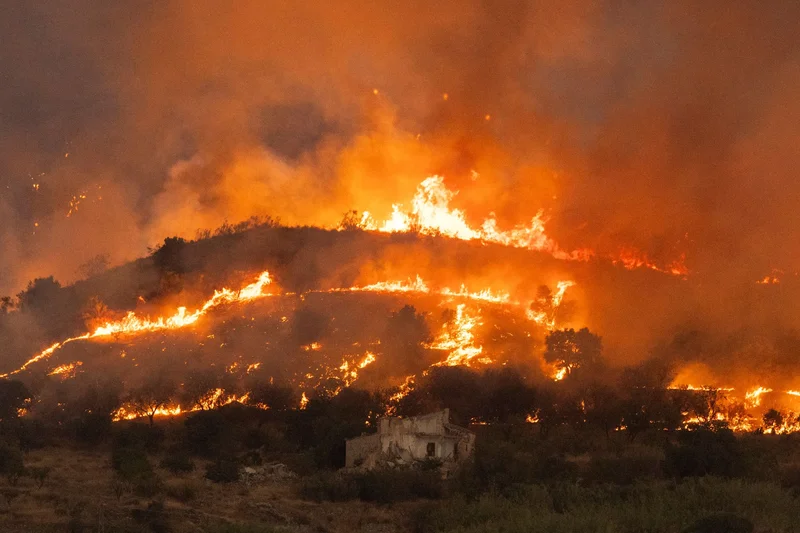
Spain declared a national emergency in the community of Madrid and the province of Ávila due to the spread of intense wildfires. With fires still burning out of control, this year is shaping up to be one of the most devastating wildfire seasons on record for the region.
“We are facing a dramatic situation, not only in various Spanish provinces but also in regions of neighboring countries,” warned Spain prime minister Pedro Sánchez. He noted that “all available resources” have been deployed to manage the emergency in the cities of Ávila, León, Toledo, Madrid, and other parts of the country amidst a national state of emergency.
France has also been hit by massive blazes that have spawned their own weather. All told, the two countries have seen fires burn over more than 741,000 acres, according to European Forest Fire Information System, and hundreds of thousands have been forced to evacuate. Wildfires in Spain have burned double the annual average area, while in France, this year's fire season has been six times more destructive than normal.
Extreme heat has helped fuel the fires as has abnormally dry weather that's primed vegetation to burn. The same phenomenon is playing out around the world, largely driven by climate change. With more megafires burning and even more on the horizon, firefighters are looking for new tools to combat them. That includes efforts in Spain, where the country has developed or tested technological innovations to prevent, detect, and contain forest fires.
Ecofire
This is a biodegradable liquid composed of various 100 percent organic substances in a water-based formula. It's up to 40 times more effective at extinguishing fires than water, while it acts six to 10 times faster. The product can also be applied preventively to vegetation to create an insulating layer that blocks heat and oxygen and prevents combustion at temperatures of 100 degrees Celsius (212 degrees Fahrenheit) or higher.
Predifire
Once a wildfire has exploded, it's harder to battle it. That makes better predictions vital to ensuring resources don't get spread too thin. Predifire is an early-warning system for forest fires supported by the University of Córdoba and the companies Automatismos ITEA and Somnum Technologies. The technology combines artificial intelligence, sensors, and autonomous drones to identify fire outbreaks when they're just a few acres. Its goal is to reduce response time and facilitate early intervention.
SenForFire
Other monitoring systems are also under development. They include SenForFire, a European project involving the Spanish National Research Council, the University of Extremadura, and various Spanish companies. Its goal is to strengthen prevention and early detection through wireless networks of low-cost smart sensors. These devices detect and measure, in real time, combustion-related gases, environmental variables, and weather conditions to identify signs that predict the onset or progression of a fire.
Wildfire Assessment Model
Developed by Spanish researchers with funding from the Ministry of Science and Innovation, this AI model uses neural networks to analyze atmospheric variables and an index of how green vegetation is based on satellite imagery. Using this information, it estimates how far a fire might spread, how long it would take to bring it under control, and what amount of ground, human, and aerial resources would be needed to respond to the emergency in high-risk areas.
Tools for the Public
Beyond efforts to fight fires, there are also tools—including many available now—that can help the Spanish public stay safe. The government has an official Civil Protection app to access emergency information, warning maps, and emergency services.
Google Maps features a layer capable of triggering emergency alerts and displaying the perimeters of wildfires in Spain. There is also Incendios España, a real-time map platform that shows the locations of active wildfires across the country using satellite data.
This article originally appeared on WIRED en Español and has been translated from Spanish.