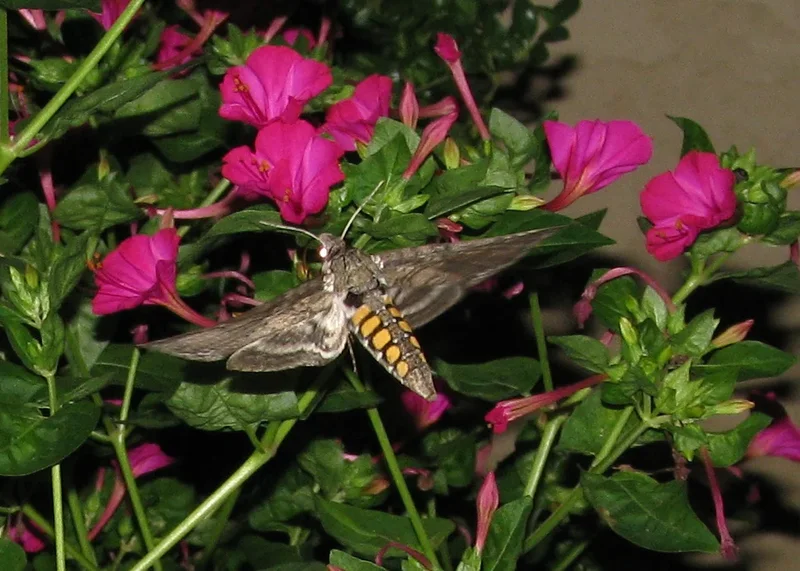
Smell is a complicated thing for insects. Research has shown that, despite limited neural capabilities, insects depend on olfactory cues to locate food, find mates, and avoid predators. Typically, this is done through their antennae, but not always.
For the tobacco hawkmoth, its sense of smell is found in their wings, according to a study published today in the Journal of Experimental Biology. For the latest work, the researchers investigated a previously unexplored function of sensory hairs on the mothâs wings. What they found was that those hairs actively contributed to the mothâs âsenseâ of smell, not just a simple exchange of chemicals. Further analysis revealed that these hairs reacted to the stinky odor of nightshade plants, the mothsâ favorite place to lay eggs.
Sniff and flap
According to the paper, insect wings carry numerous sensilla, which are tiny receptors shaped either like a small dome or a strand of hair. As sensilla play a key role in insect flight control, research has primarily focused on their mechanical function. Although scientists knew sensilla also had chemical functions, they were more interested in exploring the sensorsâ role as âtaste bristles,â as the paper puts it.
Then in recent years, researchers found evidence supporting the hypothesis that the yellow fever mosquitoâs wings served as an olfactory organâa ânose.â On the other hand, other research identified similar genes in the wings of the tobacco hawkmoth. Put together, the findings led the team to wonder if the moths were also sniffing things with their wings.
Wing science
For the study, the team âgentlyâ snipped the edges of the moth wings and sprayed a mist of gold over them. When the researchers placed the wings under a microscope, they saw that, between slender hairs typical of insect wings, there were âstubbier, porousâ hairs that âmight contribute to the insectâs sense of smell,â according to the statement. Then, they picked out 33 taste and scent receptors, 15 of which were along the wingâs edge, that might be relevant for this sense of smell.
To test whether the hairs were really smelling anything, the team latched an electrical circuit onto the wing to see which scents the wing would react to, or âsmell.â Surprisingly, the wing only reacted to two smells common in nightshade plants. The researchers also tried trimming off the edges of the wings to see if the edge hairs were doing most of the work. As it turned out, the wings still reacted to the nightshade scents.
âMost studies on the wing sensory hairs of butterflies and moths have focused on the sense of touch,â Sonja Bisch-Knaden, a study co-author and a biologist at the Max Planck Institute for Chemical Ecology, said in a statement. âThis suggests that the moth has special sensory hairs across its wings, not just along the edges, that can smell those odors.”