Edmonton mops up — again — in what is officially the rainiest summer on record
City has applied for disaster assistance from the provincial government
Edmonton's soggy summer has officially set a new seasonal record.
The news from Environment Canada comes as the city mops up from a Saturday evening storm that rolled through the capital city region, dropping 30 millimetres of rain from 9 p.m. to 10 p.m. Wind speeds averaged 39 km/h during that time, while a maximum speed of 94 km/h was recorded by Environment Canada, said meteorologist Jennifer Kowal.
After the weekend storm, Edmonton has seen 503.7 millimetres of rain this summer, Kowal told CBC News on Monday. The previous rainfall record was 417.1 millimetres in 1953.
“It really looks like the increased temperature this summer and the water on the ground is going to just continue this pattern, at least for the foreseeable future,” said Kowal.
The Saturday storm came after multiple severe thunderstorm warnings and watches were issued by Environment Canada for much of central Alberta, including Edmonton.
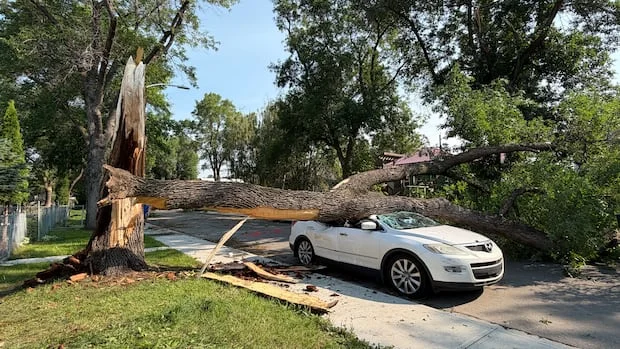
On Monday, the city issued a statement detailing the impact of the powerful storm, which closed roads, flooded neighbourhoods, shut down outdoor events and downed trees.
LISTEN | Why is it raining so much?:Post Malone concert cancelled
One of the Saturday night’s biggest incidents took place at Commonwealth Stadium, where American rapper Post Malone was playing his second of two back-to-back concerts at the outdoor venue.
Saturday's rainfall damaged parts of the stadium and sent about 31,000 fans scurrying for cover.
Stadium staff used audio messaging and the venue’s jumbotron to ask attendees to move to the open-air buildings into sheltered areas, such as the stadium’s concourse which the city said is large enough to hold the fans.
- A look at Edmonton’s plan to curb future flooding
- Tornadoes in Alberta already up more than 50 per cent from last year
“The safety of fans, staff, crew and artists is of utmost importance,” the city said in its release.
All of Commonwealth Stadium’s emergency protocols were followed, and no injuries were reported, according to the city.
The concert was ultimately cancelled and refunds have been issued to ticket holders by Ticketmaster and Live Nation, the release said.
WATCH | Concertgoers reflect on Edmonton storm:Some roads, facilities remain closed
Crews were still working Monday to reopen roadways, clear debris and assess damage, but City of Edmonton infrastructure has largely withstood the heavy rainfall this summer, the city said in its news release.
Fallen trees and flooding closed multiple roadways in Edmonton on Saturday and into Sunday, including Yellowhead Trail, Whitemud Drive, Groat Road and Connors Road. These roads are now open, the city said.
- Edmonton records its rainiest June ever following latest weekend downpour: Environment Canada
- Q&A: What is driving Edmonton's recent heavy rainfalls?
The 130th Avenue and 107th Street intersection remains closed, while 178th Street’s ramp to Whitemud Drive has been reduced to one lane until repairs are complete, according to the city.
Many city recreation facilities and attractions are closed due to the storm, including:
- Peter Hemingway Aquatic Centre at Coronation Park Sports and Recreation Centre
- The main pool, hot tub and sauna at Grand Trunk Fitness and Leisure Centre
- The Indigenous Peoples Experience at Fort Edmonton Park.
The city said it’s monitoring trail conditions in the river valley, and asked residents to exercise caution in the area.
“The North Saskatchewan River is powerful and unpredictable. Higher water levels, swift currents, submerged debris and unstable riverbanks can create dangerous conditions,” the release said, adding that if water rises to unsafe levels, the city will post closure signs and provide updated trail conditions online.
WATCH | Edmontonians clean up after summer storm:Administration asking province for funds
The city said June’s storms have prompted it to apply for the province’s Hazard Assistance and Resilience Program (HARP), which asks Alberta to reimburse municipalities for up to 90 per cent of eligible disaster costs.
June’s storms caused roughly $26 million in uninsurable loss and damage, the city said. According to the Insurance Bureau of Canada, as of mid-July, Edmonton storms have caused $230M in insured damages since May.
“The city continues to assess the impacts from July storms and will submit further HARP applications by the end of August,” it said. “Where possible, the city has leveraged existing warranties and insurance.”