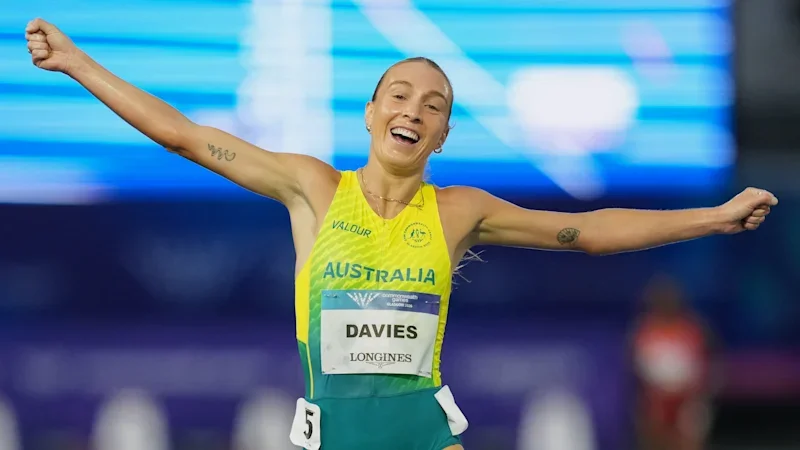
Glasgow: Rose Davies looked at the big screen and couldn’t work out how far ahead she was. She had taken the lead with two laps of the 10,000 metres to go, and she was flying.
But the screen was deceptive. Were her opponents closing? Had she gone too early?
“I was running scared. You know, anything could happen, and I had no idea where the girls were,” she said.
“I was trying to look on the big screen, but I was just going as hard as I could in the last 100 metres. But yeah, once I crossed the line, I was very happy.”
Davies became the first Australian to win gold on the Commonwealth Games track on day one of the athletics in Glasgow, the first Australian woman to win a gold medal in this event. She did so beating the two best runners from Africa – the continent that dominates distance running – Kenyan Diana Wanza and Rwanda’s Florence Niyonkuru. The pair just won gold and silver at the African championships in May.
With six laps to go, Wanza made a break on a clustered field and opened up a big lead. Davies didn’t completely let her go, but still Wanza had a tough 30-metre gap on her, while Davies’ move to keep Wanza in touch meant she also opened up about a 30-metre gap on Niyonkura at the head of the chasing pack.
Davies didn’t panic. She ground at the lead and, sensing Wanza tiring, she pushed with two laps to go and opened up a solid lead of her own. Not that she knew she had.
“She did make a pretty hard move with six laps to go, I think, and I knew it was a long way out. So I think I thought if I stayed relatively close I’ll be able to close the gap. And yeah, that’s what I did,” Davies said.
“I could tell she was slowing, but I wasn’t sure how much of a gap I had, and I knew that the race for third, they were coming too, so they could have finished really fast. So I was just still trying to run, you know, my race and run as fast as I could and finish strong.
“It was a funny race. It was very up and down, lots of surges. But yeah, I just stayed patient and backed myself in that last 600, and yeah, I’m happy I did.”
Davies ran 31:39.32, well ahead of Wanza who hung on for silver in 31:50.13 and Niyonjuru in third in 31:55.47.
“It’s huge. Like to beat anyone here is a hard thing, but yeah, I knew they were going to be hard to beat today, and they were probably the main competition. So I just had to stay calm and back myself in,” she said.
“That’s crazy [being the first Australian to win the 10,000m gold]. I’m so happy. I didn’t know that. I just found that out then. So that’s really cool,” she said.
A week ago the 26-year-old, who battled injuries early in her career, broke the national 5000m record when she came third in the London Diamond League. That day too she had to run down a leader, but unlike in Glasgow, in London she unwisely didn’t keep pushing but sat on the lead and was herself swamped at the line. She learnt from that.
“Instead of going past her [in London] I sat and I got kicked on in the last bit. So tonight I just tried to stay calm and when I saw she was slowing, I felt really strong. So I just thought, back myself in and go as hard as I could. And yeah, I’m stoked I did that.
“I feel like you have to back yourself in, no matter how fast other girls are. And I’ve been training really well, racing really well, so there was no reason why I couldn’t beat them. I just kept reminding myself that.”
Browning slams 100m qualifying rules
Earlier on the first day of athletics competition, sprint champion Rohan Browning slammed the 100m qualifying at the Games as “plainly unfair” and manufactured to get certain runners into the finals.
Runners with the eight fastest times in the first half of this calendar year have automatically been placed in the semi-finals without having to run heats.
Only the 17 fastest times in the heats will advance to the semi-finals in Glasgow. Ordinarily, the first two finishers in each heat, and then two or three of the next fastest runners across all heats, would advance.
“It’s an unheard-of progression. It’s extremely weird,” said Browning, an Olympic and world championships semi-finalist.
“I mean, it’s gusty out there. So when they just make up these rules about eight guys get to go through and the rest of the field goes through like on the time trial rather than, you know, first or second across the line, the reality is some heats will get better conditions than others. So I don’t know what’s going on.
“I think when you turn up to a championships, you’re prepared to run three rounds, and the reality is you’ve got to run hard for all of them. So, you know, I felt like I was running hard out there, even if it also felt a little awkward.”
Browning qualified for the semi-finals, placing second in his heat with a time of 10.24s.
“Of course, it’s not fair. Clearly, it’s not fair,” Browning said of the fact eight athletes had automatically advanced to the semi-finals without running a heat.
“Like it’s clearly been engineered to try to achieve a desired outcome. Whatever’s motivated that decision, I don’t know what it is or if it’s reasonable or not. But clearly, it’s not fair. I think everyone would agree on that.
“You would expect to [advance after automatically finishing second] but it’s possible that people might get a slow heat and nobody might go through from that heat.
“Look, at the end of the day, this sport is meritocracy at its finest. If you’re quick enough, you go through.
“So I suppose you could say those guys have earned their place through the season. In all likelihood, they’re probably the guys who are going to make the final, regardless. But you just don’t know … some guys might be injured, some guys might be out of shape.”
Further to Browning’s point, for the final heat of the morning, there was a big +3.9m/s tailwind which would make any time illegal, as far as records go. But there was no adjustment for the wind in any of the heats.
While all heats had some form of tailwind, most were only light, although that changed late.
Get around our Commonwealth Games coverage
- Safety fears: Runners told not to wear uniforms while training, after Glasgow violence
- Wiggle in the wild: Why the original red Wiggle is in the stands at these Games
- Comeback gold: Why Williamson’s win in the 100m breaststroke was extra special
Follow our coverage of the Commonwealth Games with live blogs covering every moment of the action from 6pm AEST daily.** **