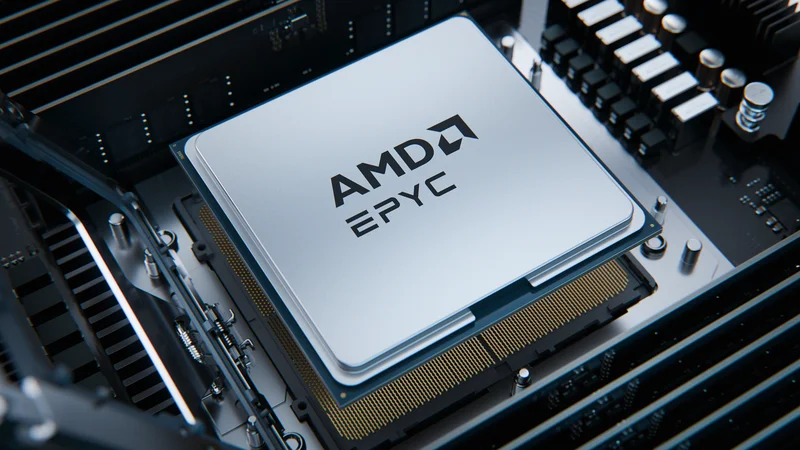
- AMD EPYC 9006 "Venice" offers mammoth 256-core, 512-thread configuration that incorporates up to 1GB of L3 cache and PCI-E 6.0 and 16 DDR5 memory channels under the hood
- It's the first time AMD's EPYC lineup sees high core count CPUs push past the 5GHz barrier
- AMD is claiming a win by stating that its newest EPYC CPU offers the "most agents per watt, per dollar, per rack"
AMD's newly-announced 6th Gen EPYC 9006 "Venice" seems to be a genuine silicon milestone (the first x86 server CPU on a 2nm-class node, up to 256 cores and 512 threads) which sees the company aim to secure its position in the AI data center CPU market.
The launch comes at a time when AMD has caught Intel on the back foot but finds its position threatened in turn by Nvidia's Vera CPU, which it touts as a faster, more efficient alternative to traditional x86 offerings, including AMD's own EPYC lineup.
With a staggered launch in place for the four CPUs AMD showcased at the AAI event, the stack is expected to be fully available to consumers sometime in 2027, even as its beefy 256-core CPU targets a Q4 2026 launch.
A massive upgrade on multiple fronts
AMD's Venice is a serious generational step. It is built on TSMC's N2 process, the foundry's first move from FinFET to gate-all-around nanosheet transistors, and Team Red says the family is the first high-performance computing product in the industry to reach volume production on the node.
AMD's recently announced flagship model, the 256-core, 512-thread EPYC 9996, features its new SP7 socket, offering 16-channel DDR5 memory, PCIe 6.0 support, and boost clocks that push past 5GHz.
This effectively doubles what is currently on offer for AMD's current-gen EPYC CPUs: memory moves to 16 channels of DDR5-8000, or MRDIMM at 12,800 MT/s, for roughly 1.6 TB/s per socket.
AMD goes one step further with the 9006X lineup (expected 2H 2027), which replaces the cores it cuts down on with a much larger L3 cache per core, a design that it touts makes it much better than rivals at workflows including HPC, technical computing, and data-intensive workloads, which benefit from the larger cache (and memory bandwidth) on offer.
“6th Gen AMD EPYC delivers workload-optimized compute for the full spectrum of modern data center needs; from running more agents and feeding GPUs across rack-scale AI infrastructure to powering the business-critical applications and services organizations rely on every day," noted SVP & GM of Compute and Enterprise AI at AMD, Dan McNamara.
AMD argues that the shape of the data center is changing into a three-tier agentic architecture, with each tier creating distinct CPU demand, which results in workflows centering around agent sandbox execution, AI host nodes, and general-purpose servers, all of which its EPYC CPUs are designed to handle.
The EPYC 9006 series also powers AMD's rack-scale Helios, as it aims to take on Nvidia's Vera Rubin NVL72 rack-scale offering with its own solution.
With AMD also offering a more mainstream 9006 SP8 and the EYPC 9006 LP as an AI host node CPU that uses LPDDR memory, it is aiming to capture all ends of the AI data center CPU market and cement its current lead in a segment that is sure to be increasingly competitive in the days to come.
Rahim Amir is a UAE-based tech writer who enjoys building PCs as much as he enjoys writing about them. He has been professionally writing about PC hardware since 2023, focusing on buyer’s guides, hardware reviews, and sponsored content and features related to tech.
Having built hundreds of gaming PCs and being an avid gamer in his spare time, Rahim tends to have stronger opinions about hardware than most. This is particularly on display when he gets his way with powerful, but minimalistic RGB builds even as Small Form Factor (SFF) PCs come a close second.