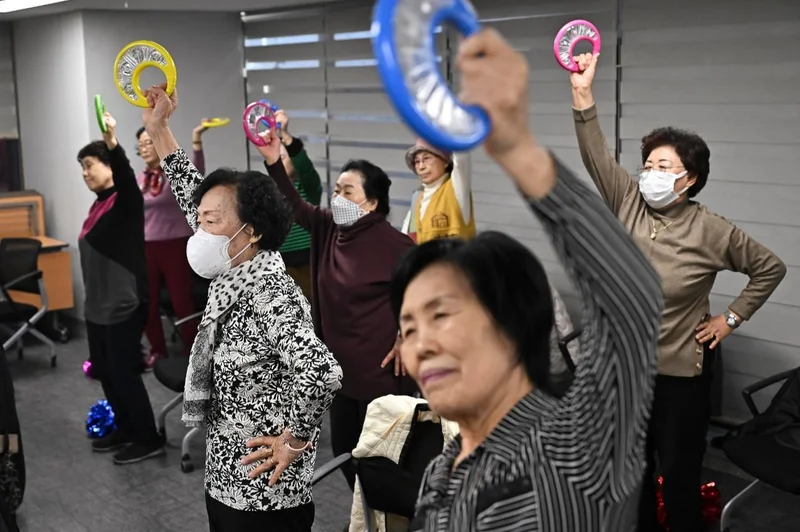
Korea’s population is aging faster than almost anywhere else in the developed world. More than 1 in 5 — around 11.25 million people — are now aged 65 or older, a demographic shift that is expected to propel the country’s silver economy from 72 trillion won in 2020 to 168 trillion won by 2030.
Yet one corner of that economy remains strikingly underdeveloped: senior living.
Unlike nursing homes, which are designed primarily around long-term clinical care, senior living communities combine housing with hospitality, wellness and social engagement.
“Residents are customers choosing a lifestyle rather than patients receiving care,” said Josh Rose-Nokes, head of Asia Pacific living research at Cushman & Wakefield.
While countries like Australia and Japan have built more mature senior living sectors supported by experienced operators and deep pools of institutional capital, Korea is still in the early stages of developing the asset class.
“On penetration, independent senior housing and retirement living provision in Korea sit at a fraction of 1 percent of the older population, against roughly 2 percent in Japan and around 8 percent in Australia,” he said.
The market that does exist is concentrated almost entirely at the premium end, targeting affluent retirees, leaving few options for the much larger middle-income segment.
For Rose-Nokes, that imbalance is precisely what makes Korea one of the region’s more compelling long-term opportunities. “It undoubtedly represents both a societal need and a substantial opportunity,” he said.
Demand, meanwhile, is also changing. Today’s retirees are entering their golden years with different expectations from the generations before them, reshaping not only what senior living looks like, but what residents are looking for.
“They’re approaching aging differently from previous generations. Many are healthier, wealthier and more socially active than ever before. Increasingly, they are not simply looking for a place to live, but for environments that offer wellness, hospitality, community engagement and convenience.”
That evolution is changing the competitive equation for developers and operators alike. The underlying real estate still matters. But so do community programming, dining, wellness services and social interaction — the day-to-day experience it delivers after residents move in.
“The sector is truly operational real estate … The ability to run a community well, with high occupancy, resident satisfaction, service revenue, staff retention and reputation are all key,” Rose-Nokes said.
Turning demand into supply
If demographics are driving demand, the next question is whether Korea can build a living market capable of meeting it. According to Rose-Nokes, that ultimately hinges on execution — namely, regulation, experienced operators and the policy consistency needed to unlock long-term institutional capital.
Encouragingly, he said, one of the sector’s biggest historical constraints has begun to ease.
“The 2024 Senior Residence Promotion Plan and subsequent reforms introduced rental-based ‘Silver Stay’ products, permitted assisted living-style communities and, critically, removed the requirement that operators own both the land and the building,” he noted.
That change may sound technical, but its implications are significant. Previously, operators had to own the underlying property themselves, making expansion highly capital-intensive and limiting participation by institutional investors. Separating ownership from operations opens the market to real estate investment trusts, private funds and other institutional financing structures that have long supported more mature senior living markets overseas.
Signs of interest are already beginning to emerge. In June, the National Pension Service said it had begun studying potential investments in the senior housing sector.
“A national pension fund investing in housing for the generation it exists to serve is liability-matching in the most literal sense,” said the APAC living research head.
What the country also requires is a larger cohort of specialist operators capable of delivering the level of service today’s retirees expect.
“Korea needs a broader pool of experienced operators with track records that institutional investors can underwrite. Building that capability will take time and may require partnerships with established international specialists.”
But above all, Rose-Nokes argues, the sector needs policy stability.
Institutional investors typically allocate capital over decades, not years. Frequent shifts in housing policy can create uncertainty that discourages long-term investment.
“There is a risk that frequent regulatory changes in Korea’s broader housing policy discourage investors, so a valuable thing the government could provide now is certainty, ideally through dedicated senior living legislation insulated from the broader housing-market cycle,” he noted.
For him, getting the regulatory framework right is ultimately what separates markets that scale from those that stall.
“The government’s job is not to build all senior housing; it is to make senior housing buildable,” he added. “For the mid- to upper-market sector, if the government sets clear and stable rules, private capital can do the rest.”
The question is no longer whether institutional investors will enter Korea’s living sector; they already have.
“Since 2023, global sovereign, pension and private equity capital has entered Korea’s senior, co-living and rental housing through platforms, conversions and portfolio acquisitions,” Rose-Nokes explained. “The key question now is how quickly Korea can scale institutional-grade opportunities and provide sufficient regulatory certainty to support long-term capital deployment.”