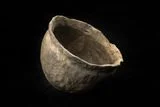
A field course out of the University of Florida meets in a patch of Gainesville woods each Friday of the spring semester, where students spend the afternoon scraping soil away one careful layer at a time inside marked-off dirt squares. Typically, what turns up are broken pieces of pottery. Earlier this year, students uncovered something that wasn't broken at all.
It was a small clay pot, still whole after roughly 400 years underground, compact enough to cup in one hand. Pottery that old rarely survives in one piece, usually worn apart by time, farming, or the decision to throw away something no longer wanted. This one raised a different possibility: that someone had placed it, intact, into a pit on purpose.
The site is Mission San Francisco de Potano, a 17th-century Spanish mission in northwest Gainesville that once served as a village of the Potano, part of Florida's Timucua people.
Gifford Waters co-teaches the field course and manages the historical archaeology collection at the Florida Museum of Natural History. Complete artifacts aren't new to him; shipwreck sites tend to preserve them well since so little disturbs the wreckage once it settles, but nothing like this had ever come out of a land dig he'd worked on.
“You don’t leave things behind that you can still use, so why was this purposefully put into a pit?” Waters shared in a press release.
Read More: Railway Excavations Uncover a 1,740-Year-Old Coin of Britain's Breakaway Roman Emperor
The History of Mission San Francisco de Potano
The Potano, part of the Timucua people, were living in the area near present-day Payne's Prairie and Orange Lake when armed conflict with Spanish forces drove them out in 1585.
A friar arrived roughly twenty years afterward to establish a mission among them, one piece of a much larger Spanish strategy that eventually placed more than a hundred such missions across Florida over the next century, aimed at cementing control over the region.
Population estimates put the mission village at a few hundred Potano residents at its largest, alongside a single resident friar representing the entire Spanish presence there. Use of the site ended around 1706, and it went unnoticed for more than two centuries until artifacts began turning up again in the 1950s.
Since 2006, researchers have pulled over 7,000 objects from the ground there, the bulk of them Native American pottery pieces, along with items like beads, tools, nails, and the remains of meals, turtles, freshwater fish, and turkey.
Why the 400-Year-Old Pot Was Probably Not Used for Cooking
Excavators found the vessel inside a Spanish-built structure. British raids intensified in the early 1700s, when records indicate a small detachment of soldiers was stationed at the mission. A gun sight and musket side plate found nearby have researchers considering whether the building served as a barracks.
The pot’s depth suggests it dates to the mission’s century-long history, though its design matches no style the team recognizes.
Its interior also lacks the charred residue left by repeated cooking over a flame. Surface scorch marks may date to its original firing or from being placed near a fire to warm prepared food.
Pottery at Mission San Francisco de Potano Reflects Trade and Migration
Not long after finding the intact pot, the students uncovered fragments of a much larger vessel nearby. Its rough surface and composition did not match local pottery.
It may have arrived through trade with communities around St. Augustine or present-day Jacksonville, or with a newcomer carrying different pottery traditions.
“During the later years of this mission, folks from different parts of Florida and Native Americans from different areas moved into and around the site. It’s really neat to see these differences and connections in the artifacts,” Waters said. “It shows both the persistence and change of traditions over time.”
The intact pot cannot name its maker, but the students could hold that person’s work four centuries later.
Read More: Charred Food in Ancient Pots Reveals Surprisingly Complex Prehistoric European Cuisine
Article Sources
Our writers at Discovermagazine.com use peer-reviewed studies and high-quality sources for our articles, and our editors review for scientific accuracy and editorial standards. Review the sources used below for this article:
- This article references information from Florida Museum of Natural History: Students unearth rare, centuries-year-old pot at local mission site