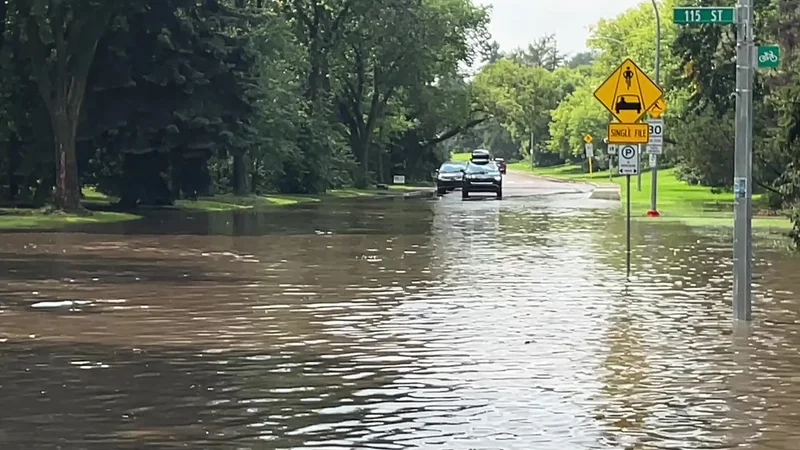
Another day, another storm.
Three waves of heavy rainfall doused the region Monday afternoon as a line of storm cells swept northeast across central Alberta.
Environment Canada said its meteorologists were tracking a cluster of severe thunderstorms capable of producing strong wind gusts, loonie- to ping pong ball-size hail and very heavy rain.
The first wave hit at 1 p.m. over south Edmonton and was moving northeast at 20-30 km/h. The second and third waves swept through over the ensuing hour and a half, dropping enough rain to turn roads into rivers and lakes.
Reports of flooding came in from across Edmonton: streets underwater in Belgravia and the University of Alberta area, as well as in newer neighbourhoods like The Alces in the far southeast.
Transit was also impacted after a tree fell on the Valley Line southeast tracks in the Strathearn area, halting the line between the Holyrood and Muttart stops.
The Edmonton Transit Service said bus replacement was running between Bonnie Doon and downtown; however, it was going slowly after flooding shut down the interchange of Connors Hill and 98 Avenue in the river valley.
The city said at 4 p.m. the Valley Line replacement bus service and Route 500X are on detour and are experiencing major delays. The city was working on finding an alternative option as soon as possible.
Buildings also flooded.
Get breaking National news
At 1:30 p.m., Service Canada updated its website to say the passport office at Canada Place in downtown Edmonton was closed due to flooding and water damage. No other details were available as of publishing.
Unprecedented summer of rain
Edmonton has experienced unprecedented rainfall this summer, the city said on Monday.
According to Environment Canada, the city has received a combined 511 millimetres of rain over June and July, which the city said is the highest volume since 1953.
Before Monday, 239.8mm of rain had fallen in Edmonton so far in July. It comes after a record-breaking amount of rain fell in June — over 260 mm — breaking a 112-year-old record.
The rainfall total for Monday afternoon’s storm is not yet known.
The typical monthly average in summer is between 70 and 80 millimetres, with an average annual rainfall of 423 millimetres.
The nearly two months of several storms a week have left the groundwater table so saturated that more runoff than normal is making its way into the stormwater system — which is struggling to keep up.
Last week, city-owned utility provider EPCOR said the region needs a lengthy stretch of dry weather to allow its stormwater system to recover.
Recent flooding has affected major routes, including underpasses on Yellowhead Trail and Whitemud Drive, and led to sinkholes popping up around the city.
Monday’s rainfall is the latest in what has been a month of nearly back-to-back severe thunderstorms, including one on Saturday night that dropped 30 millimetres of rain in about an hour.
That storm shut down Whitemud Drive yet again in west Edmonton, where excess rainwater turned the freeway into a lake under the 170 Street overpass.
Yellowhead Trail, Groat Road and Connors Road also flooded that night.
About 31,000 concert-goers attending the Post Malone show at Commonwealth Stadium were forced to take refuge in the concourse after fierce winds and sideways rain forced the concert to end early. Full refunds were given to all Saturday ticket holders.
The city said between Saturday evening and Monday morning, crews responded to 341 reports of broken, hanging and downed trees or branches and that work continues. Since July 1, crews have responded to 2,256 storm-related issues, including fallen trees and branches.
Edmonton Fire Rescue handled 252 calls for support from firefighters between 5 p.m. on Saturday and 6:30 a.m. on Sunday.
Saturday’s storm also forced the closure of Elk Island National Park, east of Edmonton, where Parks Canada said downed trees and flooding presented a danger to guests.