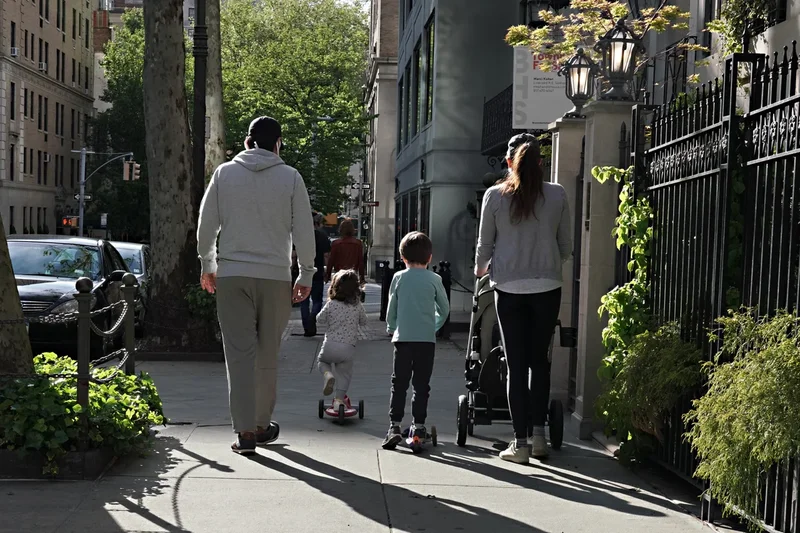
America’s biggest cities are seeing a drastic decline in the number of children living there due to falling birth rates, the cost of living and safety concerns, according to analysis.
The number of children under 18 living in major cities is down six percent in the past decade, compared with a one percent decline nationwide, according to the Wall Street Journal.
The drop is even steeper among families with young kids **— ** the number of children under 5 in big cities has fallen 15 percent, compared with a seven percent decline nationwide.
It comes as the number of births in the U.S. decreased by one percent last year, with more than 3.6 million births recorded, according to the Centers for Disease Control and Prevention.
Birth rates in large urban counties fell 18 percent between 2010 and 2024, according to an analysis by Connor O’Brien, a fellow at the Institute for Progress. It was the largest drop of any county type.
Aside from declining birth rates, big cities are also seeing families move due to concerns about costs, safety and quality of life, according to the WSJ.
San Jose, California, saw the number of children under 5 drop 34 percent in the last decade, the most of any large city.
Even relatively affordable cities are experiencing a decline. Albuquerque, New Mexico, for example, is seeing a 15 percent drop in the number of children, with about half of that figure due to more families leaving than arriving. And in Milwaukee, Wisconsin, the number of kids has declined 11 percent.
In New York City, the number of children is down eight percent over the past decade, the publication reported.
It could take about 65 years for a typical household living in New York City to afford a down payment of $265,000 on a home, according to an analysis released last month by retail mortgage lender Rocket Mortgage.
“Local home prices are driven by local incomes. In more affordable markets, buyers can accumulate a down payment much faster because home prices—and therefore down payment requirements—are significantly lower,” Chen Zhao, Redfin Head of Economic Research, said in a statement released with Rocket Mortgage’s findings.
Some cities are responding with childcare initiatives, but experts say it isn’t clear whether the policies will make a big enough impact.
New York City Mayor Zohran Mamdani is working on a free childcare pilot where about 40 kids of city workers, ages six weeks to three years, will receive year-round childcare during work hours at no cost to the parents. But his campaign promise of universal child care in the Big Apple still has a long way to go.
There are some big cities where the population of kids is growing.
Of the 38 cities with more than 500,000 residents that the WSJ analyzed, 13 saw a seven percent increase in children over the past decade while their overall population grew 12 percent.
Many of those cities were in the Sunbelt and are often affordable for middle-class families, the publication noted.