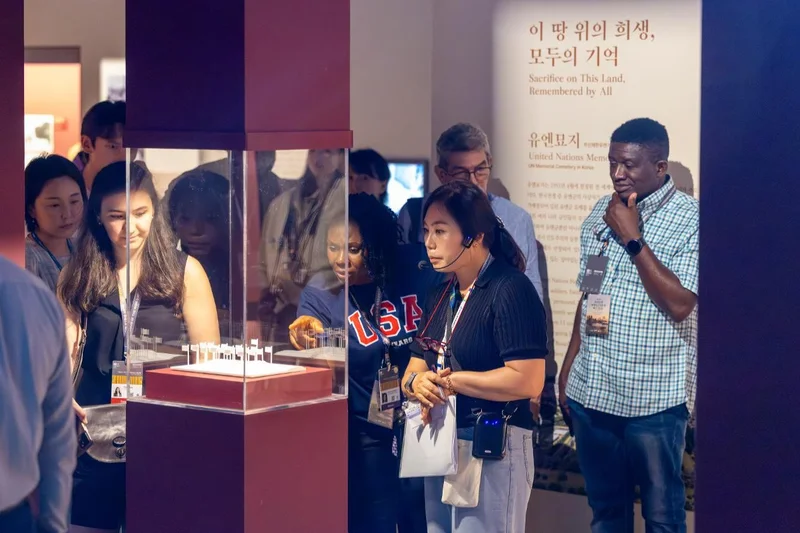
Delegates from the World Heritage Committee listen to a tour guide at the Busan Modern \& Contemporary History Museum, Tuesday. Yonhap
The Korea Heritage Service and the Korean National Commission for UNESCO unveiled findings from a joint research initiative on Tuesday, examining how heritage sites intersect with memory and conflict on the sidelines of the 48th session of the World Heritage Committee at BEXCO in Busan.
The event, themed "Unveiling Shared Pasts and Shaping Common Futures," drew roughly 100 attendees, including national delegations to the World Heritage Committee, UNESCO representatives and advisory personnel, and international heritage scholars.
The World Heritage Committee serves as the intergovernmental authority overseeing the UNESCO World Heritage Convention, which designates sites of exceptional global cultural or natural value.
Launched in 2024, the International Joint Research on Transnational Heritage project sees the Korea Heritage Service and the Korean National Commission for UNESCO collaborating with global experts. Together, they study cross-border histories, collective memories and the broader dynamics of conflict and reconciliation.
Lynn Meskell, a professor at the University of Pennsylvania, opened the session with her talk, "Weaponizing Heritage in 21st Century Conflict." She analyzed how heritage sites are wielded as strategic levers in diplomacy, security and global disputes, while outlining future frameworks for heritage protection.
Yujie Zhu, a professor at the Australian National University, followed with a talk on transnational heritage networks. He explored how museums can bridge fragmented memories and cross-border reconciliation efforts, particularly around memories of war, forced migration and historical trauma.
Laurajane Smith, founder of the Association of Critical Heritage Studies, moderated a panel discussion immediately after the presentations.
Choi Jae-heon, president of the Korean committee of ICOMOS — a UNESCO advisory body — joined the panel to highlight the role of transnational heritage in shaping World Heritage policy and fostering international cooperation.
The Korea Heritage Service noted that it plans to deepen collaboration with global scholars and institutions, reinforcing Korea’s leadership within the World Heritage community.
This article was published with the assistance of generative AI and edited by The Korea Times.