From failing O levels to a PhD in public health: How this NUS grad redefined success for himself
AI generated
SINGAPORE – At 16, Mervin Tee spent his school holidays packing toilet paper and sanitary pads into trolleys bound for Changi Airport.
A few months later, he failed his O-level exams.
“I thought of giving up studying altogether... I was the only one who didn’t make it out of school at that point in time, so it was definitely devastating.”
Two decades on, at 37, Tee holds a PhD from the NUS Saw Swee Hock School of Public Health (SSHSPH), where he researched cognitive decline using neuroimaging. Such research involves using scans to study changes in the brain that may aid earlier detection and improve understanding of the condition.
Between those two points lay a factory job, two food-chain shifts a day, a scholarship he almost did not apply for, a stint in social work and the determination to find a career that aligned with his values.
Tee grew up in a low-income household where his parents, who had no formal education, could offer little guidance on his academic path.
The arrival of his baby brother, just before his O levels, brought added strain: his mother, a full-time housewife, had a difficult delivery, which meant more caregiving duties at home.
This was on top of a household income of about $1,800 a month for a family of four. His father was the sole breadwinner, working odd jobs in the construction industry.
“I did not have a lot of support at home. I did not have tuition, and my command of English was not as great then,” he said.
He failed the exams, scoring an L1R5 of 38 and an L1R4 of 31.
With no place in a polytechnic or the Institute of Technical Education, and his family unable to afford another year of secondary school, Tee took a full-time job at an elevator manufacturing factory, assembling buttons for $3.50 an hour.
He rose at 5.30am and returned home after 8pm, squeezing in revision for a private retake of his O levels.
Asked whether he pressed on with his studies because he wanted to, or because he felt he had to, Tee said it was a bit of both.
Constant pressure
“There was this constant pressure, the need to at least get an education certificate,” he said.
“If I don’t make it, then that’s it... It was really that one last chance to see if I could make it anywhere.”
Part of the pressure came from watching his peers move ahead without him.
“My friends were all advancing in their education… and I was the only one who didn’t progress to either poly or ITE,” he said.
“There was a lot of comparing – my friends were everywhere, but I wasn’t going anywhere. So I asked myself, was I just going to be stuck in my life like that?” Tee added.
His second attempt at the O levels brought his L1R5 down to 18 and his L1R4 to 13.
When asked what led to the improvement, Tee said his mode of revision changed, and he also took subjects he felt he could do better in. For example, he took pure geography instead of combined humanities.
“I did a lot more practice rather than just forcing myself to remember,” he said.
He managed to secure a place at Republic Polytechnic (RP) to study Biomedical Science – a course he chose because of its reputation for hands-on learning. Tee had always been interested in science, a subject he was strong in.
Tee said the school’s problem-based learning format, where students come up with solutions to problems through independent research before teaching them to the class, helped him discover that he learnt better through application.
Poly life was also fully self-funded – Tee held down two jobs at McDonald’s and Subway, sometimes working 24 hours straight during public holidays for double pay. This was while he was also training with RP’s floorball team.
“That was when I realised I could push myself beyond what I thought were my limits.”
After polytechnic, Tee went on to complete his national service before applying to local universities.
He was offered a scholarship by Newcastle University, in collaboration with the Singapore Institute of Technology (SIT), to pursue a degree in food and human nutrition.
While at SIT, he held a part-time job in corporate communications.
He completed his degree in 2014 and did two research stints, first at Newcastle University and later at Nanyang Technological University (NTU), where he developed diets for patients with difficulty swallowing.
After spending about 2½ years in research, Tee slowly found his work increasingly disconnected from the patients it was meant to help.
Desire to help others
“I thought that maybe research is just not meant for me, and perhaps I could pursue something that I really want, to help people,” he said.
He then spent five years in social work, first mentoring at-risk youth, then supporting low-income families.
While doing social work, he started to pick up data science through online courses in his free time.
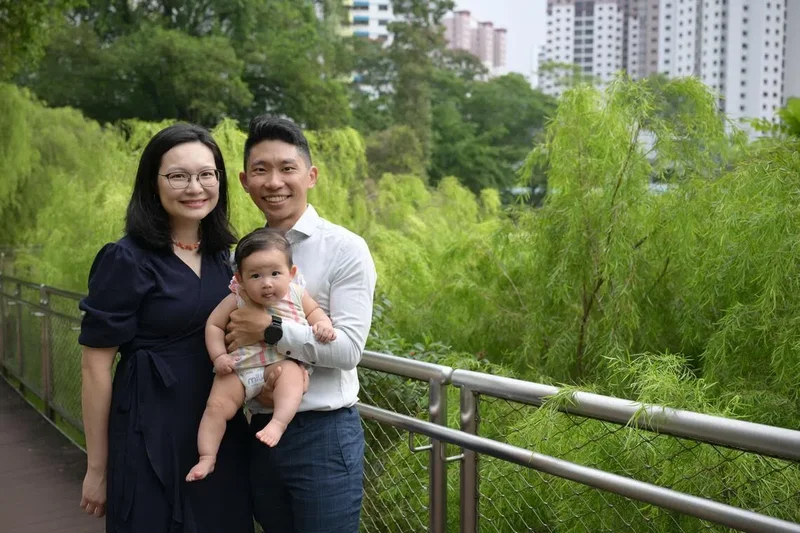
It was then that his wife, Cindy Chan, 34, a researcher at SSHSPH, encouraged him to return to research. This led Tee to take a leap of faith in 2022.
At SSHSPH, he enrolled in a PhD in cognitive decline research, a year after Chan had begun her own PhD on promoting healthy lifestyles among primary school pupils.
Determined to graduate alongside her, Tee completed his in three and a half years, ahead of the usual four years. The couple also welcomed their first child during their PhD studies.
Looking back at his 16-year-old self, Tee’s advice was simple: Do not stop trying just because others say it cannot be done.
“If you do not try, you may regret it later,” he said.
Tee will continue his research as a postdoctoral fellow at NTU, hoping to eventually expand into mental health research. Chan, meanwhile, plans to explore adolescent behavioural science.
His view of success, too, has shifted.
Having grown up in financial hardship, Tee said money mattered to him. He said he felt the pay cut keenly when he left research for social work.
But the shift changed how he saw success. “I realised that doing something more meaningful would still make me a happier person,” he said.
“(Success) is not quantifiable, like the way I used to perceive it. It is about what I have achieved that carries true meaning for me, whether in academics or in my hobbies.”