The rescue of downed American crew members of an Apache AH-64 attack helicopter last month off the coast of Oman by a Saronic Corsair unmanned surface vessel captured the world’s attention as a premiere example of human-machine teaming in a combat situation.
Uncrewed vessels, commonly known as drone boats, have long been a staple of Ukrainian tactics against Russian ships in the Black Sea and famously used with explosives. The drone boat rescue in the Middle East represented a change in sea drone tactics, raising discussions about how USVs can remove service members from harm’s way.
Yet drone boats have revolutionized sea warfare to such an extent that using them for surveillance, rescue missions and even as self-propelled sea bombs sells their potential short. Drone boats lend themselves to a wide array of tactics. They exist now in so many varied forms that they have already overtaken many of the traditional functions of larger surface warfare ships.
Modular Design Concepts
“The value of a USV is that you can constantly be iterating and innovating as quickly as technology is coming out, and then placing them and scaling them in a way that you couldn’t with larger fleets,” said Jim Harvey, chief technology officer at MARTAC.
The company produces unmanned surface vessels including the MANTAS T-12, which the Pentagon provided to the Philippine Navy in 2024. Its vessels feature a modular design capability that allow them to equip torpedoes and underwater vehicles, representing a trend defining approaches to USVs worldwide.
This month, the United Kingdom’s Ministry of Defence conducted an exercise with ACUA Ocean and Teledyne FLIR to launch a tethered unmanned aircraft system from ACUA’s Pioneer – a drone boat that resembles a floating platform and can launch various types of other drones into the air and underwater.
Rockets and Anti-Ship Warfare
Ukraine’s famous Sea Baby USV has also adapted to incorporate new capabilities. It can now carry FPV drones and thermobaric rockets. In a further expansion of the tactical role of drone boats, the U.S. Navy revealed this month that it used USVs in a large-scale sinking exercise this month.
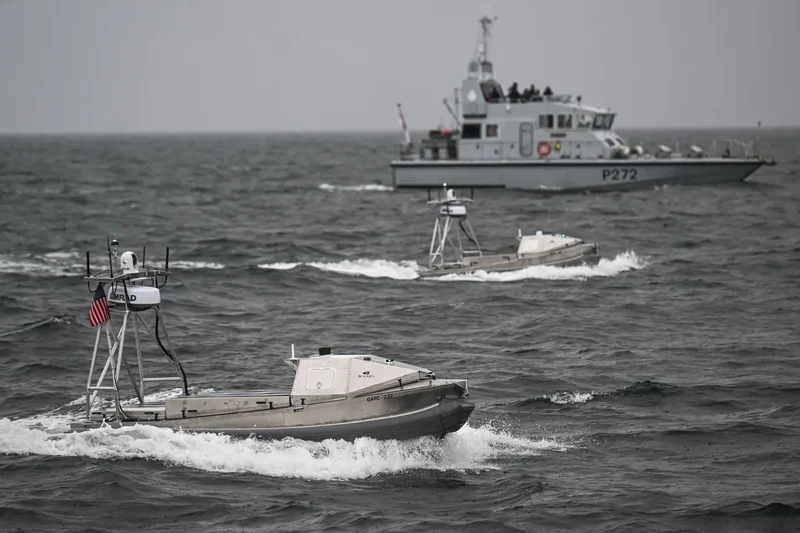
It was reported to be the first time that the Navy’s Global Autonomous Reconnaissance Craft (GARC) manufactured by BlackSea Technologies was used in a live-fire exercise. The Navy integrated the 16-foot USV into Baltic Sea exercises last June.
Recent military exercises conducted by the U.S. and NATO nations, in addition to evolution in the capabilities of drone boats, paint a clear picture of a changed sea warfare environment in which larger ships have already lost relevance.
Mobile Submarine Pens
Smaller autonomous vessels, in addition to being cheaper to manufacture than large surface ships, are now effectively functioning as small aircraft carriers and mobile submarine pens.
In addition to releasing unmanned aircraft systems of various sizes, they can tow and release a diverse array of unmanned underwater vessels and self-guided munitions. They can also conduct electronic warfare, including jamming, spoofing and signal disruption.
Eliminating the Need For Larger Ships
Currently, military forces worldwide are using drone boats in tandem with larger manned surface vessels. While it is unlikely that the need for manned surface craft will completely disappear, the rapid revolution of USVs and the range of tactics they are now capable of lend credence to the argument that the need for large surface fleets will disappear.
The hybrid fleet concept is already being overtaken by the pace of technology as functions of larger ships can now be farmed out to drones at minimal human risk and the reach of surveillance and firepower at sea has vastly expanded.
The potential of sea drone technology extends far beyond functioning as munitions or as rescue vehicles, although those purposes are militarily necessary. As drone boats become multipurpose assets, military forces must change the way they view war at sea to ensure that new tactics maximize the potential of new leaps in technology.