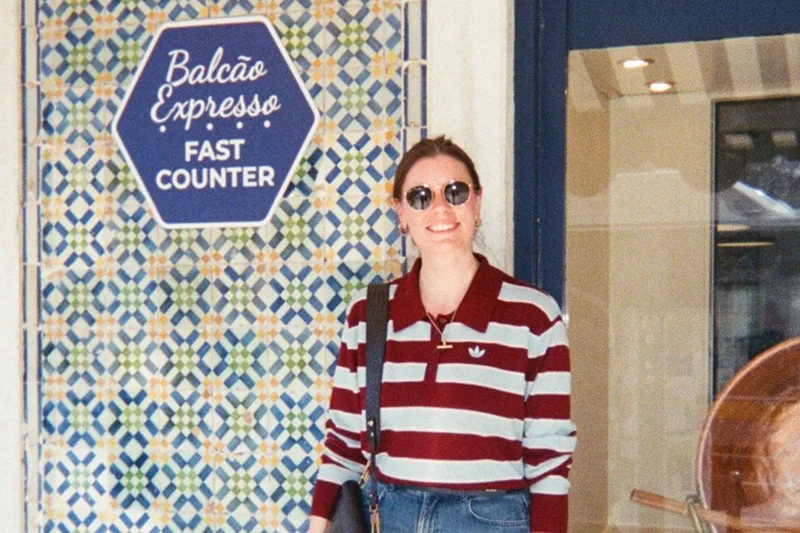
I have almost 120,000 photos on my phone, dating back to 2011. It sounds like an insane amount, though not unusual for a millennial like me, who grew up in tandem with ever-improving camera phones and has a deeply rooted fear of losing my digitally captured life.
Now, I’m as tired of the digital admin of safeguarding my photos as I am of my snap-happy habits. I decided to try the trend flooding my Instagram declaring 2026 as “the year of analogue” – an irony not lost on me – and use a film camera for my trip to Lisbon with my friend Rebecca.
Gen Zers are popularising film photography again in their search for offline activities, and research shows the wholesale film market grew by 127 per cent between 2020 and 2026, with more than 300 new film labs opening globally to keep up with demand.
Famed for its miradouros (viewpoints), bright yellow trams and pretty azulejos-clad (glazed patterned tiles) buildings, I imagined Lisbon would translate beautifully onto film. I hoped going analogue would make me more thoughtful about what I chose to capture from my travels.
Read more: Where to stay in Lisbon’s city centre
To do it, I ordered a simple and cheap 35mm reusable plastic film camera, but over two weeks later, it still hadn’t arrived. Instead, rather resentfully, I picked up a Fujifilm disposable camera from Argos. It meant I had just 27 shots on one film instead of the three films I’d ordered. With a limited number of pictures available, I really had to think about what I was going to capture.
After dropping our bags off at the hotel in the artsy Santos neighbourhood in the early afternoon, our first stop was nearby natural wine bar, Insaciável, for wine and small plates. While roaming Santos' pretty streets with colourful tiled villas and the pretty pastel-pink Church Santos-O-Velho, I was already regretting not having two disposable cameras.
The following morning, we hopped on the Tram 28 and headed to one of the city’s miradouros, Jardim Júlio de Castilho in the historic centre. From the high vantage point, I took one of the trip’s best photos; overlooking the Tagus River, where the sky’s electric blues faded to a light pastel blue and contrasted the reddish rooftops. It looked like a painting.
As I listened to a group of musicians perched on the wall of blue and white azulejos, beneath a pergola covered in bougainvillaea yet to bloom with the river behind, I wished my camera had the ability to do video too.
Instead I soaked in the moment among the growing crowd. The singer had wonderful gravelly harmonies as she strummed the guitar, and a man played the flute while another tapped the cajón he was sitting on and the drum in front of him.
Later, we walked down to the Rua Augusta Arch that commemorated life after the city’s 18th-century earthquake. It’s flanked by the Praça do Comércio’s sunny Lisbon-yellow buildings – and a blue sky backdrop made it another one of my favourite photos.
Near the water’s edge of the Praça do Comércio square, a man was feeding seagulls, and I thought it would be a great photo, so I clicked the button on my camera again.
That afternoon, I wanted to stock up on conservas (tinned fish), which Lisbon has many shops dedicated to. In Loja Das Conservas, more than 300 varieties of colourful tins line the walls, with different shapes and bright packaging. It was a great shot in my mind, but it came out very dark. I’d also tried to cut out the staff member on the left – not so easy to do without using the crop tool on your phone.
The next day, we headed to the region of Belém to eat Pastéis de Belém’s delicious custard tarts, where I realised mastering food photography with film isn’t easy.
Read more: An insider’s guide to the perfect spring break in Lisbon
At nearby Belém Tower, I managed a selfie with the landmark behind, but hadn’t accounted for a passer-by coming into shot and ruining it.
By now, remembering to use my camera had become second nature. But I wish I’d been able to take more abstract photos and close-ups of the many beautiful tiles. I did notice that I was appreciating the slower pace with this simple camera, as I really needed to look closely in the tiny viewfinder to get my subject lined up.
Heading back to the centre via the modern trams, we stopped off at the LX-Factory in the Alcântara neighbourhood, a former textiles factory turned creative hub. I tried to photograph the wall of books inside Ler Devagar bookshop, where the industrial-looking metal staircases appeared almost suspended mid-air. My photo is unintentionally moody, despite using the flash.
I began to realise that I'd quickly forget what I’d taken a photo of, as I was unable to scroll back through a digital camera roll, à la iPhone. And with such precious few snaps available, it felt a shame to potentially repeat any – but then again, I did want my own shot of the iconic mustard-yellow Tram 28 on the city’s steep roads.
To try and get it, I perched on the smooth steps of the Church of Saint Mary Magdalene, at a three-way crossroads traversed by many of the old trams while eating my lunch; a hefty bifana – a bread bap stuffed with slow-cooked shredded pork and topped with mustard. These photos, once printed, were blurred, probably due to me moving too quickly in my excitement while holding my food. Though they still tell a story – one of me trying to get a perfect shot.
We finished the day walking up and down the cobbled hilly streets of Rua da Bica de Duarte Belo to find the famous yellow funicular. Rebecca and I took some photos of us next to it.
As much as I loved my return to film, it’s an expensive hobby. The camera and development cost just under £33. And it’s risky – I had four blanks, while only a few of my photos were perfect. Though it did make me realise how many of my adventures are seen directly through a screen, and reminded me how analogue photography can be tangible and intentional – all elements of travel that are being ebbed away in our digital world.
Being forced to slow down and having a time-lapse between the trip and receiving my photos made it clear that the photos were the real souvenirs of my trip.
Read more: The best hotels in Lisbon
Where to stay
As Janelas Verdes Inn – in the quieter and slightly bohemian Santos neighbourhood – is easily walkable to trams and the main sites.
How to get there
EasyJet’s direct flights to Lisbon take around two hours 45min from the UK’s major airports.