- Published
A conservation project in County Tyrone says it has been making progress tackling an invasive species that has been described as the UK's "most dangerous plant".
Giant hogweed contains a sap which can leave painful blistering and scarring when it comes into contact with human skin.
The plant can grow up five metres high, and it is usually found in places with damp soils, such as riverbanks and coastal areas.
The Ballinderry Rivers Trust said they have identified and have been treating a source of giant hogweed just outside Cookstown.
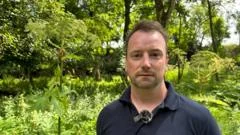
Peter Mitchell from the organisation said they have been concentrating on areas in and around Drum Manor Forest Park, close to the Ballinderry River.
He said: "Thankfully we're now able to manage it keep it at an absolute minimum around Drum Manor, and that is a success story and we've been working successfully with local angling clubs to raise awareness.
"But the reality is it has also spread miles further down the Ballinderry River and keeping on top of that is a monumental task."
There are more than 2,500 sites across Northern Ireland, external where giant hogweed has been recorded and confirmed.
Stormont has set a target for all landowners who have the plant on their land to reduce its distribution throughout Northern Ireland by 50% before 2030.
Meanwhile new figures obtained by BBC News NI show that there are more than 500 giant hogweed enforcement cases being pursued by the Northern Ireland Environment Agency.
Peter Mitchell added: "It's a particularly nasty plant that you don't want to get close to and unfortunately, it's fairly prominent here in Mid Ulster.
"We've traced it to two water tributaries coming out of Drum Manor, so you can actually see the source of it coming in just above Cookstown, spreading down the Ballinderry River and as far as Lough Neagh."
'I'll never forget it'
Sean Devlin is a member of Mid Ulster Angling Club.
He has been fishing on the Ballinderry River for more than 60 years and has firsthand had experience of the effects of getting too close to giant hogweed.
"I'll never forget when I was a young lad, I was down at the riverbank and I got the plant all over my hands and arms, because I didn't know enough about the dangers at that time.
"I initially felt a small tingle, it wasn't like a nettle where you get the full sting immediately, it wasn't until later, especially when I was the sun with it that I really felt it on my skin.
He added: "I ended up covered in these large watery blisters the whole way up my arm, I'll always remember the pain of it."
He urged anyone who sees it not to handle it and keep well away from it.
Esmée Gummer is a long distance runner who is currently taking on a 5,000km challenge across the UK over a 99 day period.
The English runner was once told she would never walk again after complications following surgery when she was 18 years old.
She had to re-learn to walk and as part of her latest challenge is hosting a free 5k in every city she visits.
Earlier this month while running in Northern Ireland she had to cope with blisters on her legs caused by exposure to giant hogweed in Scotland.
She said: " I woke up one morning with these welts on my knees and I carried on running, I remember going to bed that night and woke up in agony.
"My knees were on fire and all these blisters began to form, I've never felt a pain like it."
'The pain was indescribable'
She added: "Thankfully one of my friends who is a doctor came to my aid and bandage my legs up, but running through the pain was extremely tough.
"I had really intense pain for about 10 days, particularly at night after running all day, the pain was indescribable, it was like fiery pain."
Gummer says the support she received from people across Northern Ireland helped her run through the pain caused by the giant hogweed burns.
What is giant hogweed?
Giant hogweed is a toxic plant.
The plant itself originates from Asia.
The invasive plant has been present in Britain and Ireland since the early 19th Century.
It was first introduced as an ornamental garden plant used primarily in large stately homes, but it subsequently escaped into the wider countryside.
It is now associated with river corridors and lake margins in all counties of Northern Ireland.
It contains a sap which irritates skin when it is exposed to sunlight and can cause blistering and swelling.
Symptoms are usually noticeable within 24 hours and may be made worse by over-exposure to the sun.
The plant, can grow up to 14-15ft (4.5m) tall.
Government advice around contact with giant hogweed is to cover any affected skin immediately, wash with cold water and avoid exposure in the sun.
The Northern Ireland Environment Agency (NIEA) advises anyone who is concerned about giant hogweed to report it through its official monitoring system or the apps iRecord or iNaturalist.
A spokesperson for NIEA said: "Each record is followed up, with landowners being informed of their legal responsibilities to put immediate management measures in place."