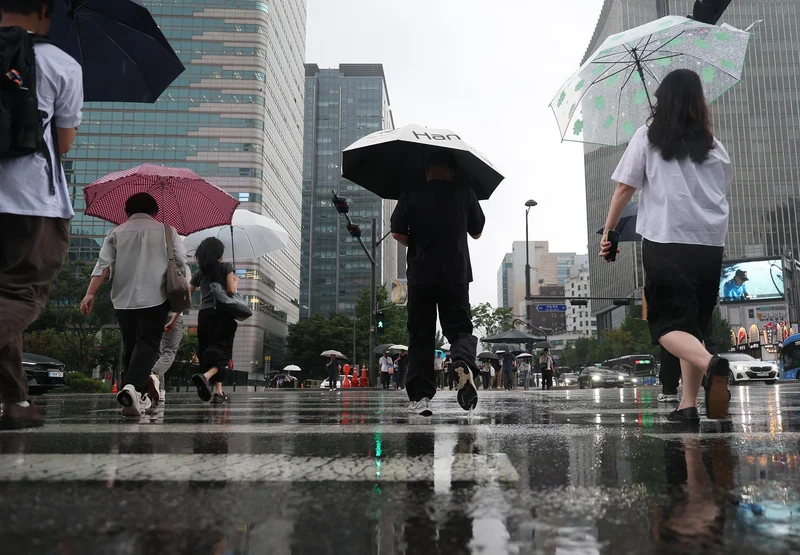
When 57-year-old construction day laborer Kwon Jae-hyuk tuned in to the weather forecast last Monday evening, the report warned that a powerful rainstorm would sweep across Seoul the following morning, bringing 30 to 50 millimeters of rain per hour.
Knowing that construction sites shut down in such severe weather, Kwon decided not to work. But the next morning brought only a light drizzle of no more than 3 mm per hour, leaving him frustrated.
“I decided not to work because the forecast said it was going to pour, with as much as 50 millimeters of rain per hour, but all we got was a trickle,” Kwon said. “For day laborers like us, inaccurate forecasts like this are infuriating.”
The same frustration resurfaces every summer, as complaints pour in over inaccurate forecasts from the Korea Meteorological Administration (KMA). Summer weather has always been difficult to predict because of atmospheric instability, but the KMA says forecasting has become even harder in recent years for a more fundamental reason: Climate change is making the atmosphere over Korea increasingly unstable, while sudden, highly localized downpours have become an almost daily occurrence.
One of the most notable departures from past weather patterns is the increasing frequency of extreme downpours concentrated over narrow areas. These highly localized downpours can create wide variations in rainfall even within the same forecast zone.
On July 20, the KMA forecast that Seoul, Gyeonggi Province and Incheon would receive between 30 and 100 mm of rain the following day. It also warned of torrential rain reaching 30 to 50 mm per hour in the morning and 20 to 30 mm per hour in the afternoon.
But the rain was concentrated in only a few parts of Seoul. Maximum hourly rainfall reached 47 millimeters in Eunpyeong District and 43.5 mm in Guro District. In Gangdong and Gangnam districts, by contrast, it topped out at just 3.5 mm, a difference of more than tenfold.
That day, the rain was concentrated in the western part of the capital region, with daily totals reaching 74 mm in Eunpyeong, 60.5 mm in Guro, 72.5 mm in Paju, Gyeonggi Province, and 69 mm on Ganghwa Island in Incheon. Gangdong and Songpa districts, meanwhile, received only 17 mm.
Timing was another problem over the Constitution Day holiday. The KMA forecast rain in the capital region on both July 18 and 19, but the rain had stopped by the morning of July 18.
But the problem goes beyond any single inaccurate forecast. The atmosphere is more unstable in summer than in other seasons, making it difficult to predict precisely when and where rain will fall. The KMA’s accuracy rate for predicting whether precipitation will occur, known as ACC, remained at around 95 percent from January through March this year before slipping to 89 percent in June.
“In summer, rain clouds do not develop evenly across a broad area. Instead, cloud bands are patchy and riddled with gaps,” a KMA official said. “Even within the same rain band, one area may receive less than 1 mm per hour while another gets 80 mm.”
Forecasting is further complicated by how quickly summer rain systems can form and dissipate.
“Mesoscale precipitation, in which small rain clouds less than 100 kilometers wide produce rain, is common during summer,” said Jang Eun-chul, a professor of atmospheric science at Kongju National University. “Because these systems have such short life cycles, from formation to dissipation, numerical weather prediction models often struggle to capture them when forecasts are generated.”
Another factor blamed for inaccurate forecasts is the overly broad grouping of forecast areas. The KMA typically issues forecasts for large zones such as the capital region, encompassing Seoul and its surrounding cities, or the central region, which covers the capital area, the two Chungcheong provinces and Gangwon Province.
When rain is concentrated north of the Han River, residents south of the river are more likely to feel that the forecast was wrong.
But providing geographically specific forecasts for each of Seoul’s districts is currently impossible, according to the KMA.
“No numerical model currently available anywhere in the world can produce reliable forecasts for each individual district,” a KMA official said. “Simply increasing the resolution would also have the adverse effect of slowing down the forecasting process.”
Experts favor broader forecast areas because they help prevent flood damage and thereby serve the fundamental purpose of weather forecasting.
“It is better to issue rain warnings across a wider area, even if some places end up receiving no rain, than to exclude areas that later turn out to be at risk,” Jang said, stressing that the primary purpose of weather forecasts is disaster prevention.
Ha Kyung-ja, a professor of atmospheric environmental sciences at Pusan National University, agreed that breaking forecasts down by district or neighborhood could lead to even greater damage when predictions prove wrong.
Her reasoning was that it is safer to forecast 100 mm of rain across Seoul than to predict 100 mm in Gangnam District and 30 mm in Songpa District, only for the rain band to shift unexpectedly and dump 100 mm on Songpa instead.
Meanwhile, the KMA said this summer’s monsoon season officially ended Saturday in southern Korea and Sunday in the central region.
The agency forecast that extreme heat approaching 40 degrees Celsius would persist beginning this week, particularly across Gwangju, South Jeolla Province and the Gyeongsang provinces.
This article from the Hankook Ilbo, the sister publication of The Korea Times, is translated by a generative AI system and edited by The Korea Times.