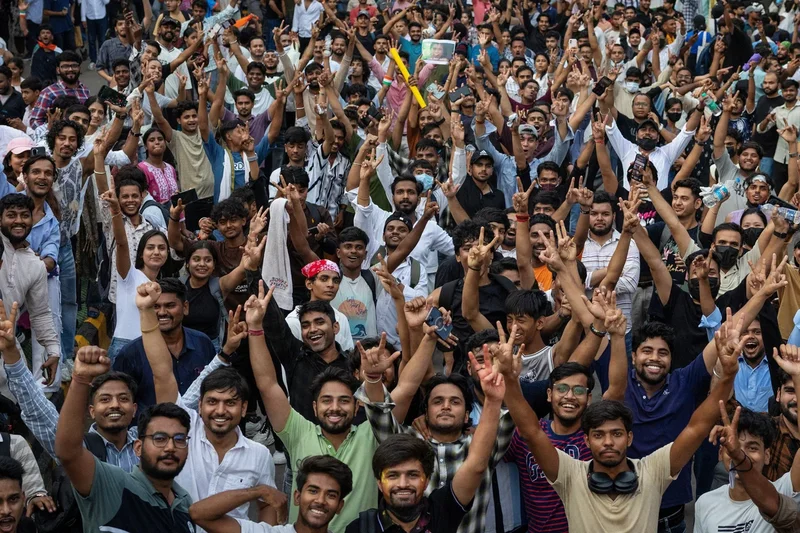
Members of a popular, youth-led mass movement against one of Narendra Modi's ministers have threatened to renew their agitation if all the people arrested by the police for showing up at the protests are not released.
The Cockroach Janta Party’s (CJP) months-long demonstration in the national capital of Delhi forced the country's education minister, Dharmendra Pradhan, to resign in a rare victory for mainly Gen Z protesters and setback for Mr Modi’s government.
Thousands of students joined the “cockroach” party's call to protest at Jantar Mantar, while in other parts of the country people poured onto the streets demanding accountability from the Indian government following a series of entrance exam paper leaks that affected millions of students.
The party on Monday warned the Modi government against backtracking on their promise that that no punitive action would be taken against protesters in states ruled by the Bharatiya Janata Party (BJP) that governs at the national level. CJP said they had received reports of students held in detention in the eastern states of Assam, West Bengal, and Bihar.
Saurav Das, a spokesperson with CJP, said the nationwide protests were called off on Saturday after the Modi government "assured us that no punitive action would be taken against any protester, either now or in the future".
But more than 100 people were arrested across the country following the protests, with many of them named under non-bailable charges, the party said.
Members of the CJP and the Indian government held three rounds of talks before announcing Mr Pradhan's resignation. The CJP subsequently called off their agitation.
The CJP said the BJP government in West Bengal was "targeting a particular community", while in Bihar "excessive police brutality was seen in Siwan, Patna and Chapra". A Bihar police officer was suspended for firing rounds in the air from an AK-47 assault rifle to disperse student protesters.
“If the government does not honour the agreement and release everyone detained or arrested, we will be compelled to resume the protest,” said Ashutosh Ranka, a spokesperson with the party.
Members of the All India Students Association (AISA), who took part in the Jantar Mantar protests, separately met the Bihar police chief and threatened to renew the agitation if protesters were not released.
The Bihar police late on Monday evening said “no adverse legal action” would be initiated against any protester and announced withdrawal of all cases filed before 6pm local time on Sunday.
The Assam government has also withdrawn cases and released those arrested during the agitation, AISA announced.
However, the West Bengal government filed fresh cases on Monday for display of "offensive posters" at a rally held last Friday, which saw the participation of hundreds and thousands of people. The state police have so far arrested 16 people, most of them Muslims.
A police complaint has been filed against actor Sreelekha Mitra for holding a cartoon of prime minister Modi at Friday's rally, while another person has been arrested for posting an "objectionable picture" featuring the Indian leader.
The Delhi police have reportedly begun a crackdown on alleged abusive social media posts targeting Mr Modi and asked three social media platforms to remove posts laced with "objectionable language and offensive remarks", according to reports.
"An exercise to identify such content across different social media platforms is already underway," an unnamed official told PTI news agency.
The youth protest was fought both on the streets and online, with Instagram flooded with reels and memes mocking the prime minister. Several journalists, politicians and social media users have claimed that their posts criticising the government have been swiftly removed by the platform.
The Independent has reached out to Meta for comment.
The CJP on Monday said it had set up a legal fund to help meet the expenses of protesters implicated in criminal cases by the police.
The education minister's resignation marked the first major concession from Mr Modi’s government in almost 12 years after the youth movement spearheaded by the CJP emerged as one of the biggest challenges to his office.
The protests were triggered by the leakage of question papers for a national medical college entrance exam in May, taken by more than 2 million students, forcing a re-test.
A violent police crackdown on 20 July, which saw the use of brute force, tear gas and pellet guns on students, galvanised the protest into a nationwide movement against the Modi government.
Chief Justice of India, Surya Kant, criticised the excessive use of police force on students, adding that the right to protest peacefully was guaranteed by the Indian constitution.
"So long as there is a peaceful agitation, merely because there is an agitation, there can’t be excesses," he said.
The CJP was founded by Abhijeet Dipke, who studied PR in the US, in response to disparaging remarks made by Mr Kant likening some young people to cockroaches.