NUS rare collections, research papers to be made searchable through new AI chatbot
AI generated
SINGAPORE - Insights from Singapore’s first Chinese daily newspaper Lat Pau, launched in 1881, and a literary collection by a Tang Dynasty writer will soon be accessible through simple prompts, with the rollout of a new artificial intelligence platform developed by the National University of Singapore (NUS).
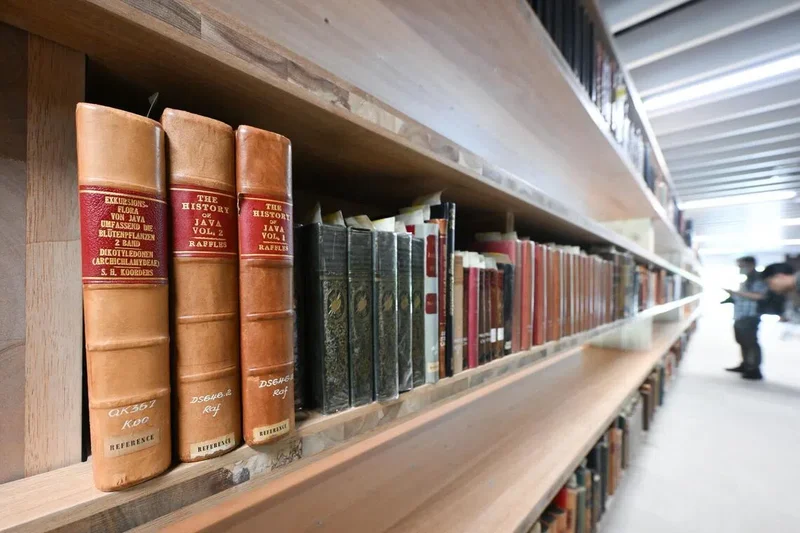
These hidden gems are part of a vast repository of 150,000 rare collections and internal research papers digitised to train its platform, called AI Sense Maker, which will launch in August for NUS students, faculty and alumni.
Designed to support students and researchers in academic inquiries, AI Sense Maker can understand questions in natural language and reply with topic summaries, sources, related concepts and a list of references for further reading.
Announcing the launch on July 28, NUS University Librarian and Associate Professor Natalie Pang, said that the tool aims to shorten research discovery timelines from an average of two weeks to around 30 minutes.
Source credibility is also a major issue that the tool aims to address for those in higher education.
“One of the problems with many popular AI tools is they may not always be actually using credible, trusted sources... In higher education, we want to make sure that students are using AI in a way that enhances their learning,” she said.
The internal research papers published by NUS are in the fields of engineering, life sciences, medicine, humanities and computing, while the rare collections on humanities, social sciences, natural sciences and medicine in South-east Asia date back to the 17th century.
Some highlights include Lat Pau, the first Chinese daily published in the Nanyang region, and the first printed edition of Sir Stamford Raffles’ memoir on the History of Java published in 1817.
Original musical compositions and scripts belonging to beloved entertainer Wang Sha will also be digitised and included in AI Sense Maker’s knowledge base.
The platform is powered by OpenAI’s large-language model GPT 4.1, and uses retrieval-augmented generation to ensure that it does not falsify answers, and only produces results based on its database of sources.
Guardrails are included to prevent the AI tool from searching the public internet to generate a response to users’ prompts.
The system has limitations. It currently supports one-off queries.
But NUS said it is working on an upcoming feature to remember chat histories to allow users to hold longer conversations with follow-up questions. Another upcoming feature is voice-to-text transcription.
One of the key features of AI Sense Maker is a knowledge graph, which shows how ideas and themes gleaned from the user’s question and answers are linked to each other.
For instance, responding to a query on why some neighbourhoods in Singapore feel hotter than others, the AI tool cited building density, lack of greenery in urban environment, surface materials used and the presence of water features as related factors. A knowledge graph to support this query shows urban ecology, environmental science, atmospheric physics and microclimatology as related themes.
The knowledge graph aims to boost the initial phases of research work, said NUS chief IT officer Tan Shui-Min. “AI Sense Maker is able to return cited answers, which can map concepts across different disciplines. Because of this, themes and gaps will become visible to the researcher.”