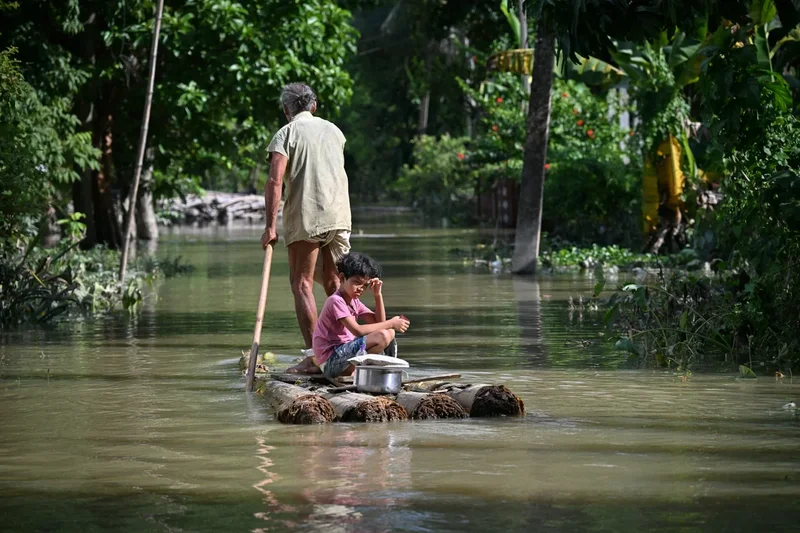
At least 68 people died and more than 700,000 were affected due to floods that inundated hundreds of villages and drove tens of thousands into relief camps across the Indian state of Assam.
Assam, a tea-growing state in India's remote north-east, is crossed by the Brahmaputra, one of Asia's largest rivers, which swells each monsoon and regularly bursts its banks.
This year the flooding has been unusually severe in the state's east, where the death toll rose to 68 by Monday, according to local reports, though official figures issued over the weekend put it at 66. Authorities have warned the number could rise further.
At its peak, the flooding affected around 700,000 people across a dozen districts, submerging more than 800 villages, the Assam State Disaster Management Authority said. By Tuesday the waters had begun to recede and the number of people affected had fallen to about 445,000, according to the news agency PTI.
The district of Sivasagar has been the worst hit, followed by Charaideo and Jorhat, all in the east of the state near the border with Nagaland. Officials have attributed the disaster to a sudden, intense burst of rain, known as a cloudburst, over Nagaland in mid-July, which sent water rushing down into Assam's low-lying plains and overwhelmed rivers already swollen by the monsoon.
The state's chief minister, Himanta Biswa Sarma, described the situation as "very, very pathetic" and said parts of the state had been left in a condition beyond description. He said many residents of Sivasagar and Charaideo were unaccustomed to flooding and had been caught off guard.
"People in Sivasagar and Charaideo are not familiar with floods, and were caught unawares," Mr Sarma said, according to the Assam Tribune.
"The character of the calamity has changed. We need to prepare ourselves for such events in future."
Rescue teams from the army, air force and national and state disaster response forces have been deployed, evacuating stranded residents by boat from areas cut off by the water.
Mr Sarma said road links to some of the worst-affected areas had been severed, leaving tens of thousands of people beyond reach. Efforts to drop supplies by helicopter and drone had failed because the packages burst on landing, he said.
More than 180 relief camps and distribution centres have been set up, sheltering tens of thousands of people. Officials said rice, lentils and salt were being handed out in the worst-hit areas, and power, which had been switched off as a precaution during the floods, was being restored in stages.
The floods have devastated farmland in a state where most people depend on agriculture. More than 35,000 hectares of cropland were left underwater, and hundreds of thousands of cattle and poultry were affected, with thousands swept away. In one village in Sivasagar, a resident, Mitali Gogoi, said her home had been inundated within hours overnight.
"The floodwater inundated our house within hours last night. We didn't even get time to move our belongings," Ms Gogoi told the news agency ANI. "We don't have proper food or drinking water. We collect water from flooded roads in bottles because there is no other option."
Deadly floods return to Assam almost every year during the monsoon, which runs from June to September and brings most of India's annual rainfall.
In 2024 the state's flood season killed more than 100 people and affected millions. Scientists have warned that a warming climate is making such downpours more intense and erratic, while deforestation and building on flood plains leave more people exposed.
The opposition Congress party called for immediate central government assistance for the affected families. Its president, Mallikarjun Kharge, said almost a million people had been affected over the course of the flooding and urged that compensation be provided for every life, home and livelihood lost.