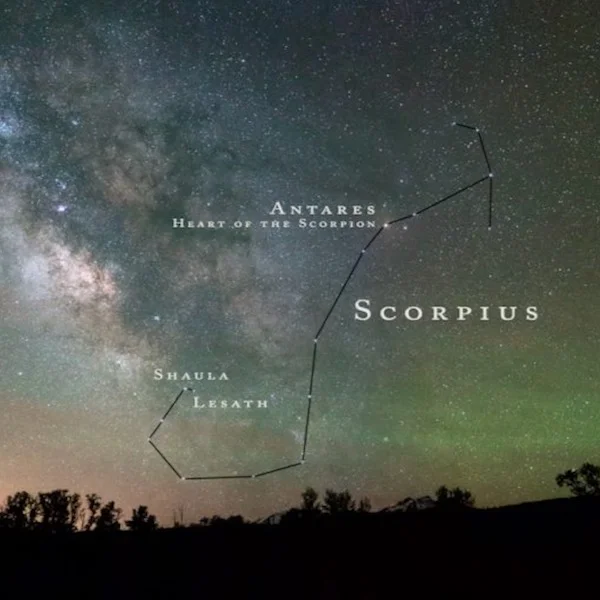
Scorpius and the Scorpion’s Stinger stars
The zodiacal constellation Scorpius the Scorpion is one of the few constellations that truly looks like its name.
That’s because it has a graceful, J-shaped pattern of stars resembling a real scorpion’s curved tail. And at the end of this line of stars are two stars noticeable for their nearness to each other. They are Shaula and Lesath. Together, these stars represent the Scorpion’s Stinger.
Although Shaula and Lesath appear close together, they’re only close along our line of sight. In reality, these two stars are separated by about 5 light-years.
Shaula, the second brightest star in the constellation Scorpius, is a triple star system that shines at magnitude +1.62.
Lesath, the fainter star of the Stinger pair, doesn’t have any known companions. Its magnitude is +2.7.
In addition to being known as the Scorpion’s Stinger, these two noticeable stars are sometimes called the Cat’s Eyes. That’s because if you look at them through binoculars, they resemble the eyes of a cat in the dark.
How to see Shaula and Lesath
Scorpius is thought of as a summer constellation in the Northern Hemisphere, as that’s when it’s highest in the sky. And in the Southern Hemisphere, it’s considered a winter constellation. But it’s also visible in early northern autumn, or early southern spring.
For both hemispheres, Scorpius and its Stinger stars are highest in the sky around midnight local time in mid-June. Then by mid-July, Lesath and Shaula are at their highest in the sky around 10 p.m. When mid-August arrives, they are highest in the sky around 8 p.m. And by mid-September, at 6 p.m. The time will vary by up to an hour, depending on how far east or west you are in your time zone.
At mid-northern latitudes, Lesath and Shaula never climb very high in the sky. They are highest in the sky when they’re due south. Even then, from the northern U.S., Scorpius’ Stinger stars are barely a fist-width above your horizon if you hold your fist an arm’s length away. They are higher in the sky as seen from the southern U.S., where Scorpius becomes a glorious sight. And from the Southern Hemisphere, all of Scorpius arcs prominently high overhead.
Shaula is the 2nd-brightest star in the constellation Scorpius, after Antares. Shaula is also the 24th-brightest star in the sky. But it’s hard to think of Shaula without its partner Lesath. These two stars are very noticeable on the sky’s dome, glittering brighter than most other stars.
From the Northern Hemisphere, Scorpius will be in your southern sky. In that case, Shaula – the brighter of the two – will be the star on the left of the pair.
Science of Shaula and Lesath
Although these two stars look like a close-knit pair, they’re far apart in space. Shaula is about 571 light-years distant, whereas Lesath lies some 576 light-years away. Like all individual stars we see in our night sky, these two are members of our Milky Way galaxy.
Shaula, also known as Lambda Scorpii, is a triple system. The largest star, which has a blue-white color, is about nine times the sun’s diameter in size and has 14 times the sun’s mass. It is a Beta Cephei variable star, a class of stars characterized by rapid but small variations in brightness. There’s another blue-white star in that system. Its diameter is almost five times that of the sun and it has over 10 times the sun’s mass.
The third object in the system is what’s known as a pre-main sequence star. That’s an object that has enough mass from the surrounding dust and gas to become a star, but has not yet started nuclear fusion at its core, which would make it as a star.
Lesath’s other name is Upsilon Scorpii. It is also a hot blue-white star, with about six times the sun’s diameter and 11 times the sun’s mass.
The Milky Way runs through the stinger
On a dark, moonless night, you can see a glowing band of stars running from Scorpius’ Tail and upward through the Summer Triangle. It’s the Earth-viewed Milky Way, a roadway of stars arcing across the sky from horizon to horizon in the northern summer. What you are seeing is the edgewise view of our galaxy’s flat disk. The “haze” is really the combined light of millions upon millions of stars.
The Milky Way galaxy has an equator, just like Earth does. The galactic equator runs through Scorpius and also its neighboring constellation to the east, Sagittarius the Archer.
The ecliptic is nearby
And now shift your perspective from our great galaxy to our own local solar system, our sun’s family in space. The ecliptic is our sun’s annual path in front of the background stars. It also runs through Scorpius and Sagittarius. Check out the star chart below to see the whereabouts of the ecliptic with respect to this constellation.
History of the names Shaula and Lesath
Shaula is an Arabic name meaning the Scorpion’s Stinger. Lesath’s name is less straightforward. According to Paul Kunitach and Tim Smart, authors of A Dictionary of Modern Star Names, the name Lesath is the final result of a long and convoluted history, initially derived from a Greek word meaning a foggy conglomeration.
Bottom line: Shaula and Lesath, known as the Stinger of the Scorpion, are easy to see at the end of Scorpius’s tail.