Chinese car makers are no longer content simply to sell us their cars. They’re moving into European factories, forming partnerships with some of the continent’s most famous manufacturers and, increasingly, getting involved in the cars wearing those famous names. Should Europe welcome the investment – or be checking what’s hidden inside?
I was sitting in a Las Vegas cinema enjoying some air conditioning and Christopher Nolan’s brilliant new epic The Odyssey in glorious 70mm when news broke that Ford and Geely were joining forces in Europe.
There are worse places to receive an automotive industry alert, although getting your phone out during a Christopher Nolan film is probably grounds for being thrown out of the cinema. Quite right, too.
But the timing was rather wonderful because The Odyssey, based on Homer’s epic, begins in the aftermath of the Trojan War. And looming large over that story is the most famous bit of strategic deception in history: the wooden horse apparently left as a gift outside Troy.
The Trojans dragged it inside their heavily defended city, celebrated what they thought was the end of the war and went to bed. Unfortunately for them, the horse was full of Greek soldiers who crept out during the night, opened the gates and allowed the rest of the army in.
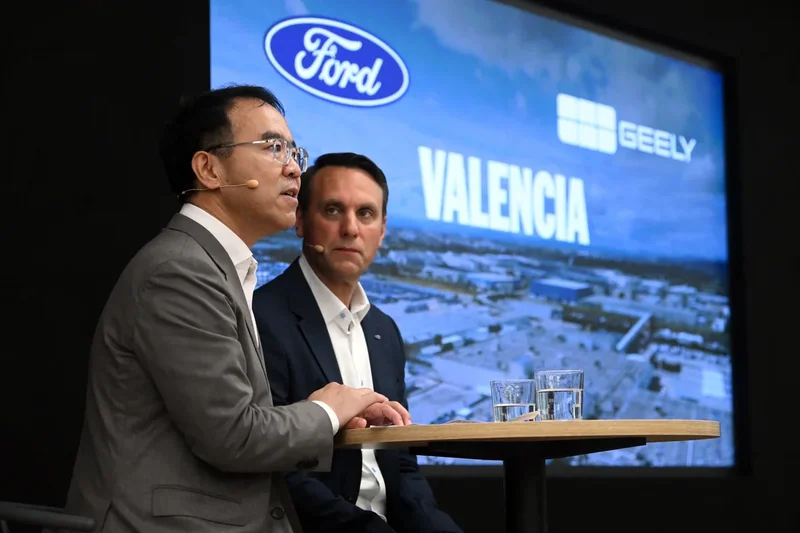
Which brings us neatly back to the European car industry. Ford and Geely have announced plans for a new joint venture at Ford’s Valencia factory in Spain. Ford will own 66 per cent, Geely 34 per cent, and the plant will build cars for both companies.
From 2028, Valencia is due to make two Geely electric SUVs, a new member of Ford’s Bronco family and a new multi-energy Ford crossover designed by Ford but jointly developed with Geely. The existing Ford Kuga will continue there, too.
So, this isn’t simply Ford renting Geely a quiet corner of its factory and charging it for the electricity. The two companies are getting into bed together, sharing costs, expertise, production capacity and, crucially, car development.
“For nearly 50 years, Valencia has built some of the most-loved cars in our history, and now this team will help build our future,” said Jim Baumbick, president of Ford Europe. “That’s why we’re building a flexible, cost-effective industrial system with a capable partner in Geely Auto.”
That future is becoming increasingly collaborative. Ford’s current electric Explorer and Capri use Volkswagen technology, while Renault is going to develop and build two affordable electric cars for Ford. Now Ford will also work with Geely on another electrified model.
Volkswagen, Renault and Geely: three different industrial partners helping Ford create the cars it needs for Europe. What would Henry Ford think? He might be spinning in his grave at the thought of Ford relying on competitors to supply some of the fundamental engineering beneath its cars. The man who helped transform manufacturing by controlling the process from raw material to finished Model T probably wasn’t big on sharing platforms.
Then again, he was also obsessed with cutting costs, improving efficiency and making cars ordinary people could afford. He might look at the economics of developing modern electric cars and decide Ford is doing exactly the right thing.
The sums involved are enormous, Europe’s market is brutally competitive, and factories need lots of cars moving through them to make money. An underused plant is an expensive collection of buildings, robots and very talented people standing around waiting for something to do.
Geely brings volume, technology, batteries, software and access to a vast Chinese supply chain. Ford brings a European factory, an experienced workforce, a trusted badge, dealer networks and more than a century of brand recognition.
It makes perfect business sense. But it’s still worth asking where it ends for Ford.
Of course, Ford is not alone – just a few weeks ago, Nissan signed a non-binding agreement with Chery to investigate building Chery cars at the Nissan plant in Sunderland – once Europe’s most productive car plant. It could bring additional jobs and make better use of one of Britain’s most important car factories.
Again, that sounds like good news. Jobs are protected, the plant gets more volume and Chery gains European production without having to build a factory from scratch.
BYD, meanwhile, is preparing to start making cars at its new Hungarian factory later this year. But it also wants a second European plant and would rather take over an existing one. “We would prefer to take over an existing plant,” BYD executive vice-president Stella Li said recently.
BYD has been linked with Stellantis’s giant manufacturing footprint, among others, and Europe has no shortage of factories operating below their potential. Building an entirely new plant takes years. Taking over an existing one – complete with workers, transport links and suppliers – is much quicker.
It also helps Chinese manufacturers sidestep tariffs imposed on electric cars imported from China and prepares them for potential rules demanding more European content in cars sold here.
So, is this a Trojan Horse strategy? Not in the strictest sense, no. Geely, Chery and BYD are hardly hiding inside wooden SUVs while pretending to be a present. Everybody can see them coming and European manufacturers are willingly opening the gates.
Chinese manufacturers know that exporting cars from China will only take them so far
Nor is there necessarily a sinister masterplan being coordinated from Beijing. These are ambitious, highly competitive companies chasing growth, just as European, American, Japanese and Korean manufacturers have done around the world for decades.
But the long-term strategy is clear enough: become local. Chinese manufacturers know that exporting cars from China will only take them so far. Tariffs can rise, politicians can become nervous and customers may still feel more comfortable buying a car built closer to home.
Manufacturing in Europe changes the conversation. A Geely built in Spain or a Chery made in Sunderland supports European jobs, pays European wages and uses at least some European suppliers. It becomes much harder to dismiss it as a cheap foreign import.
Working with established manufacturers also gives Chinese companies something money alone can’t buy quickly: local knowledge, credibility and an understanding of what European customers expect. And they’ll be learning all the time.
The danger for Europe’s manufacturers is that they gradually surrender the clever, valuable bits of the business. First, they share a factory. Then a platform. Then batteries, software, electrical systems and development. Eventually, the badge and the styling are the only differences left.
At that point, who really owns the relationship with the customer? And who has become dependent on whom?
Customers may not care. Most people don’t inspect the corporate family tree before choosing a washing machine or television – or increasingly a car. Many customers don’t know – or care – where their car is built. They buy the product that looks good, works well, offers the best deal and wears the right badge.
If a Ford developed with Geely is more affordable, has better technology and goes farther on a charge, buyers won’t reject it because Henry Ford didn’t design the battery himself.
The badge still has power, but only if the car underneath it is competitive. That may be the most uncomfortable lesson for Europe’s car makers. The Chinese haven’t broken into the market through trickery. They’ve arrived with cars that are improving at extraordinary speed, packed with kit and usually priced aggressively.
European manufacturers can slam the gates shut, but that risks leaving their factories empty and their cars too expensive. Or they can invite Chinese companies inside and hope collaboration makes them stronger.
It might save Ford’s Valencia plant. It might bring more jobs to Sunderland. It might give customers better cars for less money.
It might also mark the moment when the European car industry began handing over much more than spare factory capacity.
The Trojans, after all, thought bringing the horse inside was a pretty good idea at the time.
To get the latest motoring insights from EV editor Steve Fowler delivered straight to your inbox, simply enter your email address in the box at the top of this page.
Each edition of DriveSmart offers clear, expert guidance on the fast-moving world of electric vehicles and modern motoring, from trusted reviews and practical tips to the biggest industry news of the week.
You can also head to our newsletter preference centre to sign up for the email.