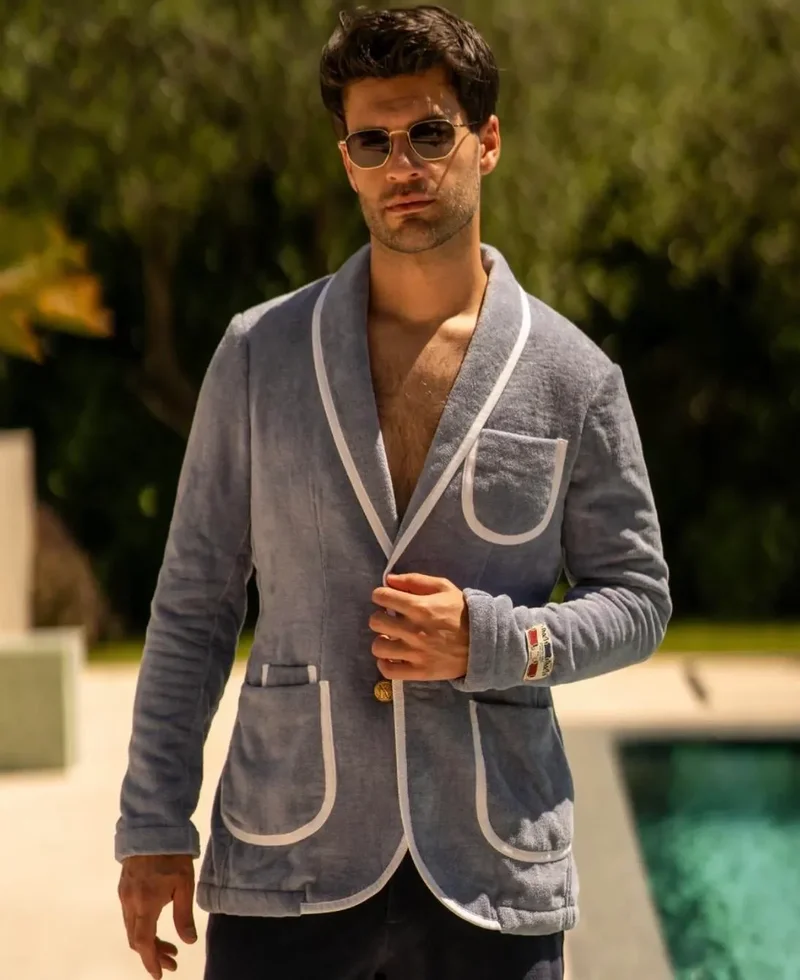
There are easier ways to enter the fashion industry than deciding the world needs a luxurious jacket made from towelling.
There are certainly easier ways to do it with no formal fashion training, a tiny team and some 40,000 kilometres spent driving around northern Italy trying to persuade manufacturers to help turn an unusual idea into a viable product.
Yet that is essentially how brothers Federico and Gabriel Uribe built 209 Mare, the Monaco-based luxury resort wear company founded in 2016 around a problem so specific that most established fashion businesses probably wouldn’t have considered it a problem at all.
What do you wear when you leave the yacht, beach or swimming pool but aren’t quite ready to get dressed again?
The Uribes’ answer was the terry beach blazer: the relaxed function of a towel or robe, reconstructed into something tailored enough to take its wearer from a sun lounger to lunch without requiring the ritual of disappearing upstairs to change.
It sounds wonderfully niche, precisely why I think the business behind it deserves attention.
In an industry where emerging brands are routinely encouraged to expand their ranges, chase followers and pursue wholesale scale, 209 Mare has largely travelled in the opposite direction. It created a category it calls “Rivierawear”, attached itself unapologetically to the visual language of Monaco, Saint-Tropez and the Mediterranean, and concentrated on reaching a comparatively small group of customers capable of spending €600, €800 or upwards of €1,200 on something most of us previously associated with hotel bathrooms.
Eight years after its market launch, the company says it has sold to customers in more than 100 countries. Its internal operation remains remarkably lean, with estimates placing the permanent team at fewer than 10 people, while specialist manufacturing is outsourced to European partners.
Don’t Compete When You Can Create The Category
One of the hardest things for any start-up is explaining why it needs to exist.
209 Mare’s answer is unusually easy to understand because its founders began with a use case rather than a collection.
Luxury swimwear, linen shirts and blazers all certainly existed before them. So did towelling robes. The opportunity was sitting between them.
By taking high-grade French terry and giving it the structure and detailing associated with tailoring, the brothers created something recognisable enough for customers to understand immediately but different enough to avoid a direct comparison with thousands of existing resortwear products.
That distinction gave the company something particularly valuable for a small business: pricing independence.
Its beach blazers and tuxedos can run from around €600 to more than €1,200, while shorts occupy a significantly higher price point than mainstream swimwear. Industry estimates place the company’s annual revenues somewhere in the $1 million to $5 million range, although as a privately owned business 209 Mare does not publish audited revenue or valuation figures.
The more revealing number may be headcount.
A company can now design in Monaco, manufacture through specialist European suppliers, sell directly around the world and establish physical presence through carefully selected hospitality and retail partners without employing the hundreds of people once associated with international fashion distribution.
40,000 Kilometres Before The First Collection
The polished photographs of 209 Mare against superyachts and Mediterranean swimming pools make the company look as though it emerged fully formed from Port Hercule, yet the reality seems considerably less glamorous.
After forming the business in September 2016, the brothers spent much of their first year developing prototypes, testing textiles and travelling around Italy in search of suppliers capable of producing what they had imagined. By their account, those sourcing trips accumulated more than 40,000 kilometres before the brand properly reached market in summer 2017.
There is something useful in that contrast because luxury is frequently presented as if it begins with branding. In practice, premium positioning collapses rather quickly if the product doesn’t survive scrutiny once somebody gets close enough to touch it.
209 Mare designs from Monaco while using specialist production capabilities elsewhere in Europe, including manufacturing in Portugal and textile expertise across France and Italy. Instead of carrying the fixed cost of owning factories or building a huge permanent workforce, it buys expertise where that expertise already exists.
The model is lean, but the customer never needs to experience it as lean.
That’s an increasingly important distinction for today’s entrepreneurs. Consumers don’t necessarily care how many desks are in headquarters. They care whether the product, service and experience feel complete.
Monaco Is More Than An Address
209 Mare also understood very early that place could become part of the product.
Monaco isn’t merely printed underneath the company name. It provides the entire visual and behavioural context in which the clothes make sense.
Put a terry blazer under fluorescent lighting in a conventional shop and a customer may reasonably wonder why it costs hundreds of euros. Put the same jacket beside a Riva, a beach club or overlooking Port Hercule during the Monaco Grand Prix and the proposition changes.
The brand isn’t really selling towelling, instead selling the uniform for a particular lifestyle.
Its first prototype was introduced around the Monaco Grand Prix, an event that effectively concentrates the company’s target audience into a few square kilometres: international wealth, yachts, hospitality, sport, fashion and an extraordinary density of cameras and social media activity.
That context has continued to shape the company’s marketing.
209 Mare has described an ambition to create highly 'Instagramable’ beachwear, and its imagery rarely behaves like a traditional product catalogue. The clothes appear in the environment for which they were designed - super yachts, Mediterranean resorts, sports cars and beach clubs—allowing lifestyle to do much of the selling.
10,000 Right People Can Beat 500,000 Wrong Ones
Perhaps the most interesting numbers in the 209 Mare story come from digital marketing.
Work carried out with luxury digital agency Relevance reported a 500% increase in website traffic and approximately 4:1 return on advertising spend from targeted campaigns. In simple terms, every unit of advertising spend generated four in attributed revenue.
Those results also challenge one of social media’s most persistent vanities: follower count.
209 Mare has operated with an Instagram audience measured in the tens of thousands rather than millions. For a mass fashion business, that might appear modest. For a company selling €500+ resort wear to customers whose interests cluster around Monaco, yachting, luxury travel and premium hospitality, relevance is considerably more valuable than reach.
A million people admiring a jacket they will never buy isn’t necessarily an audience.
Ten thousand people who understand the product, inhabit the places associated with it and possess the means to purchase it can be a market.
That philosophy extends into partnerships. Rather than attempting to compete for the largest mainstream influencers, the company has aligned itself with figures embedded in the Monaco and luxury lifestyle ecosystem, including Tom Claeren, while collaborations such as Hadid Eyewear have provided access to adjacent luxury audiences.
Today’s brand objective isn’t ubiquity but more recognition in the right room.
Let The Hotel Become The Store
Physical distribution follows much the same logic.
Opening a flagship in every desirable resort destination would be ruinously expensive for a business of this scale. Getting the product into the places where wealthy customers already holiday achieves something remarkably similar without carrying anything like the same property burden.
209 Mare has used placements and pop-ups associated with premium hospitality, including names such as The Ritz-Carlton and Delano, to put its product directly into the customer’s holiday environment.
Hospitality effectively becomes both distribution and demonstration.
For luxury brands watching the economics of traditional retail become increasingly difficult, that model deserves considerably more attention.
209 Mare may never need hundreds of stores or millions of customers. Its business is built around something much more precise: identifying a small but valuable consumer problem, owning the category created to solve it and ensuring the product appears wherever the customer is most likely to want it.
There is a temptation in business to equate growth with becoming broader.
Sometimes the more profitable opportunity is to become narrower, and exceptionally difficult to replace.