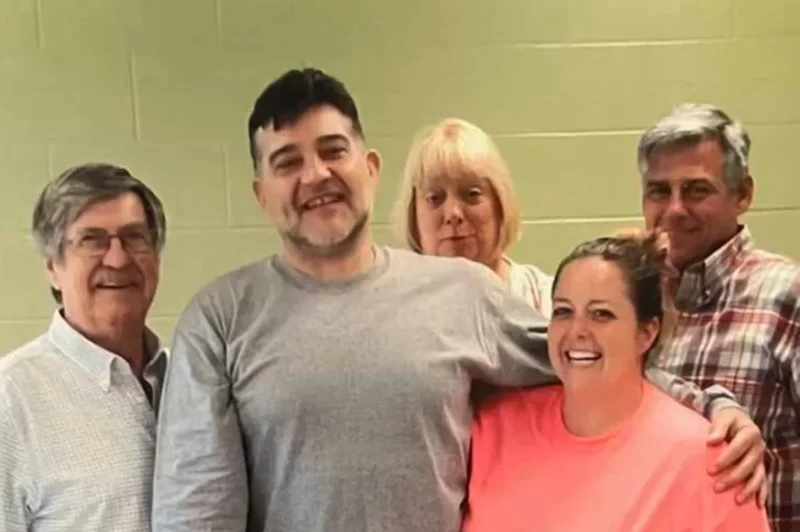
A Louisiana man who spent nearly three decades on death row walked free Wednesday after courts concluded his murder conviction relied on discredited bite-mark evidence that judges described as "junk science."
Jimmie "Chris" Duncan was released on a $150,000 bond after his 1998 first-degree murder conviction was overturned. He had been convicted of raping and murdering 23-month-old Haley Oliveaux, the daughter of his then-girlfriend, Allison Layton Statham.
Fourth Judicial District Judge Alvin Sharp vacated the conviction in April after hearing expert testimony that the forensic evidence used to convict Duncan was "not scientifically defensible" and that the toddler's death appeared consistent with an accidental drowning. Last month, the Louisiana Supreme Court ruled that "no rational juror" would convict Duncan based on the scientific evidence presented at his original trial.
"The presumption is not great that he is guilty," Sharp wrote in granting Duncan bail, citing the new forensic evidence and Duncan's lack of any prior criminal history.
Duncan's attorneys called the ruling a major step toward clearing his name, saying the court had found "clear and convincing evidence" pointing to his factual innocence.
The case has become one of the nation's highest-profile examples of convictions built on bite-mark analysis, a once-common forensic technique that has since been widely discredited. An Associated Press review in 2013 identified at least two dozen wrongful convictions or criminal charges since 2000 that relied on bite-mark evidence.
Prosecutors' case centered on testimony from forensic dentist Michael West and pathologist Steven Hayne, whose work has since been linked to multiple wrongful convictions. Duncan's legal team argued the pair relied on flawed methods that modern forensic science has rejected.
Court filings from Duncan's attorneys allege a videotaped examination showed West pressing a mold of Duncan's teeth into the child's body before concluding the marks matched his bite. A state expert who later testified at trial was unaware of how the marks had been created, according to the defense.
Hayne has since died. West has acknowledged that DNA testing has largely made bite-mark analysis obsolete but has defended his work in cases that were later overturned.
During Duncan's bail hearing, Haley's mother delivered some of the most emotional testimony in the case, telling the judge she no longer believes Duncan killed her daughter.
Instead, Allison Layton Statham said Haley, who had a history of seizures, accidentally drowned in the bathtub.
"Haley died because she was sick," Statham testified, according to court records.
She said prosecutors never informed her of evidence that could have cleared Duncan and accused investigators and forensic experts of creating a false narrative that devastated both families.
"The horror story that they put out and desecrated my baby's memory makes me infuriated," she told the court. "I was not informed of anything that would have exonerated Mr. Duncan at all. Had I been then, things would have turned out a lot different for Mr. Duncan and all of our families."
Innocence Project attorney M. Chris Fabricant told the court that "bite mark evidence is junk science," arguing there is no more prejudicial form of unreliable forensic evidence.
The case also highlights Louisiana's long history of wrongful convictions. According to the Death Penalty Information Center, more than 200 death row inmates have been exonerated nationwide since 1973, including 12 in Louisiana. The state's last death row exoneration came in 2016.
Louisiana Attorney General Liz Murrill opposed Duncan's release, arguing he should remain behind bars while the state Supreme Court reviews prosecutors' effort to reinstate the conviction. The high court, however, allowed the district judge to decide whether Duncan could be released on bail.
Prosecutors continue to seek reinstatement of Duncan's conviction and are still pursuing the death penalty. The Ouachita Parish District Attorney's Office has declined to comment because the appeal remains pending before the Louisiana Supreme Court.
Duncan, who had been one of 55 inmates on Louisiana's death row at the Louisiana State Penitentiary at Angola, plans to live with relatives in central Louisiana while the legal battle over his case continues. His attorneys described him as a model prisoner who spent years helping fellow death row inmates earn their GEDs and said he has strong community support as he continues his fight for full exoneration.