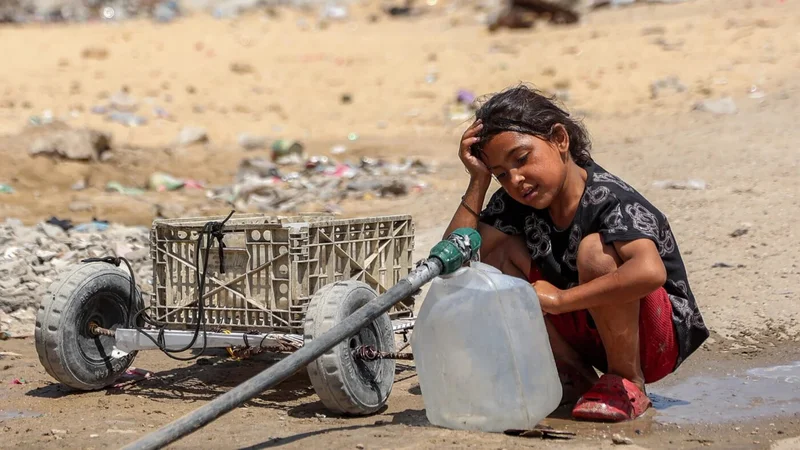
'It feels like hell': Gaza families battle suffocating summer heat in tents
When Middle East Eye met Rajaa Jendiya in January, she described Gaza's winter as the harshest she had endured in nearly two years of displacement.
Now, the rain has stopped, but the same tent that failed to protect the Palestinian widow and mother of three from the winter cold has become a trap for stifling heat under Gaza's summer sun.
"It's exactly like living in a greenhouse. The way the tent traps the sun's rays and concentrates the heat creates the same conditions as a greenhouse,” Jediya told MEE.
“The temperature and humidity become so intense that it feels literally suffocating and I have to go outside."
Jendiya lost her husband when Israeli forces killed him on 14 March 2024 in one of the “flour massacres” during Israel's siege and starvation of northern Gaza.
She is among the hundreds of thousands of Palestinians in Gaza who remain displaced, living in makeshift shelters such as the school in the heart of Gaza City where she now stays after her home in the Shujaiya neighbourhood of eastern Gaza was destroyed in an Israeli bombing.
With little access to basic services and few ways to escape the heat, summer has brought a new set of challenges for displaced families.
“The heat is something, and the insects that come with it are another thing,” Jediya said.
“All night long, we cannot sleep because of the mosquitoes, and once the sun rises, flies take over,” she explained.
“We cannot sleep either at night or during the day, and with the heat, we see new kinds of insects we have never seen before.”
Widespread skin diseases
Gaza’s summers are marked by high humidity due to the coastal enclave’s location along the Mediterranean Sea. Average temperatures reach around 30-32°C, but frequently rise above 35°C during heatwaves.
Today, around 1.9 million of Gaza’s 2.1 million residents remain displaced, many living in makeshift tents and facing ongoing health and environmental risks, according to Unicef.
Jendiya says she regularly takes her children to hospital because of illnesses linked to the unhealthy conditions in the school-turned-displacement camp.
'We spend every day searching for a way to breathe'
- Mona al-Mallahi, displaced Palestinian woman
“Inside and around the school, you often see sewage water overflowing, while rubbish accumulates, attracting flies and insects,” she told MEE.
“These conditions become even worse with the heat, and many times my children have developed skin diseases.”
Skin diseases have become increasingly widespread among displaced Palestinians across the Gaza Strip, where health workers have reported cases of scabies, fungal infections, rashes, lice, and other skin conditions, particularly among children.
Mona al-Mallahi, 47, who has set up her tent on a street island opposite al-Azhar University of Gaza, says she spends much of her day outside to escape the heat trapped inside.
“There is no escape from the heat. During the day, we cannot stay inside the tent because it becomes unbearably hot, but outside there is no shade to protect us from the blazing sun,” she said.
“We spend every day searching for a way to breathe.”
The Israeli destruction of more than 81 percent of Gaza’s buildings during the genocide has made conditions even harsher for those displaced in tents.
Israeli forces flattened much of the Strip’s urban landscape and destroyed trees along streets and public spaces, leaving people in tents more exposed to the scorching summer sun.
Despite the October ceasefire, Israel has also continued to restrict the entry of emergency shelter materials and relief supplies, further deepening Gaza’s shelter crisis.
‘Drenched in sweat’
Meanwhile, with more than 80 percent of Gaza’s water, sanitation and hygiene infrastructure damaged or destroyed, most displaced people do not have what they describe as the “luxury” of running water.
“We are drenched in sweat from the moment we wake up until we go to sleep. I need to shower at least five times a day just to cope, but that’s impossible,” Mallahi said.
“We barely have enough water for the most basic needs, let alone to cool ourselves down.”
Many displaced people obtain water for washing and bathing by filling containers from nearby schools, homes or displacement sites.
Drinking water is even harder to access: families often have to queue for hours to fill containers from water distribution trucks, usually provided through charity initiatives.
“I used to hear about the suffering of people living in tents and pray that God would help them, but I never imagined how much they endure until I experienced it myself,” Mallahi said.
Mallahi lost her home in Gaza City’s Zeitoun neighbourhood last year, just days before the October ceasefire agreement came into effect.
Before the bombing, the Israeli military had issued mass evacuation orders for residents of southeastern Gaza City. Mallahi and her married son left their home and sought refuge at her brother’s house in the Sabra neighbourhood in central Gaza City.
A few days later, the Israeli military issued evacuation orders for all residents of Gaza City. While Mallahi moved to another part of the city, refusing to leave for the southern governorates, her son decided to remain with his children at his uncle’s home.
An Israeli air strike later flattened the building, killing her son and his children.
No electricity
Even those who still have houses say their living conditions offer little relief from the summer heat.
“The only difference is that we have a ceiling above our heads to protect us from the sun. But we still suffer from the heat and insects with very little protection,” Emad al-Sirsawi, who lives in a damaged apartment in Tal al-Hawa, southwest of Gaza City, told MEE.
'No one can find comfort in Gaza, neither in summer nor in winter'
- Emad al-Sirsawi, Palestinian father
“We don’t have air conditioners or fans. And even if some of us had them before the war, we cannot use them because there is no electricity, or because we cannot afford the electricity supplied by private generators.”
Since the beginning of Israel’s military offensive on Gaza in October 2023, the Strip has been plunged into darkness due to fuel shortages and the destruction of much of its electricity infrastructure.
Today, even after the ceasefire agreement, Gaza’s electricity authority remains unable to restore a reliable power supply for residents, even partially.
As an alternative, private generator owners in neighbourhoods across Gaza sell limited electricity to residents at extremely high prices.
In some areas, one kilowatt-hour costs around 35 Israeli shekels (around $11.5), leaving most residents able to use this electricity only for essential needs such as lighting and charging their devices.
“Our inability to use refrigerators is another thing. Whatever food we have spoils by the end of the day, so we lose large amounts of it,” al-Sirsawi, a father of six, said.
“We are forced to cook every day, but we do not have cooking gas and thus have to rely on firewood even in this extreme heat.”
“No one can find comfort in Gaza, neither in summer nor in winter.”