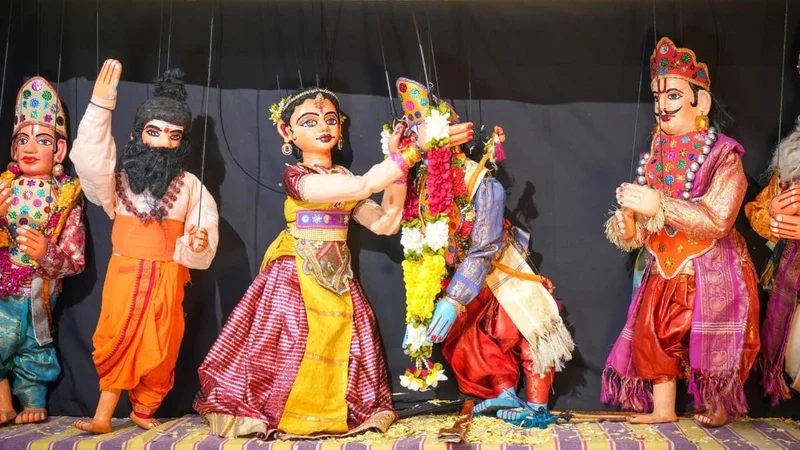
Long before wooden puppetry (Bommalattam) became a recognised folk art form presented on stages in Tamil Nadu villages, it had already found a mention in Tamil literature. Among its earliest references are the Thirukkural couplets by Thiruvalluvar, who refers to wooden puppets (marappavai) as a powerful metaphor for life. In Kural 1,020, he says the actions of a man without modesty are like the movements of a wooden puppet operated with strings. He is as soulless as the puppet. In verse 1,058, he says that if there are no mendicants to seek charity, then the world will consist only of people who move like wooden marionettes. Such references point to the antiquity of wooden puppetry.
“The art requires a knowledge of music, literature and folk arts, skill in mimicry, a sense of humour and enormous stamina, “ says T.S. Murugan, of Sri Murugan Sangeetha Bommalatta sabha, who belongs to a hereditary family practising this folk art form.
“My father T.N. Sankaran, who was the recipient of the Puraskar award from the Sangeet Natak Akademi, learnt Carnatic music from many gurus, one of whom was Kumbakonam Rajamanickam Pillai. Recognising his talent, Mani Iyer of Mangalagana Sabha, Kumbakonam’s most popular wooden puppetry company, asked my father to join his troupe, as a singer and also to render dialogues. Since my father was visually challenged, he did not operate the puppets. A surgery after a few years restored his vision in one eye,” he adds. Murugan further shares that, impressed by his father’s resonant singing at their wooden puppetry shows staged during the Agama Silpa Sadas, Kanchi Paramacharya honoured him with the ‘Sankaranadan’ title.
Sankaran was also held in high regard by music aficionados. “E. Krishna Iyer — lawyer and founder-secretary of the Music Academy, once arranged a puppet show at Rashtrapathi Bhavan. Mani Iyer decided to leave appa behind. However, Krishna Iyer insisted that the show could not go on without my father and was prepared to cancel it if he was unavailable.”
When Mani Iyer passed away, Sankaran decided to have his own company, and thus was born Sri Murugan Sangeetha Bommalatta sabha. New puppets had to be made for the company. While carpenters sculpted the torso and limbs, Sankaran’s wife made the faces and did the painting.
How big are the wooden puppets? “Puppets portraying children are typically about a ft tall, while those representing demons are three ft in height and weigh as much as 22 kilograms. Each puppet is brought to life using black strings,” explains Murugan.
While traditional stories from the epics and Puranas are part of their repertoire, Murugan has also adapted the traditional art form to address contemporary issues such as environmental conservation and AIDS awareness. A new theme means making new props, new clothes, etc. Some shows go on for many hours. For instance, a recent show on Harishchandra went on for six hours. Does the audience have the patience to sit through long shows? “It all depends on how interesting the show is.” The troupe has been performing in the Ramanathapuram palace for close to 80 years.
A wooden puppet show begins with a herald giving the audience an introduction to the story. This is followed by a ‘dancer’ puppet performing a jati, thillana and a Tamil song. After this, the actual thematic performance begins. Classical compositions of the Trinity are sung as interludes when puppets are taken down to fix new props for the next scene. Abhangs, bhajans and Purandaradasa kritis accompany characters such as Narada, while some productions begin with puppetry adaptations of folk forms such as karagam before beginning the main story. In keeping with the changing preferences of the audience members, film songs too have found a place in the repertoire.
Wooden puppetry has also found a place in Tamil films. For instance, Sankaran presented the wooden puppet sequence in the Tamil film Kannkaatchi. InSigappu Malargal, the Yesudas song ‘Oru bommallattam nadakkuthu’ featured four of the troupe’s puppets operated by four men. But director S.A. Chandrasekhar wanted the focus to be on just one man. So the scene had only Sankaran handling the puppets. In the Kamal Hassan starrer Indian, Sukanya played the role of a puppeteer. The puppet shows in this film were done by Murugan’s company.
Murugan has been in the field for more than 45 years. He speaks of the difficulties the company has faced. As a ten-year old, he has witnessed how, on one occasion, the troupe walked across a river, carrying the puppets in trunks, placed on their heads. When they reached the village where the show was to take place, they found there was no power supply, and they had to manage with petromax lights. Once when Sankaran was transporting some puppets in a rickshaw, the rickshaw puller and he stopped by to have a cup of tea, when a speeding truck hit the rickshaw, breaking eleven puppets.
More recently, a suitcase full of puppets was stolen in a bus. When a complaint was lodged with the police, they told the troupe to be happy that they hadn’t lost anything valuable. “Puppets are valuable. A puppet can cost anywhere between one and one-and-a-half lakhs. Besides, we were on our way to a show,” rues Murugan, who further adds that wooden puppetry is not a folk art that is performed in the open like other folk art forms. “It requires a stage, a script and should be classified as theatre.”
What future does the art have? “A show requires at least 15 trained persons. During my father’s time, the troupe had close to 600 people, but now we have only a few permanent members. Most of them have taken up other jobs and participate in shows only when they are free. While we continue to perform at temples across Ramanathapuram and Salem districts, many shrines that once hosted puppet shows have stopped continuing the tradition. Because, remuneration doesn’t match the expenses.
However, Murugan is optimistic, as his brothers, Ravi and Gopi, and his sons, Karthikeyan and Sangeeth Sriram, have all been trained in the art. Gopi, a recipient of the Yuva Purasakar, even turned down a corporate job for the sake of this art. Yet, Murugan believes individual commitment alone cannot secure the future of this traditional folk art form. “This art needs more government support if it is to preserved for posterity,” he says.
Published - July 28, 2026 04:46 pm IST