Govt proactively reformed laws to deal with real-world problems, advance public interest: Shanmugam
AI generated
SINGAPORE - Close to 1,000 laws were passed in the past 25 years as the Government proactively reformed legislation to deal with real-world problems and advance the public interest, said Senior Minister K. Shanmugam on July 28.
These laws have reshaped the legal landscape across many areas of Singapore society, he said. In doing so, they have also reshaped the framework of society itself, benefitting a substantial section of the public.
They include the streamlining of family justice to reduce divorce costs and trauma, establishing arbitration frameworks to bolster Singapore’s international standing, and creating emergency legislation during the Covid-19 pandemic to provide financial relief to Singaporeans and businesses, among others.
In Singapore, changes to the law were undertaken by the Government through the legislative process in Parliament, but this is not always the case elsewhere, said Shanmugam, who is also Coordinating Minister for National Security and Home Affairs Minister.
In many countries, because of political deadlock and controversies, or simply a lack of political will, parliaments abdicate their law-making power, he said. The courts end up reforming laws even though they are not equipped to do so.
“The Government’s power to make law is a very significant power. Fundamental – when you want to do law reform, change laws,” he said.
“In Singapore, changes to the law, law reform – the Government does it. The Courts perform their traditional role: which is to apply the law to the cases before them.”
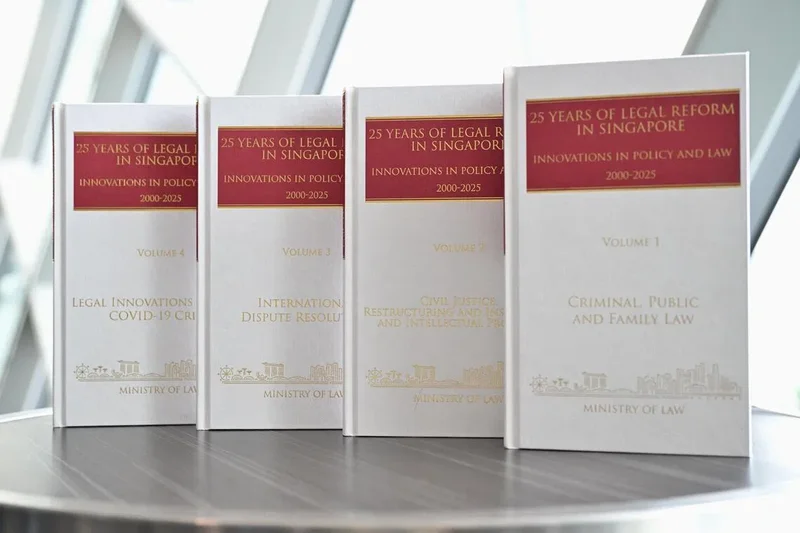
Shanmugam, who was law minister from 2008 to 2025, was speaking at the launch of a four-volume series that chronicles Singapore’s legal reforms over the last 25 years.
During this time, he said, the Government had deliberately and practically made laws that shape the legal environment to deal with real-world problems, make difficult choices, and advance the public interest.
“Law reform changes rights, obligations. It creates institutions. It determines when the state should intervene and where boundaries should be drawn,” he said.
One example is how changes to family law have directly improved the lives of ordinary Singaporeans.
He recounted how he had met two distressed women separately at his Meet-the-People sessions – both were struggling through protracted and financially draining divorces under the laws then.
The Government eventually passed the Family Justice Act in 2014, which established the Family Justice Courts, and also introduced the simplified divorce track in 2015 to resolve divorce cases quicker, at lower cost, and with less friction for the parties.
In 2026, about two-thirds of approximately 6,000 annual divorces here were handled via the simplified track.
The median completion period has also been reduced to four months, and costs range from $1,000 to $3,000 if disputes are sorted out early.
Citing these changes to the law, Shanmugam said that when the legal reforms were first mooted, no one thought that family law needed to change, because that was how things had always been done.
“I mention this to make a basic point about law reform: We are limited only by our own ideas and imagination,” he said.
Law reforms in criminal law have helped strengthen access to justice, he said. In arbitration, they have shaped Singapore as a trusted place for international business and dispute resolution.
During the Covid-19 pandemic, the legislative reforms provided relief for Singaporeans and business during a crisis, he said.
Attorney-General Lucien Wong was central to the efforts then to introduce the novel legislation that was conceptualised and drafted in about nine days, said Shanmugam. Other lawyers involved include the late Patrick Ang, former managing partner of Rajah and Tann, and Sushil Nair, the incoming Chief Justice who was then with Drew & Napier.
Speaking at the same event, Law Minister Edwin Tong said law reform in Singapore is never pursued for its own sake.
“It is undertaken to strengthen trust, to support progress, and to ensure that our legal system continues to serve the needs of both Singapore and Singaporeans,” he added.
Behind each change lies years of careful work, research, consultation, debate, and drafting, he said.
Good law reform is not simply about writing better laws, but about understanding how society is changing, anticipating challenges, deciding on trade-offs, and balancing competing interests with care.
Tong said the next 25 years will bring new challenges as artificial intelligence, digital technologies and demographic change will test Singapore’s legal system in new ways.
“Singapore’s strength has never been simply about having good laws. It’s been our willingness to review them constantly, the courage to improve on them and adapt them when circumstances demand,” he said.
Acknowledging Shanmugam’s role in many of the reforms, Tong said the senior minister had championed the philosophy that law reform must serve the public interest well, by strengthening justice, supporting economic growth, and reinforcing confidence in the legal institutions.
“Many of the innovative and landmark reforms documented in these volumes bear his imprint and deep personal attention,” said Tong.
Shanmugam, recounting a conversation with founding prime minister Lee Kuan Yew when they discussed his career, said the former prime minister’s words were firmly in his mind when he took over as law minister in 2008.
“He said a minister can conceptualise, help pass legislation and can have a very substantial positive impact on society as a whole – and help make Singapore a much better place for everyone.”