Myanmar’s military-backed parliament has passed a bill that allows the death penalty for people who kidnap, detain, or use violence to force victims to work in online scam centres.
The Anti-Online Scam Bill was approved after both houses of parliament adopted amendments in Naypyidaw, union parliament speaker Aung Lin Dwe said during a live television broadcast.
The legislation imposes prison terms of 10 years to life for using violence, torture or unlawful detention to force people into cyber fraud.
It mandates the death penalty if the abuse results in a victim’s death.
Coup leader-turned-president Min Aung Hlaing approved a draft of the bill in May.
Online scam centres have expanded rapidly across Southeast Asia since the Covid-19 pandemic. Myanmar, Cambodia and Laos have become major bases for criminal groups that run fraud schemes targeting people around the world.
The anti-scam legislation is the first piece of legislation passed under Myanmar’s new government, led by Mr Min.
Observers note that this legislation is part of the military junta’s broader effort to show it is tackling cross-border crime and strengthen its international standing after the military coup isolated it five years ago.
However, its impact may be limited, as large parts of Myanmar remain outside the military’s control and are held by ethnic armed groups.
In Myanmar, an MP named Aye Chan told the media that the death sentence remained in the approved version of the law.
“There were not many significant changes to the proposed draft bill after discussions between the lower house and upper house. The important parts of the bill remained the same.”
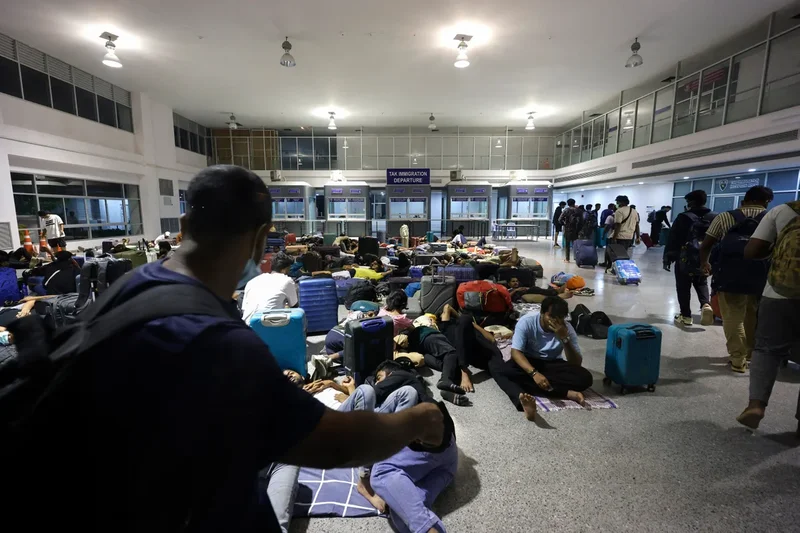
The authorities say they had detained 14,718 foreign nationals who entered Myanmar illegally as of late June. They also said they had demolished all 77 buildings linked to illegal gambling and online scam operations in major border hubs, including the notorious Shwe Kokko and KK Park complexes in Myawaddy Township.
KK Park was just one of dozens of scam compounds along the Thai-Myanmar border.
According to the United Nations, scam-related losses across East Asia, Southeast Asia, Australia and New Zealand were estimated at between $88.3bn and $114.1bn in 2025. The losses were greater than the annual economic output of several countries in the region.
FBI data shows that Americans lost nearly $21bn to scams in 2025 alone.
Last year in October, Jeremy Douglas, former regional representative for Southeast Asia and the Pacific, now the current chief of staff for the United Nations Office on Drugs and Crime, said that Southeast Asia – particularly the Mekong Region’s border areas between Cambodia, Laos, Myanmar and Thailand – is “arguably the most significant global hub for scams and illegal online gaming”.
Earlier this year, a report published by Amnesty International described the growing number of survivors abandoned on the streets of Cambodia and Myanmar after escaping cyberscam compounds as an “international crisis”.