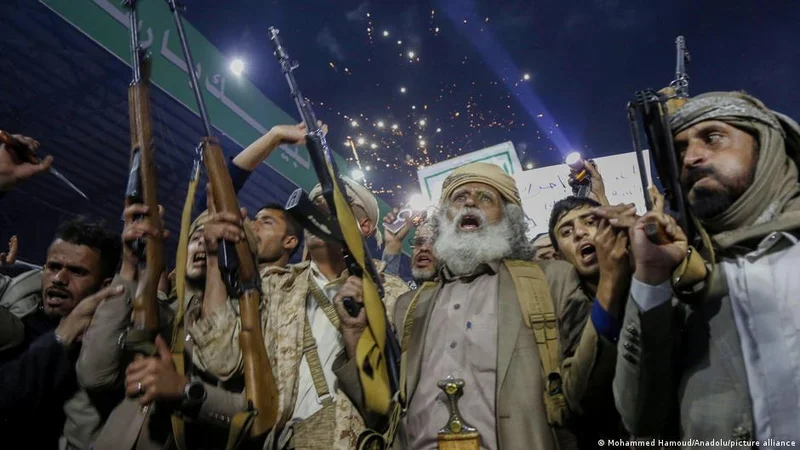
Pakistan condemned attacks on Saudi oil tankers in the Red Sea by Iran-backed Yemeni Houthi militia last week as the conflict in the Middle East threatens to expand.
In a statement, the Pakistani Foreign Ministry warned that any Houthi threat to Pakistani maritime interests in the Red Sea could be met with the "lawful use of force."
Pakistan enjoys a trade and security relationship with Saudi Arabia, and Pakistani-flagged vessels frequent Saudi ports in the Red Sea. Last September, Pakistan and Saudi Arabia signed a mutual defense agreement that contains a "collective security" clause, meaning attack on one country is considered an attack on both.
After the Houthis launched missiles at southern Saudi Arabia last week, Pakistan's Foreign Ministry expressed its "unwavering commitment" to the security pact.
At the same time, Pakistan also has ties with Iran, and has been a key mediator between Tehran and Washington to end the Iran war.
Any military act against the Iran-backed Houthis could place Islamabad in one of the most complicated foreign policy situations it has faced in years.
Pakistan's tightrope between Saudis and Iran
Historically, Saudi Arabia and Pakistan have long shared close military and strategic relations. Pakistani military generals and advisers have aided the Kingdom for decades.
Farea Al-Muslimi, a Yemen expert at London-based think tank Chatham House, told DW that Pakistani troops are already inside Yemen in support of the Saudis, "carrying out security and training-related duties alongside Saudi forces." A Pakistani official DW spoke to categorically denied this claim.
Nevertheless, if Houthi attacks on oil tankers and commercial shipping escalate in the Red Sea, Saudi Arabia could turn to Pakistan for help.
"Pakistan is one of Riyadh's closest defense partners, and their mutual defense pact makes such a request plausible. Having also come under Iranian attack, Saudi Arabia may increasingly look to Islamabad for military assistance if it feels under growing security pressure," Michael Kugelman, senior fellow at the Washington-based Atlantic Council, told DW.
However, Pakistan's improving ties with Iran and its mediation to end the US-Iran conflict could complicate any Pakistani military role on Saudi Arabia's behalf.
"Pakistan and Iran have a complicated relationship based on the calculation of tactical gains by either side. In any case, Pakistan has warned Iran several times that in case of conflict it will support Saudi Arabia," Ayesha Siddiqa, a Pakistani military analyst and senior fellow at King's College London, told DW.
After a period of unprecedented tensions in 2024, when Iran and Pakistan exchanged cross-border missile strikes, the neighbors have since rebuilt diplomatic relations and strengthened cooperation against militant groups operating along their shared border.
"Limited military support for Saudi Arabia would not necessarily rupture Pakistan's ties with Iran. But at a time when Islamabad is trying to present itself as a neutral mediator, expanding arms support to Riyadh could deepen Tehran's suspicions and undermine Pakistan's diplomatic role," Kugelman said.
How much support can Pakistan give?
If Saudi Arabia seeks assistance, analysts say Pakistan's contribution would most likely focus on protecting Saudi interests rather than joining offensive operations.
"The preference would be for defensive engagement, as expanding operations in the Red Sea may prove too risky," said Siddiqa.
Such an approach could include intelligence sharing, air-defense cooperation, maritime surveillance, and protecting critical Saudi infrastructure, allowing Pakistan to support Riyadh without joining offensive operations.
"Despite its deep military ties and mutual defense pact with Saudi Arabia, Pakistan is unlikely to provide arms or troops. Islamabad is focused on preventing regional escalation and preserving its role as a mediator in the Iran conflict, making any military support for Riyadh politically risky and potentially damaging to its ties with Tehran," said Kugelman.
Will Saudi Arabia escalate?
Saudi Arabia has exercised considerable restraint since winding down its large-scale military campaign in Yemen. However, repeated attacks on oil infrastructure and commercial shipping may eventually force Riyadh to respond more aggressively.
"Continued Houthi attacks on Saudi vessels could prompt Riyadh to abandon its restraint and launch a military response," said Al-Muslimi.
King's College analyst Siddiqa said it is not clear that Saudi Arabia currently has the capacity to fight a prolonged sub-conventional war against the Houthis.
"While it may intensify air strikes, more bombardment alone is unlikely to achieve the objective of making the Kingdom more secure," she said.
The analysts agreed Islamabad will likely back maritime security and freedom of navigation while avoiding direct strikes on Houthi targets amid the looming US-Iran conflict. But if the Red Sea conflict escalates, staying neutral may become increasingly difficult as pressure from Riyadh and Tehran grows.
"The trajectory of the conflict with Iran will shape Saudi Arabia's tolerance for Houthi attacks," said Kugelman.
"If the current pause between the US and Iran holds, Riyadh is likely to wait out the attacks rather than escalate. But Saudi Arabia will continue to view Pakistan as a key security partner because Houthi attacks are unlikely to stop, even if the Iran conflict ends," he added.
*Edited by: Wesley Rahn *