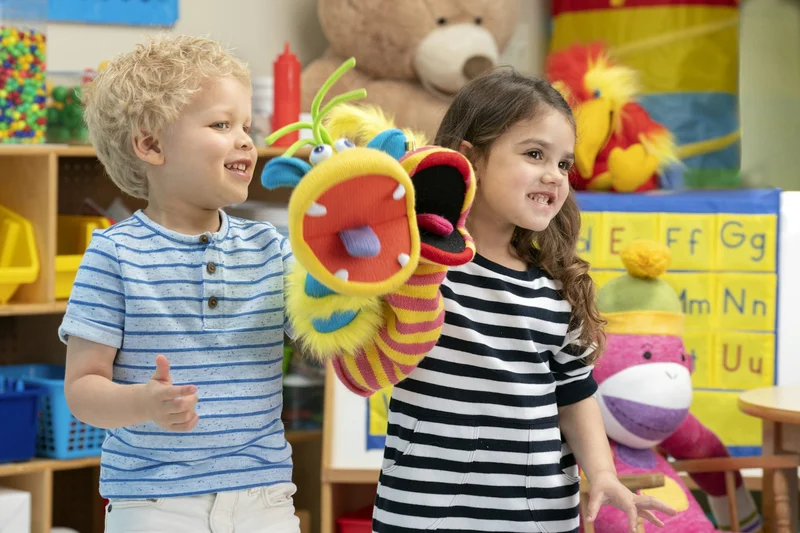
Prioritizing play offers a variety of benefits for children, from helping them grow their vocabulary to managing their big feelings with fewer behavioral problems.
Play also benefits children’s cognitive and social and emotional development.
But play isn’t always a focus in classrooms, even when it comes to very young children.
My colleagues and I conducted a study in 2019 and 2020 to understand how children from our own play-based lab preschool in Charleston, South Carolina, transitioned to formal schooling for kindergarten or first grade.
Some families at our school, which serves kids ages 2 through 6, choose to keep their child enrolled there for kindergarten. Others leave to have their children complete kindergarten in a more traditional school setting.
We found that attending a play-based early childhood program helped children develop emotional regulation, social awareness and problem-solving skills later on in elementary school.
Preparing children for school and life
Research conducted in 2015 found that children who attended a play-based preschool program scored higher on measures of vocabulary and use of grammar, compared to peers who attended a more traditional preschool program.
Another group of researchers conducted in-depth interviews in 2021 with the parents and kindergarten teachers of four children who had attended a play-based preschool. The three kindergarten teachers described the children as self-directed and eager to learn. One teacher spoke of the children’s open-mindedness. The children were also described as adept at navigating social situations, compassionate and empathetic.
For our own research, which we published in 2023, we surveyed 17 parents of children who had completed our program within the past few years. Additionally, we interviewed five parents and two alumni from the school who had reached college age. Although our sample size was small, our findings supported a play-based approach to preschool and kindergarten.
Parents said the play-based program had a significant impact on their children’s empathy and social development. They noted that their children were likely to take the lead in social interactions and frequently stood up for the underdog. Other parents said that the program fostered their children’s imaginative thinking and creativity.
Several parents credited their children’s advanced social skills to the extended time allotted for play. They described their children as being more creative, independent and resourceful than classmates.
Why play matters
While there is no single, agreed-upon definition of play, many agree that it is any activity that is intrinsically motivated, freely chosen and enjoyable. It is also flexible, creative and is not always linear or straightforward.
In part because play is challenging to define, it is also difficult to research or measure, especially in school settings.
Some play is unstructured and often referred to as free play. Think of a child alone in their backyard making a fort out of twigs and branches, or a group of children playing school.
Other play may be facilitated or guided by an adult. This could look like a child building a Lego structure while following step-by-step instructions, or a child playing school alongside his dad, who pretends to be a student.
Play-based learning involves a more structured activity or game with a particular outcome or goal. For example, a child could be playing with buttons and then be asked to sort them by size, shape or color.
There are also different types of play, including dramatic, or pretend, play.
Dramatic play can improve children’s emotion regulation, fuels their language development, and can help children work through anxiety, aggression and fear.
In my own experience teaching kindergarten, I was fascinated to observe children process traumatic experiences, such as 9/11, through reenacting events at the sand table.
Dramatic play also facilitates children’s understanding of narrative, as children create stories that place them in different roles, such as parent, teacher or doctor. Understanding narratives is key to becoming a fluent reader in the later grades.
Research has found that dramatic play can improve children’s social and emotional skills and help them process or understand the world around them, as they take on the role of veterinarian or first responder.
Constructive play, meanwhile, generally describes children building or creating things, such as blocks or art.
Block play can support children’s cognitive development and mathematical understanding. As children plan, test and revise their block structures, they learn critical thinking and develop an understanding of spatial relationships.
Longitudinal research shows that playing with blocks during the early childhood years predicts higher achievement in math in middle school and high school.
Parents of young children may understand play is important but have a harder time hanging on to that notion as their children age. However, play-based learning remains beneficial beyond the elementary school years.
Even middle and high schoolers gain important skills through play.
Sixth graders taught to solve problems through playing bank and supermarket performed better on later assessments of their math knowledge.
High school students given the opportunity to learn about kinetic energy and velocity by building a roller coaster described increased motivation and found it led to deeper understanding of the material.
Supporting play
Research shows that adults can be helpful during play when children experience conflict. Coaching from an adult can keep the play going after a disagreement and help children learn to compromise.
Adults can also help children come up with more complex characters and directions for play.
Guided play, meaning an adult asking open-ended questions to help fuel a child’s play, for example, has even been found to be more beneficial for children’s math understanding than direct instruction.
When children are given the freedom to navigate challenges during play, they build their executive functioning, problem-solving, creativity and social skills – all things that are essential for success in school and later in life.
While children’s play is most powerful when it is child-directed, adults can serve an important role in children’s exploration. Join in occasionally to ask thoughtful questions, introduce new vocabulary or characters, spark ideas, or help children work through conflicts. But try not to overthink it – it’s play, and it should be fun.