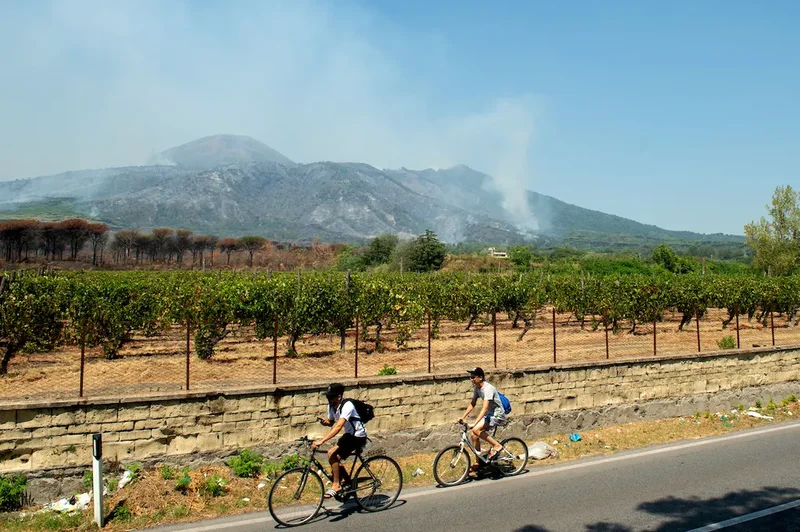
Headlines in Italy have been dominated by wildfires in recent days, with thousands of hectares burned and holidaymakers evacuated from beach clubs.
Though forest fires have long been a regular feature of summers in southern Italy, increasingly severe heatwaves and droughts linked to climate change are making them more common.
Italy hasn’t been as badly affected as France and Spain, where wildfires have devastated large areas of land, forced tens of thousands from their homes, and (in Spain’s case) led to fatalities.
But it has had a worse year than usual. Data shows that 36,600 hectares of Italian land went up in flames between January 1st and July 22nd – roughly 80 percent more than the average for the same period between 2006 and 2025, according to Greenpeace.
READ ALSO: What to do and what to avoid if you see a wildfire in Italy
Hundreds of tourists were rescued by boat from Puglia’s Gargano peninsula on Sunday, on the same stretch of coastline where a wildfire claimed three lives in 2007.
Residents were also evacuated from their homes in inland Sicily last week, where a 59-year-old firefighter died of a suspected heart attack while battling a blaze.
The situation is set to intensify with the arrival of another heatwave in August, with the EU’s European Forest Fire Information System (EFFIS) indicating a high risk of forest fires in Puglia, Basilicata, Campania, Calabria, Sardinia, and parts of Sicily from Wednesday.
From early August, the warning extends to central Italy, including Tuscany, Umbria, Marche, Lazio, Abruzzo, and Molise.
READ ALSO: Wildfires burn around Rome as region braces for more extreme heat
Italy is far from the only part of Europe under high alert over this week: if you wanted to plan your holiday around EFFIS risk projections, you’d also need to avoid all of central Spain, as well as Greece, Hungary, Slovakia, and parts of western Germany.
The centre-south of Italy has historically borne the brunt of summer wildfires, while the north is typically at lower risk due to frequent storms – so in previous years, you might have been able to avoid fires by staying in northern Italy.
But a series of heatwaves and persistent drought have sparked major blazes in the north too this summer, with Friuli Venezia Giulia, Liguria, Piedmont and Valle d'Aosta all declaring a state of "maximum" or "serious" danger due to wildfires.
Unless you’re prepared to cancel your holiday at the last minute based on the latest forecasts – which can only reliably be made a few days ahead – the best course of action is to stay informed and have a plan.
Italy doesn't make national forest fire alerts available to the public, but each region is individually responsible for managing the situation and updating civilians on the latest developments – with some doing a better job than others.
For more immediate updates, you can check for active wildfires in your area on Google Maps or incendioggi.it by following this guide.
READ ALSO: MAP: How to find out where Italy's wildfires are
Setting a google alert for ‘incendi boschivi’ along with the name of the area where you’re staying will send the latest news reports or official notices directly to your inbox without the need to actively check for updates.
If you’re staying in an area where there’s a high risk of wildfires, you might want to pack a 'go bag' with crucial items like your passport and any vital medication in case you need to evacuate quickly.
If you’re ordered to evacuate, do it. Don’t pause to try and protect your property or pack a full suitcase; winds can change, and fires can spread very rapidly.
Don’t try to drive down a road that’s been closed due to wildfires, even if it seems a long way from the blaze.
Anyone who sees a wildfire is advised to contact the EU-wide emergency number 112, or the national fire service at 115.
Don’t assume someone else has already reported the blaze, says the civil protection department: fires can get out of control within minutes, and every moment counts.