Indigenous rights are often reported on, but less often reported by the Indigenous communities struggling to exercise their rights, whether related to their land, access to resources, language and culture, and the right to freedom of expression and access to information.
Join us for a Global Voices Insights webinar to explore how narratives about Indigenous rights are framed in the mainstream and digital media around the world, and the importance of agency in telling their own stories and framing their own issues. This webinar will be part of Global Voices’ August Spotlight: Indigenous Rights, which explores how Indigenous communities around the world are finding ways to assert their rights through different mechanisms, including legal challenges, community organizing and activism, and other ways to creatively resist.
We’ll hear from Indigenous experts who have a local understanding of these conversations about how Indigenous rights are discussed and portrayed within local, national, and global media ecosystems, and their own work to promote greater self-representation through journalism, advocacy, storytelling, and media literacy.
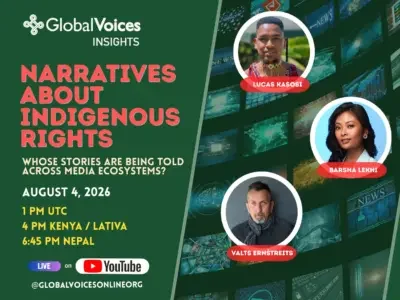
Join us on YouTube on August 4th, at 1:00 pm UTC (4:00 pm Kenya / 4:00 pm Latvia / 6:45 pm Nepal) for this discussion featuring:
Lucas Kasosi is an Indigenous Maasai journalist and communications professional from Kenya. His work focuses on Indigenous rights, self-representation, traditional knowledge, environmental justice, and community-led storytelling. Through journalism and Indigenous media, Lucas works to amplify community voices and challenge narratives about Indigenous peoples that are often shaped without their participation. His work has been published by Cultural Survival and other platforms, covering Indigenous rights, climate justice, conservation, and cultural identity.
Barsha Lekhi works at the intersection of climate change, biodiversity conservation, and Indigenous peoples, with over seven years of experience across UNESCO, UNDP, and Indigenous organizations in Nepal and across Asia. Currently, she serves as Project Officer/Indigenous Engagement Specialist at UNESCO Nepal, leading the Local and Indigenous Knowledge Systems Program and working alongside government ministries, civil society, and Indigenous communities. Her work has taken her from community consultations in Nepal to international climate negotiations at UNFCCC COP in Egypt, Dubai, and Baku. She holds a master’s degree in environmental sciences from Jawaharlal Nehru University, India, and a personal commitment to the principle that no one should be left behind not in climate/biodiversity policy, not in development planning, and not in the conversations that shape our collective future.
Valts Ernštreits is an Indigenous researcher, poet, and visual artist who has worked for decades at the intersection of language revitalization, self-representation, and Indigenous rights advocacy for Latvia’s small Indigenous Livonian community — successfully building spaces for Livonian-language use, education, and digital and media presence, and driving community activism rooted in community perspectives. His work also spans educating wider society and promoting Livonian-related themes and heritage across all levels of the education system, as well as through media and state policy. Actively engaged in advocacy and knowledge-sharing on both sides of the dialogue — working from within the Indigenous community while also serving on councils and institutions shaping governmental media policy and its implementation — his perspective offers hands-on insight into the complex realities as viewed from both sides of the contact line.