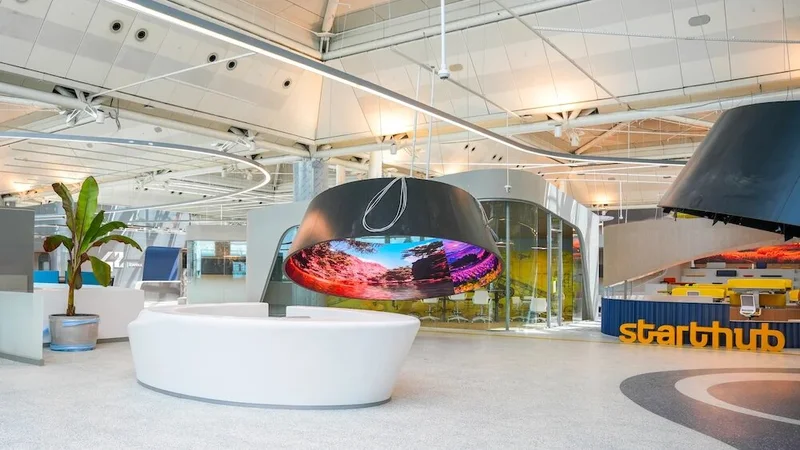
Inside Turkey's plan for world's largest startup hub at Ataturk Airport
When the car turns on to the side road leading to international departures at Istanbul's now-abandoned Ataturk Airport, the sounds of construction and new red lettering above the entrance stir old memories.
Once the beating heart of Istanbul, the vast airport carried millions of passengers to destinations around the world from the 1950s until its closure in 2018. Today, it sits largely empty at the centre of the city's transport network.
Turkish officials are now working to transform it into something entirely different: Terminal Istanbul, which they hope will become the world's largest hub for startups and entrepreneurs.
Middle East Eye was granted exclusive access to the project site.
The halls that once accommodated passengers, luggage and check-in counters are being redesigned as open-plan offices, meeting rooms, co-working spaces and incubation centres. The complex will also host international accelerator programmes for companies and investors.
Erkam Tuzgen, chief executive of the Terminal Istanbul initiative, told Middle East Eye that the goal was not merely to establish a hub for technology companies, but to create an ecosystem capable of attracting local and foreign investors, businesses and entrepreneurs.
People with innovative ideas and viable roadmaps, he said, would be able to access international mentorship and capital to help them expand into global markets.
Finding new purpose
At first glance, the scale of the project is striking. Around 200,000 sqm of terminal buildings will gradually be converted into modern workspaces.
The project's first phase is due to become operational next month, opening a 5,000-sqm area to 50 startups and other initiatives. Officials expect the number to reach 100 by the end of the year.
"We have already signed a memorandum of understanding with Techstars, one of the world's largest organisations in the entrepreneurship sector," Tuzgen said.
"It operates its own incubation and accelerator programmes, as well as investment funds, and has a network involving thousands of investments. Techstars will also be based at Terminal Istanbul, where it will run incubation and globalisation programmes."
Tuzgen said the Shanghai State-owned Capital Investment, a Chinese government entity that manages assets worth $47bn, had also signed an agreement to open an office at Terminal Istanbul. Its presence would allow the fund to engage directly with technology startups and entrepreneurs seeking investment.
The Turkish government faced fierce criticism in 2018 when it transferred commercial operations from Ataturk Airport to the newly built Istanbul Airport.
The new airport has since become one of Europe's busiest, handling an average of 1,623 flights a day in July.
Terminal Istanbul, by contrast, has so far attracted little substantial criticism, partly because the former airport buildings had stood empty and without a clear purpose for years.
A new alternative to the Gulf
Turkey is not alone in converting old transport infrastructure into a technology centre.
In 2017, France transformed a former rail freight depot in Paris into Station F, which has become one of the world's best-known startup campuses.
Tuzgen said Terminal Istanbul's ambitions went beyond creating the world's largest incubator or entrepreneurship hub. Its broader aim, he said, was to position Turkey alongside cities such as Beijing, San Francisco and New York in conversations about global technology.
Venture capital companies including Disrupt and Enhance Ventures, as well as Uzbekistan's UzVC, are negotiating separate agreements to establish a presence in the Terminal Istanbul complex, according to Tuzgen.
The Turkish government has also sought to position the country as a possible destination for businesses and investors leaving the Gulf, offering incentives to financial services companies, entrepreneurs and digital nomads.
The Istanbul Financial Center, a separate financial hub, offers substantial corporate tax exemptions.
Tuzgen said Terminal Istanbul was not seeking to capitalise on the war involving Iran and Gulf countries. However, he acknowledged that the project could provide an alternative to entrepreneurs in the region who might otherwise consider moving to Dubai to launch technology companies.
Private jets and gourmet cuisine
Flat6Labs, one of the Middle East's largest startup ecosystem builders, has signed an agreement to join the project. Monshaat, Saudi Arabia's Small and Medium Enterprises General Authority, is also negotiating a deal.
"The space immediately stands out for its creative and innovative design, with thoughtfully built areas that complement different industries," Raad Aljouni, a Switzerland-based AI venture builder, told MEE.
"Given Turkey's position linking East and West, its rich heritage, strong infrastructure and growing market, I believe Terminal Istanbul has all the ingredients to become a globally significant innovation ecosystem. That is exactly why I am excited to be part of its journey."
Several investors, speaking to MEE on condition of anonymity, said Turkey's frequently changing regulatory environment, concerns over the rule of law and its complex immigration system made it difficult for them to relocate their operations to the country.
Turkey's economic difficulties also persist, despite the government's adoption of tighter fiscal and monetary policies since 2023. Annual inflation is expected to remain close to 30 percent by the end of the year.
'Terminal Istanbul has all the ingredients to become a globally significant innovation ecosystem'
- Raad Aljouni, AI venture builder
Terminal Istanbul, however, is intended to offer several advantages that could help address some of these concerns.
Tuzgen said parliament was expected to approve legislation allowing companies to be established digitally, resolving one of the main obstacles facing businesses operating in the country.
Terminal Istanbul will also have a one-stop service centre for immigration, social security, and taxation. This will allow investors and their employees to resolve bureaucratic issues without having to visit several government agencies, a process that can be both tiring and time-consuming.
Another advantage is the airport's existing VIP terminal, which allows private jets to land and take off next to the complex.
Investors will be able to arrive, access parts of the complex without passing through passport control, hold meetings and oversee projects for several hours before flying on to their next destination.
The complex will also include several kitchens supported by the Culinary Arts Academy, known as MSA, offering modern Turkish cuisine.
The project has already generated considerable interest. Tuzgen recalled presenting it at an international conference when a prince from a Gulf kingdom approached him afterwards.
"This is a perfect project. I really liked it," the prince told him. "That is why we will do exactly the same thing in our own country."
Tuzgen admitted that, to this day, he remains unsure whether he should feel pleased by the comment or disappointed.