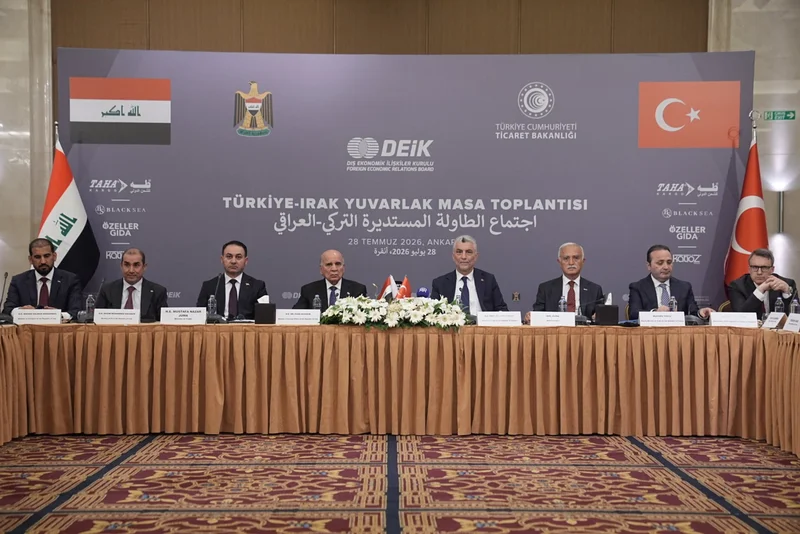
Türkiye and Iraq are seeking to modernize customs procedures at their main border crossing as the two neighbours push to expand bilateral trade to $30 billion, Trade Minister Ömer Bolat said Tuesday.
Speaking at the Türkiye-Iraq Business Roundtable Meeting in Ankara, Ömer Bolat said economic ties have expanded across trade, investment, contracting, transportation, defense, tourism and services.
Bilateral trade currently stands at about $17 billion, after reaching as high as $24 billion following the COVID-19 pandemic and during a period of elevated energy prices, he said.
Iraq is Türkiye's fifth-largest trading partner, Bolat said, adding that the two countries were determined to raise bilateral trade to $30 billion over the medium term.
Turkish contractors have completed 1,157 projects worth $40 billion in Iraq, making it their third-largest overseas market, he added.
Bolat stressed the importance of linking the Ibrahim Khalil border crossing to the Automated System for Customs Data (ASYCUDA) introduced by the Iraqi government.
"We believe that integrating the Ibrahim Khalil Customs Gate into the ASYCUDA system as soon as possible will make a very important contribution to our goal of increasing trade between Türkiye and Iraq to $30 billion," he said.
The integration would reduce uncertainty and accelerate trade, he added.
Bolat also said Türkiye was ready to support Iraq's implementation of the TIR Convention and stressed the importance of bringing bilateral agreements on investment protection and the prevention of double taxation into force.
The Turkish trade minister said recent conflicts and geopolitical developments in the Gulf have highlighted the need to strengthen trade, transport and energy corridors.
He called for the Kirkuk-Ceyhan oil pipeline to operate at full capacity, the construction of a new pipeline from Basra to Türkiye's Ceyhan terminal and progress on the Development Road project.
The planned corridor would connect Iraq's Grand Faw Port with Europe through Türkiye.
"We believe the Development Road will accelerate investment and contracting activities in Türkiye-Iraq relations through the establishment of new logistics centers and cities," he said.
Bolat also said a transit visa arrangement between Türkiye and Saudi Arabia, in effect since April 15, had opened trade routes through Iraq to Saudi Arabia, Kuwait and the wider Gulf.
He added that Türkiye would like to host the next meeting of the Türkiye-Iraq Joint Economic and Trade Committee this year.
Nail Olpak, president of Türkiye's Foreign Economic Relations Board, called for differences in customs practices between Iraq's federal government and the Kurdish Regional Government to be resolved.
He also urged authorities to improve banking channels for trade payments, accelerate e-visa procedures and provide businesspeople with multiple-entry commercial visas.