Welcome to the Proof of Usefulness Hackathon spotlight, curated by HackerNoon’s editors to showcase noteworthy tech solutions to real-world problems. Whether you’re a solopreneur, part of an early-stage startup, or a developer building something that truly matters, the Proof of Usefulness Hackathon is your chance to test your product’s utility, get featured on HackerNoon, and compete for $150k+ in prizes. Submit your project to get started!
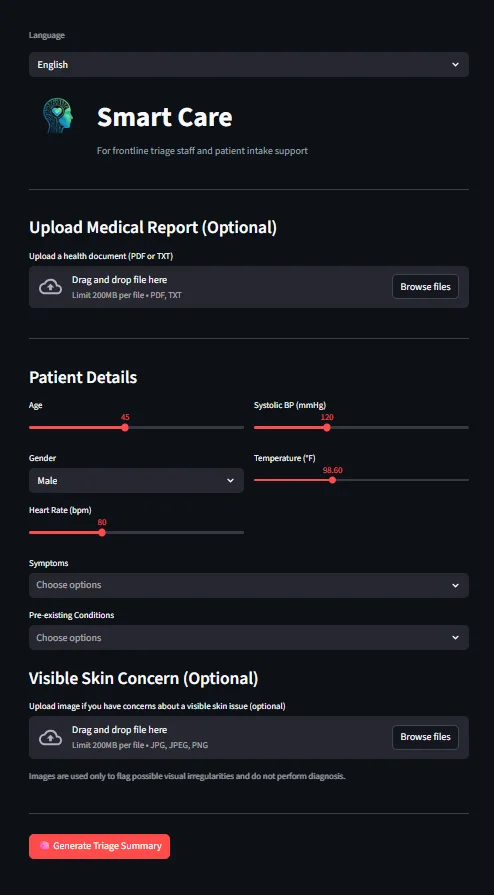
In this interview, we speak with Vidhan Gupta, the creator of Smart Care Triage. This innovative project is a decision-support tool designed to streamline hospital intake by safely prioritizing patients into low, medium, or high-risk categories based on explainable factors.
What does Smart Care Triage do?
Developed to streamline hospital intake, Smart Care is a decision-support tool that safely prioritizes patients into low, medium, or high-risk categories. It evaluates patient data to suggest relevant clinical departments and care levels based on explainable factors. This tool helps frontline staff make faster, data-driven routing decisions during busy triage scenarios. Now’s a good time for Smart Care Triage to exist because administrative burnout and decision fatigue are at critical levels, and frontline healthcare workers urgently need objective, explainable systems to help manage chaotic and high-volume intake periods.
What is your traction to date? How many people does Smart Care Triage reach?
As a newly deployed Hackathon prototype, Smart Care currently reaches a limited testing audience of hackathon judges, peer developers, and evaluators (under 50 people per month). The current focus is on system validation, safety boundary testing, and demonstrating proof-of-concept rather than public scale.
Who does your Smart Care Triage serve? What’s exciting about your users and customers?
Smart Care is built specifically for frontline healthcare workers, triage nurses, and hospital intake administrators. These professionals gain value from the system's ability to quickly process vitals and medical histories, helping to reduce decision fatigue and standardize patient routing during high-volume intake periods. As this is a new prototype, we do not currently have commercial customers.
What technologies were used in the making of Smart Care Triage? And why did you choose ones most essential to your techstack?
Smart Care Triage leverages a robust Python-centric tech stack featuring Streamlit for the user interface, alongside Pandas, NumPy, OpenCV, Pillow, and PDFPlumber for comprehensive data and document processing. For the core decision-making logic, we utilized Scikit-learn's Decision Tree Classifier because explainability is critical in a medical setting, allowing frontline staff to clearly understand why routing recommendations are made. Deployment and version control were handled seamlessly via GitHub and Streamlit Community Cloud for rapid iteration and testing.
Smart Care Triage earned a 35.03 proof of usefulness score (https://proofofusefulness.com/report/smart-care-triage) - how do you feel about that? Needs reassessment or just right?
The 35.03 score feels incredibly validating for an initial hackathon prototype! The algorithm accurately recognized our high marks in Real World Utility and Market Timing Relevance. Because we chose to be completely transparent about our pre-launch status and lack of active commercial traction, the score reflects a realistic baseline. It gives us a great, honest benchmark to improve upon as we move past the prototype stage!
What excites you about this project's potential usefulness?
What excites me most about Smart Care is its potential to directly combat administrative burnout and decision fatigue for frontline healthcare workers. Hospital intake lines can be incredibly chaotic, and having an explainable, objective decision-support tool ensures that critical patient vitals are processed instantly and safely. The multi-lingual support (English, Hindi, Tamil) also ensures that language barriers don't slow down critical routing decisions, bringing immediate, practical utility to diverse triage settings.
Walk us through your most concrete evidence of usefulness.
The most concrete evidence lies in the processing efficiency of the live Streamlit application. Manually reviewing an unstructured medical report PDF, checking vital thresholds, and checking specialty cross-references typically takes an intake worker several minutes per patient. Smart Care processes the text ingestion and spits out an explainable triage snapshot in under three seconds. In a crowded emergency room, those saved minutes directly translate to faster care initiation.
How do you measure genuine user adoption versus "tourists" who sign up but never return?
Since Smart Care is a pre-launch hackathon prototype, our retention story is focused on design intent rather than active database analytics, meaning we will measure genuine adoption versus "tourists" by tracking Session Frequency and Time-to-Triage (TTT) among active clinical intake staff. A tourist might test the sliders once out of curiosity, whereas a sticky user is a frontline worker who leaves the app open as a permanent tab throughout their entire shift. To drive this long-term retention, the system relies on eliminating workflow friction allowing staff to instantly process complex files using PDFPlumber ingestion and toggle between English, Hindi, and Tamil to completely bypass language barriers during high-stress triage environments.
If we re-score your project in 12 months, which criterion will show the biggest improvement, and what are you doing right now to make that happen?
Evidence of Traction and Functional Completeness will definitely see the biggest leap. Right now, I am focusing on building out a structured technical roadmap on our GitHub documentation. Over the next year, I want to explore integrating graph database tech like Neo4j to model deeper relationships between multi-layered symptoms and departmental loads, which will push the project's technical maturity to the next level.
How Did You Hear About HackerNoon?
I discovered HackerNoon through the developer community as a premier platform for sharing tech insights and hackathon builds. The experience using the "Proof of Usefulness" evaluation tool has been incredible-it gives developers a transparent, metric-driven breakdown of what their code actually achieves in the real world, rather than just judging a project based on visual hype.
Since Smart Care Triage is currently a pre-launch hackathon prototype, what specific validation steps or healthcare partnerships are you targeting to move from testing with evaluators to real-world hospital deployment?
The immediate next step is to get the prototype in front of practicing nursing students and triage professionals for interface and logic feedback. We want to ensure the threshold rules align perfectly with established clinical protocols (like the Emergency Severity Index). Partnering with regional clinics to run anonymous, retrospective historical patient data through the model is our primary target for clinical validation.
You mentioned projecting tests in simulated environments moving forward; what specific operational metrics will you look for to prove the prototype is ready to scale?
In a simulated hospital intake environment, we will look closely at three specific operational metrics to prove the prototype is ready for real-world scaling:
- Queue Throughput & Wait Time Reduction:We will measure the average time a patient spends in the waiting line before initial triage routing. Success means a measurable decrease in bottleneck buildup during peak simulated surge hours.
- Triage Processing Speed (Time-per-Intake):We will track the seconds saved by using automated file ingestion (PDFPlumber) and instant vital encoding compared to a standard manual intake data entry process.
- Model Decision Alignment:We will monitor the percentage of times the model's risk stratification (Low/Medium/High) perfectly matches the retrospective decisions of experienced triage nurses. We are targeting a high alignment rate, ensuring that any variance leans strictly toward conservative, safety-first over-escalation rather than under-triaging a critical patient.
Given the necessity for safe and explainable decision-making in medical settings, how do you plan to continually validate your decision-tree logic as new patient data complexities arise?
Safety-first boundaries are hardcoded into our architecture. The system is strictly designed for triage support, explicitly stating it does not provide diagnoses or final bed allocations. To handle growing patient complexities, we plan to implement a low-confidence escalation filter: whenever input data falls outside standard variance limits or hits an edge-case threshold, the system is programmed to conservatively escalate the patient to "High Risk" and flag them for immediate human intervention.
Meet our sponsors
Bright Data: Bright Data is the leading web data infrastructure company, empowering over 20,000 organizations with ethical, scalable access to real-time public web information. From startups to industry leaders, we deliver the datasets that fuel AI innovation and real-world impact. Ready to unlock the web? Learn more at brightdata.com.
Neo4j: GraphRAG combines retrieval-augmented generation with graph-native context, allowing LLMs to reason over structured relationships instead of just documents. With Neo4j, you can build GraphRAG pipelines that connect your data and surface clearer insights. Learn more.
Storyblok: Storyblok is a headless CMS built for developers who want clean architecture and full control. Structure your content once, connect it anywhere, and keep your front end truly independent. API-first. AI-ready. Framework-agnostic. Future-proof. Start for free.
Algolia: Algolia provides a managed retrieval layer that lets developers quickly build web search and intelligent AI agents. Learn more.