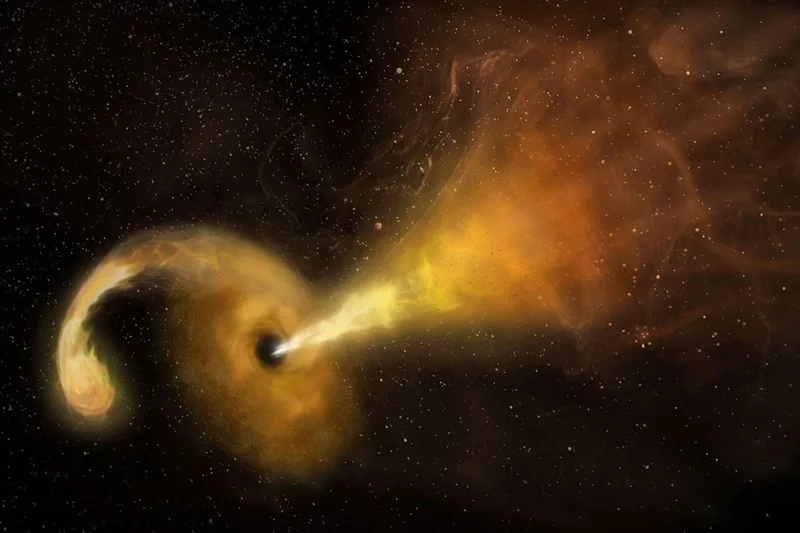
An orphaned black hole that drifted toward the outskirts of its galaxy was caught devouring an unlucky star, revealing itself through a bright flash of light in deep space. The rare cosmic event had never been seen so far outside of a galaxy’s core before.
Scientists have long theorized about wandering black holes that may have gotten displaced when galaxies collide or merge together. These dormant objects are rarely seen, however, since they don’t emit light by swallowing up surrounding material. That was until researchers caught a bright flash of light released by a star as it was being torn apart, indicating the presence of a supermassive black hole dining on its remains.
The discovery, published in The Astrophysical Journal Letters, could pave the way for the detection of more wandering black holes.
Invisible monsters
Supermassive blackholes are normally found tucked away at the center of galaxies, gobbling up material with their strong gravitational pull. Some, however, end up drifting in the outer regions of their host galaxies.
The only way to observe these wandering black holes is through a tidal disruption event, whereby a star passes too close to a blackhole and is ripped apart by its gravitational force. Astronomical surveys typically spot around 30 tidal disruption events each year, and scientists have only seen them taking place in galaxy cores.
In November 2025, the Zwicky Transient Facility (ZTF) detected an unusual brightening in a galaxy located about 750 million light-years away. ZTF scans the entire northern sky every two days using the Palomar Observatory in Southern California. To help hone in on a specific light pattern emitted by a tidal disruption event, the researchers behind the new study developed an intelligent algorithm to come through the hundreds of thousands of celestial events detected by the survey.
âOut of the half million flashes ZTF detects each night, our new artificial intelligence algorithm automatically recognized a flare that looked a lot like a tidal disruption event, despite its unusual location in the outskirts of a galaxy,â Robert Stein, a research fellow at the University of Maryland and NASAâs Goddard Space Flight Center and lead author of the new study, said in a statement.
This particular event outshone its entire host galaxy in ultraviolet wavelengths for months, radiating with the light of about 10 billion suns, according to the study.
The researchers used other telescopes, such as the SOAR (Southern Astrophysical Research) telescope in Chile, to gather follow-up observations of the ultrabright flash. They then used NASAâs Neil Gehrels Swift Observatory to look at wavelengths that are otherwise undetectable with ground-based telescopes to gather more data.
âThe combination of all this data helped us rule out other explanations and confidently say itâs a tidal disruption event, despite its strange location,â Jonathan Carney, a doctoral student at the University of North Carolina at Chapel Hill and co-author of the new study, said in a statement.
Caught in the act
The data helped scientists identify that the culprit behind the bright flash was indeed a blackhole located about 30,000 light-years away from the center of its galaxy. It has around the same mass as the blackhole at the center of our galaxy, the Milky Way’s Sagittarius A*, which is around four million times the mass of the Sun.
âTo have such a big black hole outside of a galaxy is surprising to me,â Sylvain Veilleux, astronomy professor at the University of Maryland and co-author of the study, said in a statement. âThere should be a Milky Way-like object around itâand that’s definitely not the case.â
The blackhole likely originated in the aftermath of a violent collision between two galaxies. âIt must have originated in a galaxyâs center, but not the one itâs in the outskirts of now,â Stein said. âWe think the host galaxyâs supermassive black hole is still at its core, but the one eating the star could have started off in a small galaxy that merged with the big one we see today.â
Another possibility is if three or more galaxies merged together, and the gravitational tug-of-war between each of their supermassive black holes may have flung the lightest black hole far out to the galaxyâs edge.
“Until now, we’ve started with the assumption that supermassive black holes reside in the centers of massive galaxies,â Suvi Gezari, an associate professor of astronomy at the University of Maryland and co-author of the study, said in a statement. âThis discovery will have a huge impact. It means that we’re going to find many more examples of wandering black holes, and we can understand how galaxies and their black holes merge and build up over time.â