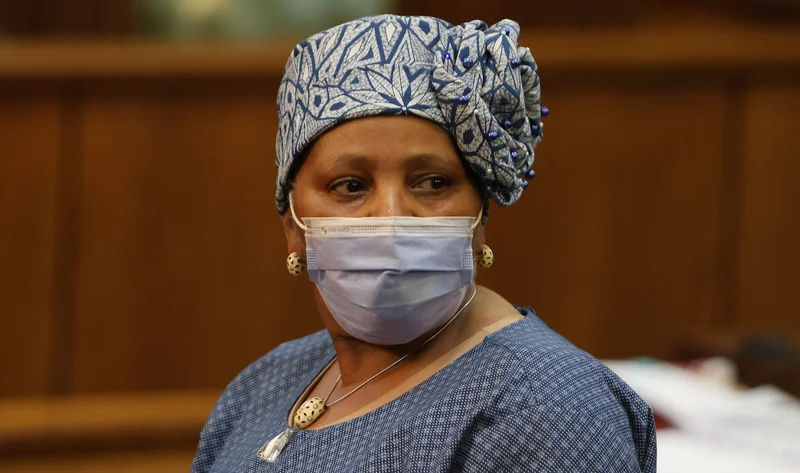
By the end of Tuesdayâs proceedings in the corruption and money laundering trial of former National Assembly speaker Nosiviwe Mapisa-Nqakula, the focus had shifted from alleged cash payments and coded conversations to the motive behind the R4.5-million payments.
The defence spent the day challenging the Stateâs key witness, Nombasa Ntsondwa-Ndhlovu, not only on inconsistencies in her evidence, but also on the Stateâs claim that the payments she allegedly made to Mapisa-Nqakula, who was minister of defence at the time, were corrupt.
The line of questioning in the Gauteng Division of the High Court in Pretoria eventually drew Judge Mashudu Munzhelele into the debate, as she pressed Ntsondwa-Ndhlovu on why she had paid large sums of money if she was not expecting any benefit in return.
âDid you pay because you were expecting to gain favours from the accused?â the judge asked.
Ntsondwa-Ndhlovu said that was not the case.
Munzhelele followed up: âSo, was it charity? What was it exactly if it was not meant for you to gain anything?â
Ntsondwa-Ndhlovu maintained that she made the payments because of Mapisa-Nqakulaâs position, influence, and to maintain a good working relationship with the Department of Defence.
Mapisa-Nqakula has pleaded not guilty to 12 counts of corruption and one count of money laundering. The State alleges she solicited or received about R4.5-million from Ntsondwa-Ndhlovu between December 2016 and July 2019 while serving as minister of defence.
Ntsondwa-Ndhlovu, the sole director of logistics company Umkhombe Marine, is testifying under an indemnity agreement with the National Prosecuting Authorityâs Investigating Directorate Against Corruption (Idac). Her evidence forms a central part of the Stateâs case.
âSelective disclosureâ accusations
Much of Tuesdayâs cross-examination focused on what Ntsondwa-Ndhlovu told UDM leader Bantu Holomisa, the first State witness, when she approached him about her allegations against Mapisa-Nqakula.
Holomisa had testified that Ntsondwa-Ndhlovu told him about several payments allegedly made to Mapisa-Nqakula, including R200,000 in March 2019.
Under cross-examiniation by senior counsel Siyabulela Maphoma, for the defence, Ntsondwa-Ndhlovu admitted that she did not disclose what the State alleges was the biggest demand â a request for R2-million.
Asked why she did not tell Holomisa about the alleged R2-million request, Ntsondwa-Ndhlovu said she had not seen the need to do so.
She conceded that she had selected what information to share with Holomisa. âIs the charge sheet correct by not making that charge?â Maphoma asked.
Ntsondwa-Ndhlovu said she was unable to comment.
The defence also highlighted differences between Holomisaâs statement, Ntsondwa-Ndhlovuâs statement and her evidence in court.
Maphoma pointed out that some transactions appeared in Holomisaâs version, but not in Ntsondwa-Ndhlovuâs evidence, while others emerged only during her testimony.
âOne of you is lying,â Maphoma said.
The first meeting with Mapisa-Nqakula
The defence also returned to the first meeting between Ntsondwa-Ndhlovu and Mapisa-Nqakula, which took place in December 2016 at the InterContinental Hotel at OR Tambo International Airport.
Earlier in her testimony, Ntsondwa-Ndhlovu said she arranged the meeting through a retired general and family friend who knew Mapisa-Nqakula.
She told the court that she had sought the meeting after paying R300,000 to the late secretary for defence, Dr Sam Gulube, to whom she had been sent by Mapisa-Nqakula, who needed to travel to the Eastern Cape.
She testified that barely a week after the payment, Gulube made another request â this time for R400,000.
Ntsondwa-Ndhlovu said she wanted to meet Mapisa-Nqakula to verify whether the requests were genuinely coming from the minister.
According to her evidence, Mapisa-Nqakula confirmed receiving the initial R300,000 during the meeting.
The defence, however, questioned why Mapisa-Nqakula allegedly acknowledged the R300,000, but did not mention the alleged R400,000 request.
âTo be clear, there was no demand made to you by the accused, there was no money paid by you to the accused in December 2016. So the only information we have on the mention of R400,000 is from Gulube,â Maphoma said.
He continued: âThat is the strange part: why is she now silent about the R400,000 when she had freely admitted about the R300,000⦠I put it to you that the accused never asked R300,000 from you.â
The defence argued that this raised questions about whether Mapisa-Nqakula had personally demanded the money, or whether the requests came only from Gulube.
Decoding the language of money
Another key part of the cross-examination focused on the coded language Ntsondwa-Ndhlovu said she and Mapisa-Nqakula used when discussing payments.
Earlier in her testimony, she said they avoided direct references to money and instead used words such as âendumbeniâ, âumuthiâ, âImpephoâ, âwigâ, âpadkosâ and âsnuffâ.
The defence pressed her to explain exactly what those words meant.
Ntsondwa-Ndhlovu testified that âsnuffâ and âImpephoâ referred to smaller amounts, generally between R100,000 and R150,000.
A âwigâ also represented a smaller amount of about R150,000.
She said that when Mapisa-Nqakula indicated that she had no âmedicineâ in her ndumba (hut), it referred to larger amounts, up to R400,000.
The defence also questioned messages where Ntsondwa-Ndhlovu herself appeared to use the coded language.
In one instance, she wanted to seek advice concerning her company being investigated for alleged tender fraud.
In another instance, she sent a message committing to provide Mapisa-Nqakula with a particular type of wig, of a specific colour and by a specific date.
Ntsondwa-Ndhlovu maintained that this was not a request for money from Mapisa-Nqakula, but rather a commitment from her to provide payment, and said the seven-day period mentioned in the message was intended to give her time to raise the money.
Ntsondwa-Ndhlovu had previously testified that she used the codes because she was worried investigators might seize her phone and discover their conversations.
The defence, however, also questioned why she had not deleted the messages if she was concerned about them being found.
Corruption question remains
At the centre of the trial is the Stateâs allegation that Mapisa-Nqakula used her position as defence minister to solicit or receive money from Ntsondwa-Ndhlovu, whose company Umkhombe Marine had secured defence-related contracts.
The State alleges that between December 2016 and July 2019, Mapisa-Nqakula received about R4.5-million from Ntsondwa-Ndhlovu, including payments made in cash and Mapisa-Nqakulaâs home renovations in Bruma, Johannesburg.
The defence, however, has sought to separate the alleged payments from the government contracts, arguing that Ntsondwa-Ndhlovu herself testified that Mapisa-Nqakula did not play a role in securing those contracts.
The cross-examination continues on Wednesday, 29 July 2026, after which it will be followed by the third State witness. DM