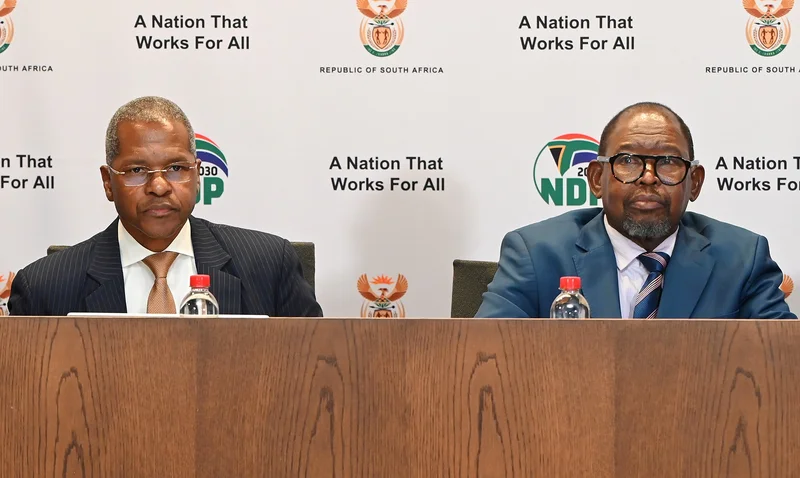
Friday is payday for municipalities that have yet to receive their equitable share, after the Treasury decided to release the funds.
Minister of Finance Enoch Godongwana announced on Tuesday that the reason for releasing the equitable share was concern over the impact on service delivery of a sustained withholding of the money.
The South African Municipal Workers Union (Samwu) welcomed the decision, saying that thousands of its members had not been paid due to a lack of municipal funds because of the withheld equitable share.
Samwu spokesperson Dumisane Magagula said the National Treasury should therefore not âexpect applause for extinguishing a fire that should never have been started in the first placeâ.
âThe release of the equitable share is welcomed because it will bring desperately needed relief to municipalities and workers, but it cannot erase the hardship unnecessarily inflicted on thousands of municipal workers and their families,â Magagula added.
Two metros still non-compliant
Two of the countryâs metros, Nelson Mandela Bay and Mangaung, were singled out as municipalities that had still not complied with Treasuryâs demands. The City of Johannesburg, the Treasury indicated, had already received a part of its equitable share to pay Eskom and Rand Water, but would receive the balance on Friday.
The Finance Minister also highlighted the high levels of non-compliance by Free State municipalities.
âThe equitable share is an important source of funding for basic services, particularly services provided to poor households. National Treasury must therefore balance its constitutional responsibility to enforce financial management requirements with the need to avoid communities carrying the immediate consequences of failures by municipal institutions and officials,â Godongwana said.
âNational Treasury recognises that communities should not carry the immediate consequences of failures by municipal institutions,â Godongwana continued, but municipalities had been given âclear notice that measurable corrective action is requiredâ.
Serious municipal money management worries
Godongwana said the Treasuryâs investigation into municipal finances revealed wider weaknesses in municipal budgeting, cash flow management, financial oversight, accountability and consequence management.
âOf particular concern is the apparent disconnect between some municipal budget assumptions and the actual financial position revealed during the withholding process.
âThe immediate financial pressure experienced following the temporary withholding raises questions about whether municipal budgets adequately reflect actual cash resources, credible collection rates, outstanding creditors, bulk-service obligations, employee costs and existing financial commitments,â Godongwana said.
âThe assessments have also identified material weaknesses in municipal governance and oversight. National Treasury is concerned that, in several cases, municipal councils, municipal public accounts committees, accounting officers, senior managers, disciplinary boards and other municipal officials have not adequately performed the duties assigned to them, Godongwana said.
The failures included delays in processing unauthorised, irregular, fruitless and wasteful expenditure (UIFWE), weak or incomplete investigations, failures to obtain supporting evidence, failures to institute disciplinary proceedings and failures to implement consequence management.
These findings raised serious concerns about whether all municipal decision-makers were acting in the best interests of their municipalities and the communities they served.
âNational Treasury will therefore place greater emphasis on the conduct not only of persons responsible for the original expenditure, but also of officials and structures responsible for investigating, reporting and acting on that expenditure,â the Finance Minister said.
Godongwana indicated that since the process began, 20 municipalities received their full equitable share after complying with the Treasuryâs demands. The other 49 would receive their partial or full allocations on Friday. These included 21 municipalities that had received partial allocations. But 28 municipalities did not comply and therefore have not received any allocations. The total amount to be paid on Friday is R7.1-billion.
Joburg intervention framework
The announcement comes as one of the non-compliant municipalities, Johannesburg, attempts to navigate intense national oversight after its quiet approval last week of 13 financial misconduct cases â involving R4.07-billion â referred to its independent disciplinary board, while continuing to shield the identities of implicated officials and the precise details of the alleged fraud.
Deputy mayor and MMC for finance, Loyiso Masuku, insisted the move sent a clear message that âconsequence management will be pursued wherever the facts and the law require itâ.
However, the confusion surrounding these cases was underscored at last Wednesdayâs 52nd extraordinary council meeting.
While council voted on the R4.07-billion referrals, the specific items and forensic reports dealing with the disciplinary proceedings were considered âin committeeâ behind closed doors. The public and media were excluded, and all documentation was withheld from the open council agenda, leaving the Cityâs press release as the sole accounting of the decision.
Compounding the pressure on Johannesburg is a parallel, time-bound ultimatum established under a provincial Section 154 intervention framework.
The metro has been given a strict 75-day mandate to execute a comprehensive operational cleanup. Under this timeline, City Manager Floyd Brink and the municipal executive have to resolve historical accounting backlogs, regularise or prosecute billions in UIFW expenditure, stabilise revenue collection and demonstrate tangible compliance progress before a formal intergovernmental audit review scheduled for September 2026.
Warnings of repeat action by Treasury
Meanwhile, Godongwana pointed out that Treasury was not finished with errant municipalities.
He said letters to premiers and MECs for Cogta and finance were sent, setting out the strict conditions for consideration in withholding the December 2026 instalment of the equitable shares. The Finance Minister said that a structured compliance programme would accompany the release of the funds on Friday.
âThe first formal reporting deadline remains 30 September 2026, in accordance with my July 2026 letter. Affected municipalities must submit the required quarterly reports and supporting evidence. They must also demonstrate achievement of the applicable UIFWE processing and reduction requirements. National Treasury will then require further measurable improvement during October and November 2026,â Godongwana said.
Minister of Cooperative Governance and Traditional Affairs Velenkosini Hlabisa said the department agreed with the Treasury that municipalities had to comply and that municipal funds had to be spent prudently.
He said the department would also work with the South African Local Government Association and provincial government to ensure municipalities complied.
The next steps included that government departments and provincial governments had to pay municipalities what they owed.
âThe truth is that we shouldnât allow a situation that would collapse councils before November,â Hlabisa said. DM