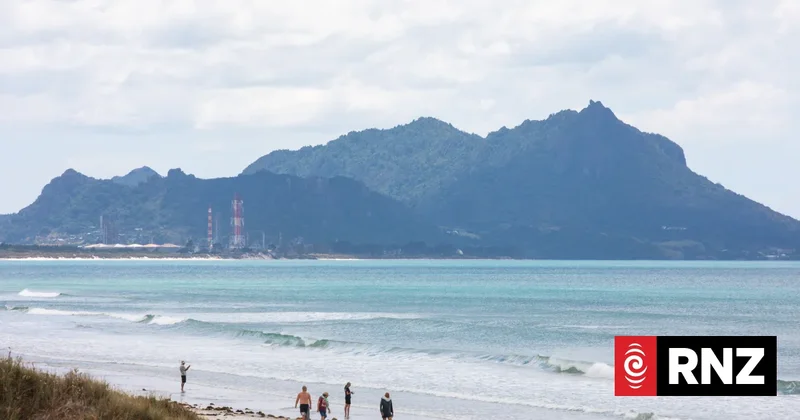
Commercial fishing could be banned along Northland's Bream Bay and in part of Whangārei Harbour if a proposed mātaitai reserve gets a green light.
Fisheries NZ is currently consulting on the proposal and will hold a public meeting at Marsden Yacht and Boat Club in One Tree Point, south of Whangārei, from 6pm on Thursday.
Recreational fishing can't be banned in mātaitai reserves - but they do allow future bylaws to be created, which could, for example, set seasonal restrictions or quotas.
The main proposal is for a mātaitai the length of Bream Bay and extending up to two nautical miles offshore.
The reserve also hugs the southern side of Whangārei Harbour as far as Oakleigh on the Mangapai River.
In total, the reserve, if approved, would cover 115 square kilometres.
A second, much smaller reserve of one square kilometre would cover Marsden Bank and Mair Bank, two well-known sandbanks off Marsden Point where taking shellfish is already under a rolling two-year ban.
Patuharakeke Rohe Moana Committee put forward the main proposal, which covered the hapū's entire rohe moana (traditional marine area).
The aim, as stated in the application, was to "protect and restore customary fisheries for present and future generations".
Spokeswoman Juliane Chetham said the hapū had been considering how it could use customary fisheries management tools, available under the Fisheries Act and kaimoana regulations, since at least 2009.
While this week's public meeting was aimed at recreational fishers, recreational fishing could not be banned in a mātaitai reserve.
"In the future, we could apply to put bylaws in place, but we're not doing that now, and that would have to follow the same consultation process, and a decision by the Minister, as we're going through now."
Chetham, who heads the hapū's resource management unit, said the only immediate change if a mātaitai was brought in would be a ban on commercial fishing.
Only a handful of commercial fishers still worked inside Whangārei Harbour, and it was not clear how much commercial fishing occurred close to shore in Bream Bay.
"But if there are some commercial fishers who are going to be adversely affected, we're keen to talk to them and discuss making exemptions or potentially changing the boundary."
Chetham said the hapū spoke to commercial fishers last year and got some general comments, but not the kind of information that could help guide decision-making.
She described the proposals as "a first pou in the ground" with much consultation and kōrero to come.
Chetham said there had been "a bit of concern" around the country when mātaitai reserves had been proposed.
Part of that was fuelled by misinformation that recreational fishers were going to be shut out.
"We're just trying to set ourselves up with the best tools available to us as kaitiaki to manage our fisheries going forward. And I think a lot of the recreational sector will share the same concerns that we do. Unfortunately, from what I see on social media, it's turned into more of a race-based kōrero, instead of a sustainable fisheries kōrero. It's very, very unfortunate."
The strongest concerns had been around finfish.
"We're not actually interested at this point in time in finfish. Not that we think they're necessarily in a healthy state, but Fisheries NZ is managing sustainability measures in that space. Shellfish are our priority."
The kaimoana beds at Marsden Bank and Mair Bank had already been closed by Fisheries NZ due to plummeting shellfish numbers, but that closure had to be renewed every two years.
"We've been monitoring pipi in particular, and they haven't recovered to a level that we and the scientists we work with consider to be abundant enough to support harvesting being opened up again," she said.
"Nonetheless, we do see little pockets of recovery, and as a longer-term solution, a mātatai and then a bylaw would allow us a more nuanced approach rather than this sort of blunt tool of saying, right, the whole thing's closed for two years. In future we'd like to be able to say, 'well, maybe we can open it for a short season'."
Chetham said a mātaitai, if granted, would have no effect on proposals to expand Northport or mine for sand off Bream Bay, both of which Patuharakeke opposed.
Those projects were covered by RMA or fast-track legislation, and in any case the sandmining would take place further offshore.
Fisheries Minister Shane Jones said the hapū were entitled to apply for a mātaitai under the Treaty of Waitangi Fisheries Act - but the Crown would make the final decision.
"I have never in my entire political career encountered an application of this scale … Mātaitai fishing reserves refer to discrete areas, and obviously we'll take advice whether a discrete area is consistent with Oakleigh to Bream Head," he said.
He encouraged Northlanders to take part in the consultation process.
The final decision would take account of all interests associated with the coastline, and was unlikely to happen before the election.
Fisheries NZ defined a mātaitai reserve as "an identified traditional fishing ground which tangata whenua have a special relationship with".
The application for the smaller mātaitai reserve had been made by Ngā Tangata Kaitiaki o Te Rerenga Parāoa, which brought together Ngāti Tu, Te Parawhau, Ngāti Kahu o Torongare and Patuharakeke.
The biggest existing mātaitai in the country, off Cape Runaway, near East Cape, measures 70 square kilometres and came into force in 2020.
Te Whānau a Kauaetangohia hapū were the applicants, supported by the New Zealand Sport Fishing Council and two local fishing clubs.