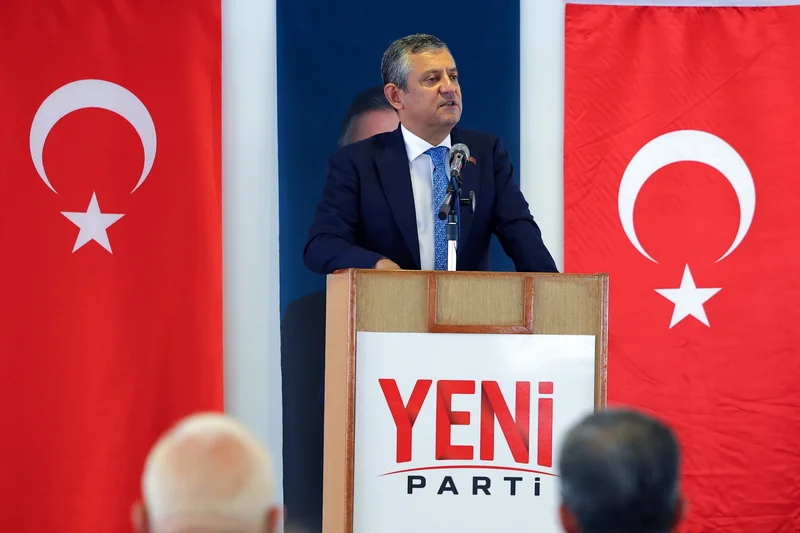
Ninety members of Parliament, together with Özgür Özel, resigned from the Republican People’s Party (CHP), Türkiye’s main opposition party, last week. Thus, they formalized the split within the party’s history and paved the way for the establishment of a new political party. Eventually, Özel declared the establishment of a new political party, the New Party (YP), last Friday.
In order to get votes from the Kemalist and secular circles, Özel imitated the path of Mustafa Kemal Atatürk, the founder of the CHP and the leader of the Independence War. He initiated the formation process at Hacı Bayram Mosque in Ankara by visiting the tomb of the famous Turkish mystic Hacı Bayram-ı Veli. He walked to the Parliament building and gave a speech in front of it, officially inaugurating the new party on Friday. The date was the anniversary of the Treaty of Lausanne, which is the symbol of international diplomatic recognition and defines the borders of the Turkish Republic in 1923.
The establishment of the New Party has dramatically changed the balance of power in the Turkish Parliament. By losing 91 members, the CHP has lost its status as the main opposition party after a very long time. Özel’s New Party has become the second largest political party in Parliament. The number of parliamentary groups has increased to seven. Accordingly, the seating arrangement in the Parliament will be re-organized.
The split will naturally cause internal turmoil within the CHP. The crisis within the party started with the 38th congress and was exacerbated with the return of Kemal Kılıçdaroğlu to the party leadership. Although many of the members of the Parliament are loyal to Kılıçdaroğlu, the leader of the CHP, some groups may criticize Kılıçdaroğlu due to the latest split.
Furthermore, the formation of the YP will force the CHP to reformulate its political perspective. It seems that the YP will face a challenge: whether it will adhere to the same principles as the CHP or not. If it remains the same as the CHP, then the need for a new political party will be questioned. Sooner or later, it must differentiate itself from the CHP.
Considering the heavy dose of symbolism, the YP will have a broader political perspective than the CHP. It seems that the YP will perceive a neo-centrist-leftist political perspective. While the CHP will continue to represent traditional social democrats, the YP will adopt a more rightward political perspective. It is most likely that it will try to attract votes from a wide political spectrum. For this, the YP will try hard to persuade conservative and nationalist voters.
Lastly, the most important issue with which the YP and the CHP are concerned is the choice of a presidential candidate. While the CHP's presidential candidate has not yet been determined, the YP's presidential candidate is former Istanbul Mayor Ekrem Imamoğlu. Therefore, many observers see Özel as a caretaker, not as the real leader. Many people believe that he is taking instructions from İmamoğlu. In other words, many political analysts think that Özel is not an independent political actor.
However, if Imamoğlu's candidacy is not accepted because of the cancellation of his university diploma, Özel may declare himself the next presidential candidate.
In this context, the case of Mansur Yavaş, the mayor of Ankara, is quite interesting. On the one hand, Yavaş did not resign from the CHP. On the other hand, he participated in the meeting organized by Özel and seemed supportive of the YP.
The secular and Kemalist votes will likely be divided into two in the next elections. As the two parties try to get votes from the same voter base, the CHP and the YP will compete with one another in the next elections. This will benefit the AK Party, since neither party may get more votes than the AK Party.