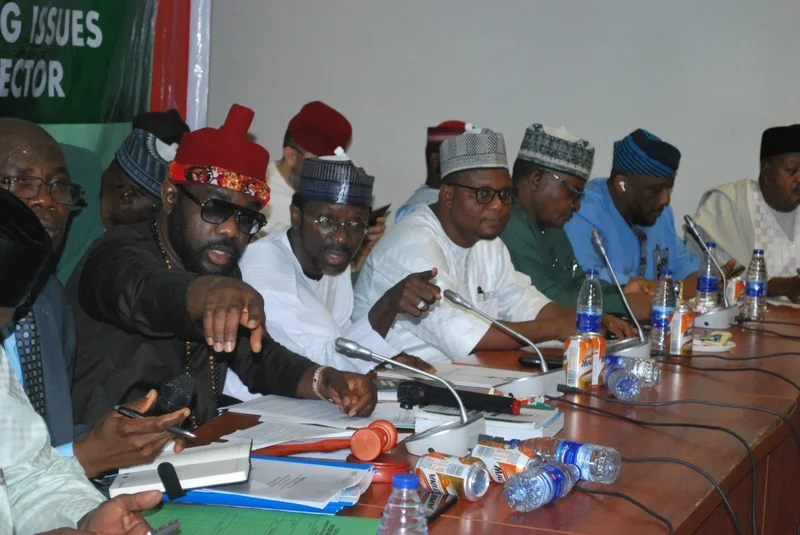
The House of Representatives is seeking to reduce tensions between petroleum importers and domestic refiners as it begins consultations with operators to strengthen Nigeria’s downstream petroleum sector and ensure a steady fuel supply.
The House Committee on Petroleum Resources (Downstream), led by Ikenga Ugochinyere (APP, Imo), held an interactive session with major players in the sector on Tuesday at the National Assembly.
Representatives of the Depot and Petroleum Products Marketers Association of Nigeria (DAPPMAN), Independent Petroleum Marketers Association of Nigeria (IPMAN), and Major Energies Marketers Association of Nigeria (MEMAN) attended the meeting.
The discussions focused largely on how to support the expansion of domestic refining capacity without compromising the availability and affordability of petroleum products nationwide.
| | |
|---|
Mr Ugochinyere said the engagement was part of the committee’s efforts to ensure that legislation and regulatory interventions in the downstream sector reflect the realities faced by businesses and consumers.
He said the House was seeking dialogue rather than confrontation in addressing disagreements within the industry.
“We are here not to interrogate, not to accuse and not to put anyone on trial. We are here to listen. We are here to talk to one another as partners who share one common destiny, a Nigeria where energy is affordable, supply is stable, and no citizen suffers because petroleum products are out of reach,” he said.
The committee chairman assured industry operators that the House would not support policies affecting the downstream sector without consulting the businesses and institutions responsible for maintaining the petroleum distribution chain.
He said the country was at a critical point in its energy transition, with domestic refining capacity expanding alongside changes in petroleum importation and renewed efforts to improve pipeline security and distribution infrastructure.
“The marketers, depot owners, independent operators and major marketers remain the bridge between government policy and the pump. When that bridge is strong, Nigerians enjoy stable prices and a reliable supply. When it is weak, the entire nation feels the consequences,” he said.
Mr Ugochinyere said the committee would consider the recommendations submitted by the various associations before proposing legislative measures to attract investment, expand domestic refining, promote competition, and ensure a reliable supply of affordable petroleum products.
He also reiterated the committee’s commitment to maintaining engagement with industry players as part of its oversight and legislative functions.
DAPPMAN seeks clearer stockholding rules
Presenting DAPPMAN’s position, its Executive Secretary, Olufemi Adewole, called on the Nigerian Midstream and Downstream Petroleum Regulatory Authority (NMDPRA) to establish clear guidelines for operating stock under Section 182 of the Petroleum Industry Act (PIA).
Mr Adewole said the guidelines should provide clear requirements for measuring, reporting, and assessing the quality of petroleum stocks, and for ensuring their quality.
He argued that strategic stockholding should not be assessed solely on the quantity of products held.
According to him, operators’ ability to rapidly finance, transport, and release petroleum products during emergencies or supply disruptions should also be part of the assessment.
DAPPMAN also proposed a joint market-monitoring mechanism involving the NMDPRA and the Federal Competition and Consumer Protection Commission (FCCPC).
The framework, it said, should monitor supply concentration, product availability, allocation practices, treatment of operators and other indicators that could signal emerging stress in the petroleum market.
The association further urged the federal government to increase investment in roads, railways, inland waterways, pipelines and petroleum depots.
It said improved infrastructure would reduce the industry’s dependence on transporting petroleum products over long distances by road from a limited number of coastal supply points.
DAPPMAN also called for a permanent consultation platform involving regulators, marketers, refiners, NNPC Limited, transport agencies and security institutions.
The platform, according to the association, would provide an avenue for stakeholders to regularly assess supply conditions, infrastructure deficiencies and emerging threats to the downstream sector.
IPMAN highlights cost, infrastructure challenges
IPMAN described the downstream petroleum industry as a strategic component of the Nigerian economy, noting that petroleum products remain essential to households, manufacturing, agriculture, transportation, healthcare and national security.
The National President, Abubakar Shettima, said that the implementation of the PIA, the deregulation of petroleum prices, efforts to revive government-owned refineries, and the emergence of large private refineries had created an opportunity for Nigeria to reduce its dependence on imported refined products.
He said the country could become a major hub for refining and petroleum distribution in Africa.
However, Mr Shettima identified several constraints that continue to affect the sector.
These include high financing costs, multiple taxes, foreign exchange volatility, inadequate storage and transportation facilities, pipeline vandalism, and limited access for independent marketers to refinery products.
He also cited delays in the payment of bridging and NTA claims, and inadequate consultation between the government and industry operators, as challenges affecting the sector.
He urged the committee to support measures that would improve petroleum logistics, increase competition, lower distribution costs and encourage further investment.
Mr Shettima also called for policies to ensure the availability and affordability of petroleum products nationwide.
MEMAN cautions against blanket import restrictions
MEMAN’s Executive Secretary, Clement Isong, acknowledged the growth of Nigeria’s domestic refining capacity, saying the country now had the potential to refine enough products to meet local demand while also exporting to international markets.
However, he cautioned the federal government against imposing blanket restrictions on petroleum product imports.
Mr Isong said the government should retain the ability to authorise imports when domestic supply falls short of demand or when unexpected disruptions threaten the market.
He said imports could serve as a temporary mechanism to prevent shortages, protect consumers from sudden price increases, and maintain stability during periods of supply disruption.
MEMAN proposed creating a strategic petroleum reserve capable of meeting at least 60 days of national consumption.
Mr Isong said such a reserve would provide a buffer against international supply disruptions and fluctuations in global petroleum prices.
He cited developments in the Liquefied Petroleum Gas (LPG) market, where increased imports helped address shortages and moderate prices, as an example of how timely intervention could stabilise the market.
While expressing support for the Federal Government’s efforts to expand domestic refining, Mr Isong said decisions on petroleum product imports should remain with the Federal Government and the NMDPRA.
He said this would allow the authorities to respond to supply conditions, maintain competition and protect consumers.
Stakeholders seek policy stability
The discussions exposed differences among downstream operators over the appropriate balance between domestic refining and petroleum imports.
While the stakeholders differed on the extent to which imports should remain part of Nigeria’s petroleum supply strategy, they broadly agreed on the need for predictable policies, better infrastructure, stronger regulatory coordination and regular engagement between government and industry.
The committee’s engagement, therefore, provides a platform for the House to examine how Nigeria can expand domestic refining capacity while retaining sufficient flexibility to prevent supply shortages.
For the downstream sector, stakeholders said the ultimate objective should be a competitive and resilient petroleum market that provides Nigerians with reliable, affordable energy while supporting long-term investment and national energy security.