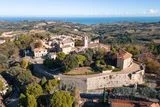
Before the Romans established dominance in ancient Italy, a diverse variety of cultures co-existed across the country. Elements of pre-Roman society, from social status to gender differences, can be seen in the way that these communities buried the dead. Yet, evidence of what they ate thousands of years ago offers an even deeper look.
The Novilara necropolis in central Italy turned out to be the perfect place for researchers to investigate pre-Roman diets — specifically, the foods consumed by the ancient Picene people. In a new study published in the Journal of Archaeological Science, researchers found isotopic signatures in the bones of those buried at the necropolis that show what the dead once ate.
These dietary clues added more dimension to what researchers understood about Picene culture — for example, men may have had greater access to animal protein than women, and many individuals seemed to have highly mobile lifestyles.
"The study demonstrates the potential of bioarchaeological approaches to understand how people experienced identity, mobility, and social differences in the past," said study author Marco Milella, a researcher at the University of Pisa, in a statement.
Read More: Early Humans Didn't Follow A Diet, They Ate For Survival
Society Before the Romans
The Iron Age in Italy saw many pre-Roman groups flourish, including the Latins, Villanovans, Veneti, and Picenes.
In addition to establishing craft industries and trade networks, pre-Roman culture was defined by the rise of more stratified societies with hierarchies of multiple groups, some more powerful than others.
One way to see how ancient societies functioned is to analyze the bones, hair, teeth, and nails of the deceased, which contain stable isotopes that reflect patterns of food and drink consumption.
Carbon stable isotope analysis can help scientists determine which plants ancient people ate based on the plants' molecular composition and photosynthesis — one isotope signature points to crops like wheat and barley, while another points to crops like millet and sorghum. Nitrogen stable isotopes, meanwhile, track the consumption of animal proteins, and stable isotopes of carbon, nitrogen, and sulfur track diets that incorporate marine resources.
"As they form, bones and teeth absorb the isotopic composition of the food and water consumed. As a result, analyzing them can provide information about diet, mobility, and the environment in which people lived," said study author Zita Laffranchi, a researcher at the University of Córdoba.
A Window Into Ancient Italian Diets
Using long bones and rib fragments sourced from 148 individuals buried at the Novilara necropolis, researchers analyzed stable isotopes of carbon, nitrogen, and sulfur.
From this analysis, they found the diet at Novilara to be largely based on cereal grains and, to a lesser extent, on animal proteins. According to the researchers, classical authors mention olives, apples, grapes, and bread made from fine spelt flour, known as Panis Picentinus, as staples of the region, and also reference animal husbandry (pigs and sheep) and sheep wool production as important economic elements.
Although Novilara is just under 4 miles from the Adriatic Sea, isotopic data didn’t show regular consumption of marine fish.
The Standard Fare of the Picene
The isotope analysis revealed that men ate more animal protein than women in Picene culture, reflecting the gender differences that had developed in pre-Roman Italy. Males were also shown to have a more varied diet, meaning they were likely more mobile than women and had more frequent contact with a wider range of environments.
The mobility of many individuals at Novilara was supported by the finding that between 1.4 and 6.4 percent of the people there came from other areas, suggesting that the Picene culture would’ve had extensive contact with other populations, even those that were distant.
Lastly, the researchers found that individuals buried with lavish grave goods, such as amber ornaments or weapons, generally ate the same foods as those buried more modestly. This shows that an individual’s social status, as conveyed by their burial, wouldn’t necessarily have been a true reflection of their position in life; the treatment of the deceased may instead have been based on the decisions and traditions of the community's surveyors, according to the researchers.
"The study shows that social inequality cannot be interpreted solely based on the objects placed in graves," Laffranchi said.
Read More: 300,000-Year-Old Wooden Tools Suggest Ancient Humans Also Ate Veggies, Not Just Meat
Article Sources
Our writers at Discovermagazine.com use peer-reviewed studies and high-quality sources for our articles, and our editors review for scientific accuracy and editorial standards. Review the sources used below for this article:
- This article references information from a study published in theJournal of Archaeological Science:Multi-isotopic insights into diet, mobility, and status in the Picene necropolis of Novilara, Italy (8th-7thcenturies BCE)